Can AI Engines See Your Business?
DIGITAL MARKETING CLINIC
Ask an AI engine to recommend a business in your category in Houston. Go ahead, do it now with your own service and your own neighborhood.
If your business is not in the answer, you were not outranked. You were never considered. That is a different problem than losing a ranking, and it has a different fix.
One answer instead of ten links
A search results page gives a customer ten links and lets them choose. An AI engine gives them one answer and a short list of sources. The funnel got narrower, and the people who used to win position 6 now win nothing.
The good news for small businesses is that this is not an advertising budget contest. Getting cited by an AI engine is mostly about whether a machine can read your site, trust what it says, and lift a clean answer out of it. Those are technical problems, and technical problems are solvable on a small business budget.
That is the whole argument behind our September class, and it is why we made technical SEO the subject rather than another session on posting more often.
Five technical things that decide whether an AI engine can use your site
Your pages have to be readable. Content buried in scripts, images with no alt text, and text locked inside page builder widgets that render late all reduce what a machine can actually extract. If the crawler cannot see it, it does not exist.
Your business facts have to match everywhere. Name, address, phone, hours. If your website says one thing and three directories say another, an engine picking one answer has a reason to skip you. This is the least glamorous work in marketing and one of the highest return. It is the core of local SEO.
Your content has to answer a question directly. Engines lift answers, not paragraphs of buildup. A page with a clear heading that matches the question, followed by a direct answer in the first two sentences, gets quoted. A page that warms up for 400 words does not.
Your structure has to make sense. One H1. Headings in order. Schema that matches what is actually on the page. This is what tells an engine what kind of thing your page is, and it is where most sites are quietly broken.
Your site has to be fast. Core Web Vitals affect crawling as well as ranking and conversion. Slow sites get crawled less thoroughly, which means less of you is available to be cited in the first place.
How to check your own site in twenty minutes
Every one of those five is checkable today, on your own site, without buying anything.
Open your homepage and turn off JavaScript, or view the page source, and see how much of your copy is actually there. Search your business name and compare the phone number across the first five results. Take your three most common customer questions and see whether any page on your site answers one in its first two sentences.
Most owners find at least two problems in twenty minutes. If you want someone else to do the looking, a free website audit covers exactly this ground, and we tell you what we find whether or not you hire us.
We also walk through the practical side of working with these engines in AI that helps, not hurts, which is worth reading before class if you want to arrive with sharper questions.
Come to the free class on Wednesday, September 30
Why Strong Technical SEO Skills Matter for AI Visibility and Winning AI Listings for Your Business
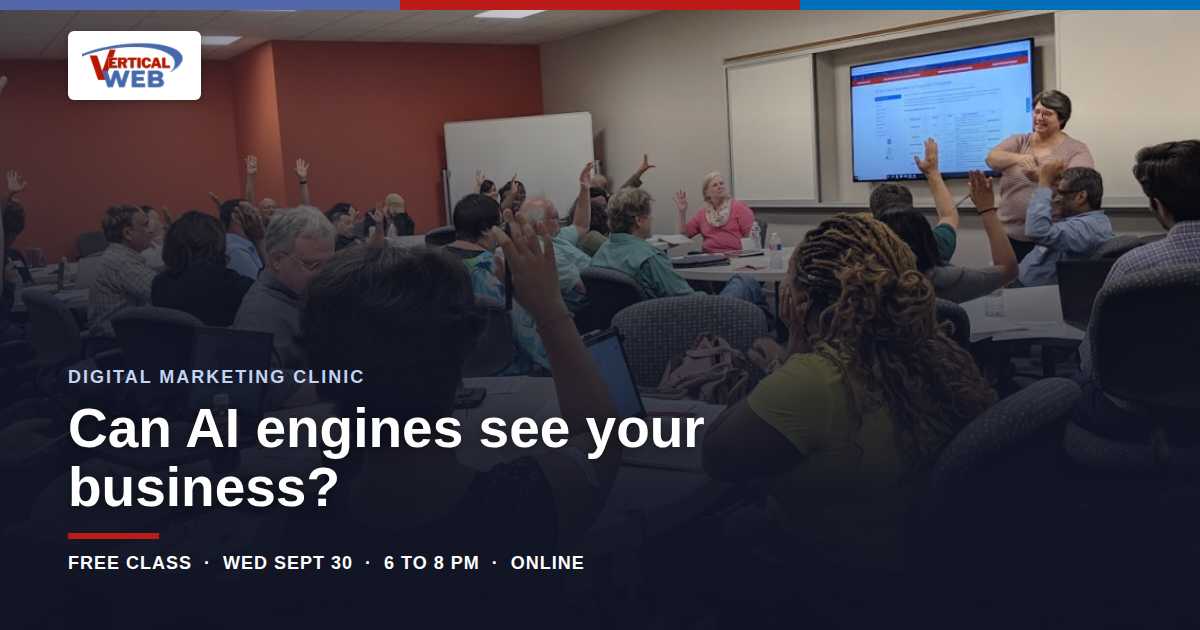
Wednesday, September 30, 2026. 6:00 PM to 8:00 PM. Online. No charge.
Taught by Beth Guide and Sandra Louvier. This is a working session, not a webinar you watch with the tab minimized. Bring your own site and your own questions, because a real block of time is set aside for open discussion.
Save your seat: register for the September 30 Digital Marketing Clinic. The full class schedule lists what is coming after this one.
What we cover in the two hours
- Technical SEO requirements for AI visibility
- Local search engine optimization and the map pack
- Convertible keywords and the sales strategy behind them
- Web design and structure a machine can read
- Social media and video, and where each genuinely helps
- Analytics and conversion management
- Open discussion about your own website
The calm version of this conversation
There is a version of this conversation that turns into panic, and it is not useful. AI engines have not replaced search. Google still sends most of the traffic most Houston businesses get, and it will for a while.
What has changed is that the technical foundation now pays twice. The same clean structure, accurate business data and fast, readable pages that earn rankings also decide whether an engine can cite you. You are not choosing between the two. You are doing one job that serves both, which is how we build every AI SEO program we run.
That is also the honest reason to come to a free class rather than buy something. If your foundation is broken, no service fixes it faster than understanding what is broken.
Frequently Asked Questions
Ask one. Type a real customer question for your category and city into ChatGPT, Gemini or Perplexity and see who gets named. Then check whether your own site answers that same question clearly in its first two sentences somewhere.
Not the way you submit a sitemap. AI engines draw on what they can crawl and on established sources about your business. The practical path is making your site readable, keeping your business information consistent everywhere, and answering real questions directly.
It helps, because it tells an engine what kind of thing your page is rather than making it guess. It is not magic on its own. Schema that does not match the visible content is worse than none, because it creates a reason to distrust the page.
Almost never. Most sites need structural fixes and clearer answers on the pages that already exist. Rewriting everything is usually a way to spend a budget without fixing the technical problems underneath.
Not soon, and probably not entirely. For now most Houston businesses still get the majority of their findable traffic through traditional search. The point is that the same technical work serves both, so you are not betting on which one wins.
Your website, your three most common customer questions, and anything from a current marketing report you do not understand. Open discussion is a real part of the two hours, so specific questions get specific answers.
Related Pages
- AI SEO Services – How we build for AI visibility and traditional search together
- Web Design Houston – Site structure and speed work from our in house team
- SEO Class Schedule – Upcoming Internet Marketing Clinic classes

- Can AI Engines See Your Business? - September 17, 2026
- What Every Houston Business Owner Should Learn About SEO - September 15, 2026
- Where Do Your Backups Live? A Houston Website Preparedness Check - September 14, 2026
Related posts:
- The Right Tools for the Job: How to Get WordPress Set Up for Business Websites
- How To Get Started in SEO: A Small Business Survival Guide
- Local SEO May Help Business During Pandemic
- Why Choosing a Web Design Company that Understands SEO is Important
- What Is Technical SEO and Why You Should Care
- Basic SEO Maintenance: Five Simple Things Site Owners Can Do to Improve SEO
- Technical SEO: The Foundation of SEO Success
- September 2019 Google Core Update Has Rolled Out!
- Ultimate Guide to Recovering from Google Algorithm Updates and Penalties
- Google Hacks for 2025