
WOOCOMMERCE DEVELOPMENT
Custom Ecommerce Web Development
Custom ecommerce development for businesses that have outgrown an out of the box store: quote carts, B2B pricing, integrations, product configurators and performance work, built in-house on WooCommerce.
Galleria 713-703-3030 | Kingwood 281-852-8253
BEYOND THE TEMPLATE
When is a standard online store not enough?
Most online stores start with a theme and a handful of plugins, and that works until the business needs something the store was never built to do. A rental company needs customers to build a quote instead of paying up front. A distributor needs customer specific pricing and net terms. A manufacturer needs products configured from options. A growing store needs inventory, accounting and shipping systems talking to each other.
That is where development comes in. Design decides how the store looks. Development decides what it can do and how reliably it does it.
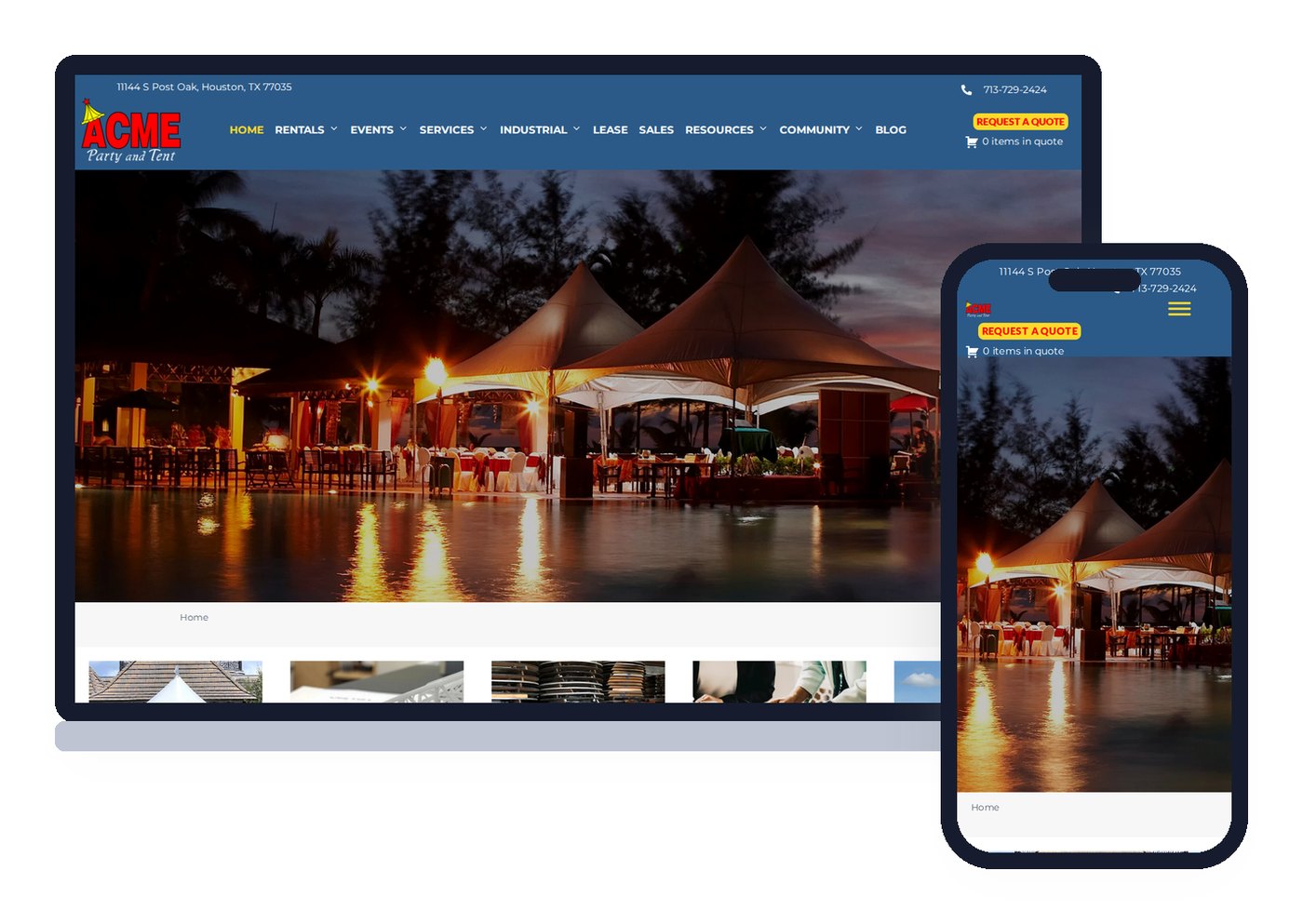
The rental store shown here lets customers add items to a custom quote cart and request a quote instead of checking out. We build that kind of functionality in-house, alongside our ecommerce web design team.
WHAT WE BUILD
Custom ecommerce development services
Quote carts and RFQ
Customers build a list and request pricing instead of checking out, with quotes routed to your team.
B2B and wholesale
Customer specific and tiered pricing, net terms, account approval, tax exemptions and purchase orders.
Product configurators
Options, add-ons and calculated pricing for configurable and made to order products.
Integrations
ERP, inventory, accounting, CRM, shipping and marketing systems connected where they offer an API.
Migrations and data
Products, customers and orders moved from other platforms, with clean data and redirects.
Performance and scaling
Speed work for large catalogs, database tuning, caching and hosting built for WooCommerce.
WHY WOOCOMMERCE
Why build a custom online store on WooCommerce?
Custom features need a platform that lets you build them. WooCommerce is open source and runs inside WordPress, so developers have full access to the code, the data and the standard hooks the platform provides. That means custom work extends the store instead of fighting it.
Hosted platforms can be simpler for a small, standard catalog, but they limit what you can change. You work within their apps, their URL structure and their rules, and you pay for the privilege every month. When a business needs a quote workflow, unusual pricing or a deep integration, those limits become expensive workarounds.
We see the pattern often. A store adds one paid app for wholesale pricing, another for quotes, another for product options and another to sync inventory. Each one solves a piece of the problem, each one charges every month and none of them were designed to work together. When one updates, another breaks, and nobody owns the whole picture. A single, well planned custom plugin on WooCommerce often replaces several of those subscriptions, runs faster and is easier to support, because one team wrote it and one team maintains it.
Ownership matters too. On WooCommerce, the store, the customer data and the custom code belong to you, on hosting you choose. If you are weighing platforms, read our WooCommerce vs Shopify comparison. For the design side of a WooCommerce build, see WooCommerce web design.
INTEGRATIONS
How do you connect an online store to the rest of the business?
Most growing stores reach a point where someone is retyping orders into accounting, updating inventory by hand or exporting spreadsheets every Monday. Integrations remove that work and the errors that come with it.
We approach every integration the same way:
- Review the systems. We look at what your ERP, inventory, accounting or shipping system can export or accept through an API before quoting.
- Define the data flow. Which records move, in which direction, how often and which system is the source of truth for each field.
- Plan for failure. Connections go down. We build logging and alerts so a failed sync is caught in hours, not discovered by an angry customer.
- Test with real data. On a staging copy, with your actual products and edge cases, before anything touches the live store.
Integrations that reach beyond the store, such as routing quotes to a CRM or automating follow up, connect with our business automation work.
THE CASE FOR VERTICAL WEB ON ECOMMERCE DEVELOPMENT
Developers, designers and hosts on one team
We teach this
Beth Guide teaches ecommerce and SEO for the SBA, the University of Houston SBDC, Lone Star College and HCC.
We host what we build
The developer who wrote your custom code can see the server it runs on. Troubleshooting takes hours, not weeks.
In-house since 1998
No offshore contractors handling your customer or payment data. Our developers are our own staff.
HOW WE DEVELOP
Our approach to ecommerce web development
Plan before code
Requirements, edge cases and integrations are documented before development starts.
Extend, do not fight
Custom features use WooCommerce’s standard hooks and data, so updates stay safe.
Test on staging
Every change is built and tested on a staging copy before it touches your live store.
Security first
Secure code, least privilege access and careful handling of customer and payment data.
Documentation
What was built, how it works and how your team uses it, written down.
Measured results
Orders, quotes, conversion and speed tracked before and after each change.
BUILT TO LAST
Can a custom store hold its rankings through Google updates?
Yes, when the fundamentals are right. Beth has a line from years of teaching: if you construct a site the way she teaches, you are close to core update proof, unless you push the envelope. Some of the sites we built have held first page rankings for around 15 years, through platform changes and redesigns.
For a custom store, that means development and SEO are planned together. Category and product URLs are clean and stable. Custom features do not generate thousands of thin or duplicate pages. Faceted filters are handled so search engines see the pages that matter. Product schema is complete. Pages stay fast even with large catalogs.
People sometimes ask whether an Amazon storefront helps their own site rank. Beth’s answer: it adds a little trust, but not enough to matter. Build your own store right and it ranks on its own.
Stores that take cards need hosting to match. Read what PCI compliant web hosting means, and see how we host stores on managed cloud hosting when catalogs and traffic grow. Our SEO services team keeps the store climbing after launch.
WHO WE BUILD FOR
Stores that need custom development
Our custom ecommerce clients tend to share one trait: their business does not fit a standard checkout. Rental companies that quote before they book. Distributors and manufacturers with account pricing, case quantities and purchase orders, covered further on our distributor website design page. Made to order shops with options that change the price. Stores with catalogs in the thousands that need speed and clean data more than a new look.
If that sounds like your business, the first step is a conversation about how you sell today and where the store gets in the way. We will tell you plainly which problems need custom code and which can be solved with a well chosen plugin, because the least custom code that solves the problem is usually the best answer. Less code means fewer things to maintain, faster pages and lower costs for years after launch.
Picking the foundation
Choosing an ecommerce platform for a custom ecommerce website
The ecommerce platform you build on decides how much flexibility and control you have later. Hosted platforms such as Shopify and BigCommerce are simple to start and handle the servers for you. They work well for a standard catalog with standard checkout. The trade-off is that custom features live inside their app store and their rules, and you pay for most of them every month.
A custom ecommerce website on WooCommerce runs inside WordPress, on hosting you choose. Your developers have full access to the code and the data, so a quote cart, a B2B price list or a deep ERP integration can be built as part of the store instead of bolted on. For businesses with unusual requirements, that flexibility usually costs less over time than a stack of paid apps.
The right choice depends on your products, your sales process and your future plans. If you sell a few hundred items at fixed prices, a hosted platform may be enough, and we will tell you that. If your ecommerce store needs to work the way your business works, custom development is the better solution. Our WooCommerce vs Shopify comparison walks through the details.
Design that sells
Custom ecommerce website design: brand, user experience and content that drive sales
A custom ecommerce website should look and feel like your brand, not like every other store on the same theme. That means your colors, your photography, your voice in the product content and a layout built around how your buyers shop. A contractor ordering parts on a phone needs a fast search and a reorder button. A consumer buying a gift needs strong photos and clear shipping details.
User experience is where most stores win or lose a sale. Every extra click between a product page and a completed purchase costs revenue. Clear filters, honest stock levels, visible shipping costs and a short checkout keep visitors moving. We test each step on a phone before launch, then watch user behavior after, so the design keeps improving.
Product content matters for search visibility too. Unique descriptions, specifications and answers to buyer questions help each product page rank. Copying the manufacturer’s text, the way many stores do, gives Google no reason to pick your page. Our WooCommerce web design team handles the design side of the build.
Where to focus first
The 80/20 rule in ecommerce, and how AI fits into ecommerce website development
The 80/20 rule in ecommerce says that a small share of your products, often around 20 percent, tends to bring in most of your sales. The same pattern usually shows up in customers and in traffic. For a custom ecommerce project, that means you should spend the most design and development effort on the products, categories and buyers that drive revenue, and keep the rest simple.
AI is changing ecommerce development in practical ways. It can help write first drafts of product descriptions, suggest related products, power on-site search and sort customer questions. It is a tool, not a replacement for real product knowledge. Generic AI copy on hundreds of product pages makes a store look like every other store. AI belongs where it saves time, with people in charge of the content buyers read.
Search is changing too. AI engines now answer shopping questions directly, and they draw on clean product data, clear specifications and strong reviews. A well structured custom store with proper schema gives them the information they need to recommend your products.
Budget and process
How a custom ecommerce web development project is scoped, priced and built
Every custom ecommerce project starts with a consultation. We learn how you sell, who buys, which systems the store has to talk to and where the current site falls short. The level of complexity, not the number of pages, drives most of the budget: custom pricing rules, configurators, integrations and data migrations each add development and testing.
After the consultation you get a written scope and price. The project then follows a clear process: planning and data mapping, design for your review, development on a private staging copy, testing of every checkout path and integration, then launch with redirects from your old URLs. Scalability is planned in from the start, so the store can grow without a rebuild.
After launch we host, update and support what we build. One in-house team owns the store, the code and the server. If your store has outgrown its template, schedule a consultation or see the full range of our ecommerce web design services.
QUESTIONS
Ecommerce web development questions
It is the engineering behind an online store: custom features, integrations, data, performance and security. Design decides how a store looks and feels. Development decides what it can do, such as quote carts, customer specific pricing, product configurators and syncing with inventory or accounting systems.
When the business needs something a theme and standard plugins cannot do cleanly. Common examples include rental quote carts, B2B pricing and net terms, made to order products with calculated pricing, ERP or inventory sync and catalogs large enough that speed becomes a problem.
WooCommerce is open source, runs on WordPress and gives full access to the code and data, so custom features can be built on its standard hooks without fighting the platform. You own the store, the customer data and the code, and you control hosting and SEO.
Usually, yes, when the system offers an API or a reliable export. We review the system first, define what data moves in which direction and how often, and build the connection with logging so problems are caught early.
Not much. Beth Guide’s view is that an Amazon presence adds some trust, but it is not enough to improve your own site’s rankings. If your store is built and structured correctly, it can rank on its own and hold up through Google updates.
We build on WooCommerce’s standard hooks and data structures, keep custom code in plugins, test every change on a staging copy and document what was built. That keeps updates safe and lets another developer understand the work.
Customer specific pricing, quote carts, account approval, purchase orders, product configurators, ERP and inventory integration, multi-warehouse stock and fast search for large catalogs.
A small share of your products and customers usually brings in most of your sales. Focus design and development effort on those first.
It depends on complexity: pricing rules, integrations, configurators and data migration drive most of the budget. You get a written scope and price after a consultation.
AI helps with product description drafts, on-site search, related products and customer questions. It works best with people reviewing the content buyers read.
Has your store outgrown its template?
Request a free website audit. We will review your store, integrations and speed, then tell you plainly what needs custom development and what does not.
Galleria 713-703-3030 | Kingwood 281-852-8253 | info@verticalweb.com
No related posts.