

Ecommerce Website Design Company
Ecommerce Web Design That Sells and Ranks
Online stores built on WooCommerce that turn browsers into buyers, rank for the products and categories your customers search, and run on hosting built for speed.
Galleria 713-703-3030 | Kingwood 281-852-8253
Built to Sell
An Online Store Has One Job: Make the Sale Easy
Ecommerce web design is different from any other kind of website design. Every page is part of a sales path: a shopper lands from search or an ad, finds the right category, compares products, trusts the store enough to buy, and checks out without friction. Any weak step in that path costs sales you never see.
Most online stores lose buyers in the same places. Category pages that cannot be filtered, product pages without the specs or photos shoppers need, slow load times on phones, surprise shipping costs and checkouts with too many fields. Fixing those is where good ecommerce design pays for itself.
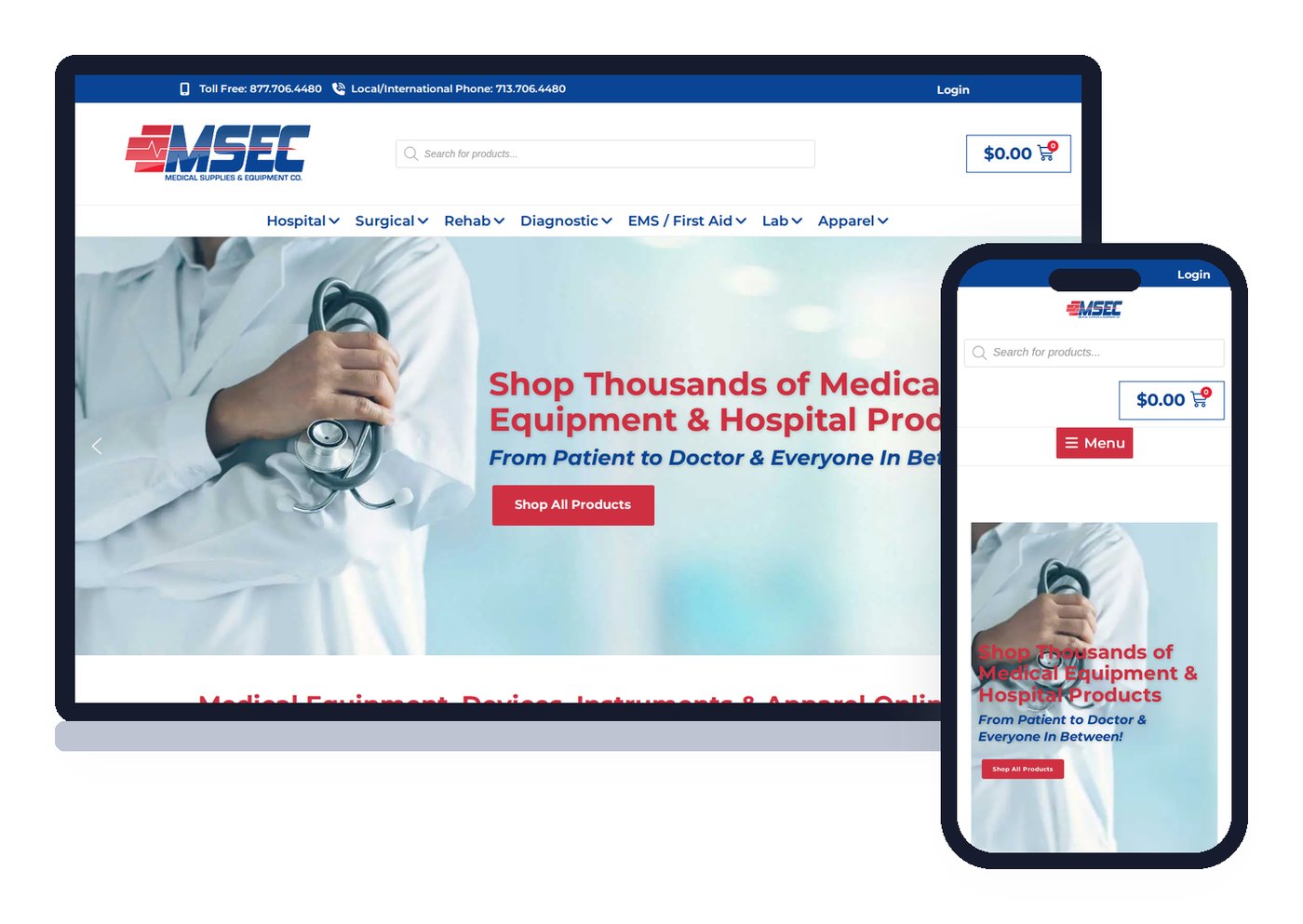
The store above is a real WooCommerce site we built and optimize for the Medical Supplies and Equipment Company, with thousands of products organized into categories shoppers can actually navigate. Every store we build is mobile-first, built on WordPress and WooCommerce so you own it, and planned for search from the first category page.
What Shoppers Need
What Turns a Visitor Into a Customer
These are the elements that decide whether a shopper buys, and we design every store around them.
Clear categories and filters
Categories that match how customers shop, with filters for size, brand, price and specs.
Fast, accurate search
Product search that handles part numbers, misspellings and partial terms.
Product pages that answer questions
Large photos, specs, variations, shipping details and reviews in one place.
Trust at checkout
Secure checkout, clear return policies, familiar payment options and visible contact details.
Shipping clarity
Shipping costs and delivery times shown before checkout, not at the last step.
A checkout built for phones
Short forms, autofill and wallet payments where your payment provider supports them.
Ecommerce Design Best Practices
Design Elements of High-Converting Online Stores
The online stores that convert best share the same design elements. None of them are decoration.
Speed on every page
Compressed images, caching and fast hosting so category and product pages load quickly on phones.
Navigation built from real search data
Menus and categories organized around what customers search for, not internal product codes.
Social proof
Reviews, ratings and trust badges near the add to cart button.
A persistent cart
A visible cart and a mini-cart that confirm every add without leaving the page.
Clear pricing and offers
Sale prices, volume pricing and promotions shown plainly and consistently.
Accessible shopping
Readable text, labeled forms and keyboard-friendly navigation for every shopper.
We also design for the shoppers who are not ready to buy yet. Wish lists, email capture, back in stock alerts and helpful buying guides bring people back, and returning visitors convert at much higher rates than first-time visitors.
Many businesses start on a hosted store builder because it is quick. As the catalog grows, those platforms can limit SEO, customization and data ownership, and fees grow with sales. WooCommerce gives you full ownership of your store, your content and your customer data, with the flexibility to grow.
Layout matters at every step. On strong ecommerce sites, users can see the price, the key specs and the add to cart button without scrolling, and the steps to complete a purchase are numbered and short. Each extra step or surprise between browsing and purchase costs sales, and the stores that make repeat purchases easy, with saved addresses, reorder buttons and order history, keep customers coming back.
Pages That Rank and Convert
Pages We Build for Ecommerce Stores
Your category and product pages are your most important landing pages. We design them to rank and to sell.
Category pages
Category pages with unique descriptions, filters and internal links, which often rank better than individual products.
Product pages
Detailed product pages with specs, variations, photos, reviews and product schema.
Buying guides
Guides that help shoppers choose, earn links and support category rankings.
Brand and collection pages
Pages for the brands and collections your customers search for by name.
Shipping, returns and FAQs
Clear policy pages that answer questions before they become support tickets.
B2B and wholesale pages
Quote requests, volume pricing and account options for business buyers.
If your store already ranks, we protect it. Before any redesign or platform migration we record product and category URLs and rankings, keep what carries value and map redirects for anything that moves. That is the approach behind every web design project we take on. Need custom features, integrations or a quote cart? See our ecommerce web development services.
Who We Build Stores For
Ecommerce Websites for Every Kind of Seller
We design around how your customers shop and how your business sells.
Large catalogs
Stores with thousands of products that need clean categories, filters and search.
Medical and industrial supplies
Specs, compliance details and B2B ordering for professional buyers.
Apparel and custom products
Variations, sizing, customization options and strong photography.
B2B and wholesale
Customer-specific pricing, quote carts, net terms and account portals.
Rentals and services
Quote-based carts and booking for rental and service businesses.
Local retailers
Online stores with local pickup and delivery for brick-and-mortar shops.
Built to Be Found
Ecommerce Web Design and SEO, Built Together
Most online stores rely on search for new customers, and category pages are where most of that traffic lands. A store built without SEO in mind ends up with thin category pages, duplicate product content and URLs that compete with each other.
We plan your category structure around real search demand, write unique category content, add product and review schema, and build internal links that help Google understand your catalog. Your store can then build on that foundation with ongoing SEO services.
Shoppers also ask AI assistants for product recommendations. Clear, structured product and category information gives AI search engines accurate details about your products to share.
Features and Integrations
Built-In Tools for Online Stores
Your store should connect to the tools your business runs on and save your team time.
Payment gateways
Secure payments through the gateway that fits your business, including wallet payments where supported.
Shipping and tax setup
Carrier rates, shipping rules, local pickup and sales tax configuration.
Inventory and ERP integration
Connections to inventory, accounting or ERP systems where they support it.
Email and abandoned cart
Order emails, marketing sign-ups and abandoned cart reminders.
Quotes and B2B pricing
Request a quote carts, customer pricing and account-based ordering.
Analytics and tracking
Ecommerce tracking so you can see which products, categories and channels drive revenue.
Speed and security are part of the design. Our stores run on ecommerce hosting we manage ourselves, so the same team that builds your store keeps it fast, secure and backed up. See more of our work in our portfolio, or start with a free website audit.
Why WooCommerce
Why We Build Online Stores on WooCommerce
You own everything
Your store, your content and your customer data live on your own site, not a rented platform.
Built for SEO
Full control over URLs, titles, category content and schema, which is where many hosted platforms fall short.
Flexible and extensible
From quote carts to subscriptions to B2B pricing, WooCommerce grows with your business.
WooCommerce runs on WordPress, so your store and your content marketing live in one place. Your blog posts, buying guides and category pages can link to each other naturally, which helps both shoppers and search engines. Your team also only has one system to learn.
WooCommerce is not the right answer for every store, and we will tell you if another platform fits your situation better. For most small and mid-size businesses that care about search visibility, ownership and flexibility, it is the strongest foundation available.
Examples and Tips
Ecommerce Website Design Examples and Tips That Drive Results
Design the whole customer journey
Map every step from landing page to thank you page, then remove friction at each one.
Typography and background that sell
Readable type, generous white space and clean backgrounds keep attention on the products.
Accessories and related products
Show accessories, bundles and related products on product and cart pages to raise order value.
Visible customer support
Phone, chat and help links in the header and footer, so shoppers can ask before they buy.
A footer that works
Policies, shipping, contact, categories and trust badges in a footer shoppers actually use.
WooCommerce vs Shopify
Both can work. WooCommerce gives more ownership and SEO control, and we help you choose.
If you are looking for inspiration, study the ecommerce site designs you enjoy buying from. The best examples share the same traits: product photos that fill the screen, clear type, plenty of white space, obvious calls to action and a checkout that feels effortless. The designs that win are rarely the flashiest. They are the ones that make buying easy.
Every ecommerce business is different, so we treat these tips as a starting point. We look at your analytics, your customer questions and your competitors, then design the store around the results you need, whether that is more first-time buyers, higher average orders or more repeat customers.
Planning Your Store
Budget, Timeline and Migration for Ecommerce Websites
An ecommerce website project starts with your catalog, your customers and your goals. The number of products and categories, the integrations you need and whether we migrate an existing store all shape the budget and the timeline. We scope every project first and give you one written price and schedule.
Migrating from another platform is common, and it is where stores most often lose rankings. We map every product and category URL, carry over reviews and product data, set up redirects and test before launch, so your customers and your search traffic follow you to the new store.
How We Work
How We Build Online Stores
1. Discovery
2. Structure
3. Design
4. Build
5. Launch and grow
FAQ
Ecommerce Web Design Questions
Store design, category and product page templates, navigation and filters, checkout design, payment and shipping setup, integrations, SEO setup with product schema, analytics and hosting. We handle design, development, content and hosting in-house.
It depends on the number of products and categories, integrations, custom features and whether we migrate an existing store. We scope the project first and give you one number in writing before work starts.
WooCommerce gives you full ownership of your store and data, strong SEO control and the flexibility to add features like quote carts, B2B pricing and subscriptions. If another platform fits your business better, we will say so.
Yes. We migrate products, categories, customers and orders where the platforms allow it, map every URL and set up redirects so you keep your rankings.
We build the foundation: category structure based on search demand, unique category content, product schema and fast performance. Ongoing SEO builds on that foundation to grow traffic and sales.
Yes. We host stores on our own servers, tuned for speed and security, with updates, backups and monitoring handled by the same team that built the store.
Yes. We build quote carts, customer-specific pricing, account portals and ordering features for business buyers.
Let's Build a Store That Sells More
Tell us about your products and your customers. We will show you what your current store is doing and what it will take to grow sales.
Galleria 713-703-3030 | Kingwood 281-852-8253 | info@verticalweb.com
Keep Exploring
Related Pages
No related posts.