
WEB DESIGN FOR CONTRACTORS AND HOME SERVICES
Contractor Website Design That Books More Jobs
Websites for roofers, HVAC and plumbing companies, electricians, remodelers, landscapers, pool builders and other contractors that turn local searches into calls, estimate requests and booked jobs.
Galleria 713-703-3030 | Kingwood 281-852-8253
CALLS COME FROM PHONES
How do homeowners pick a contractor?
When a pipe bursts, the AC quits in July or a storm tears up a roof, homeowners do not browse. They search on a phone, check two or three contractors in the map pack, glance at reviews and call the one that looks trustworthy and available. Your website has seconds to win that call.
For planned projects like remodels, replacements and pools, the decision takes longer and the website matters even more. Homeowners compare photos of your work, read reviews, check licensing and insurance and look for financing before they request an estimate.
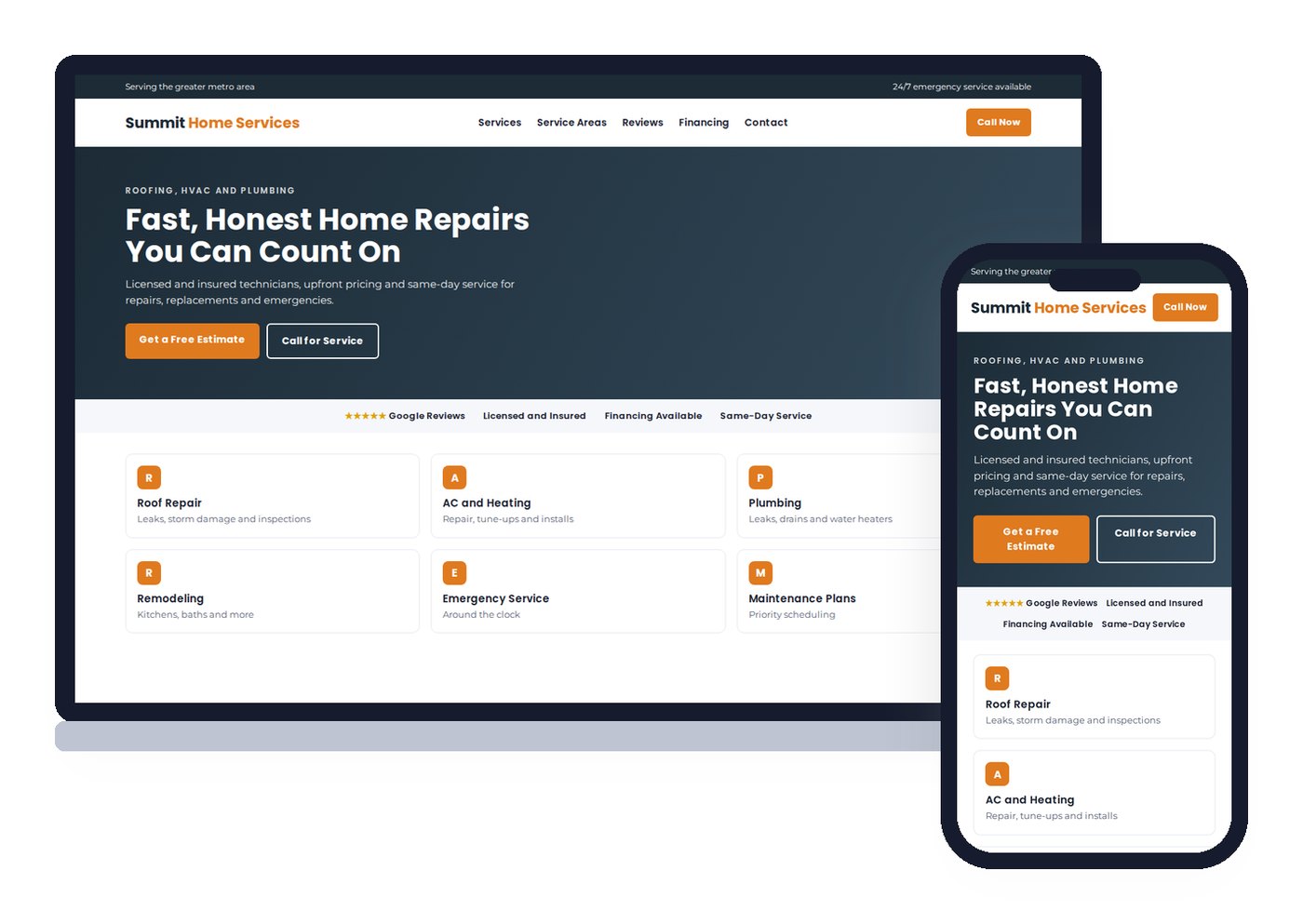
We design contractor sites for both moments: fast, tap to call pages for urgent service and proof heavy pages for bigger projects. Every site is mobile first and built on WordPress, so you can add project photos and specials yourself.
WHAT HOMEOWNERS LOOK FOR
What turns a search into a service call
Tap to call everywhere
Your number in the header of every page, plus a sticky call button on phones.
Licensed and insured
License numbers, insurance, warranties and certifications where homeowners can see them.
The service they need
A page for each service, from AC repair to roof replacement, not one long list.
Real job photos
Before and after photos of your work, your trucks and your crew.
Estimates and financing
A short estimate form with photo upload and clear financing options.
LOCAL SEARCH
How do contractors show up in the map pack?
For most contractors, the map pack is where the phone rings. Google assumes someone searching for a plumber or roofer wants one nearby, so it shows a map with three businesses first. Getting into those spots takes the website and the Google Business Profile working together.
Many contractors work from home or a shop customers never visit. Beth Guide explains to roofers and cleaners in her classes that this is fine. You can set up a service area business on Google with a base address you hide from the public and a list of the areas or ZIP codes you serve. What matters is that the website names those same areas and matches the profile’s business name and phone exactly.
The rest of the checklist:
- The right primary category on your profile, such as roofing contractor or HVAC contractor.
- A website page for each core service, written in the words homeowners use.
- Reviews that mention the job and the area, such as “replaced our roof in Atascocita after the hail storm.”
- Consistent listings on directories and maps apps.
- LocalBusiness schema on the website with services and service areas.
Our local SEO team manages the profile and listings side, and Beth’s guide to Google Business Profile categories for the Houston map pack explains the setting that matters most.
CITY PAGES DONE RIGHT
Should a contractor make a page for every city?
This is one of the most common contractor SEO mistakes Beth sees. A roofer creates pages for The Woodlands, Kingwood, Sugar Land, Houston and The Heights, and every page has the exact same text with only the city name changed. That is duplicate content. At best Google ignores the copies. At worst it trusts the whole site less.
A city or neighborhood page earns its place when it says something only you could say about that area:
- The jobs you do most there, such as slab leak repair in older Meyerland homes or storm damage roofing in Kingwood after hail season.
- Local conditions that affect the work, such as soil, flooding, HOA rules or permit requirements.
- Photos of real projects in that area, with the homeowner’s permission.
- Reviews from customers who live there.
- How fast you can usually get there and where your crews are based.
Fewer strong area pages beat dozens of thin ones every time. If your current site already has a stack of copied city pages, our SEO repair team can consolidate and rewrite them without losing what ranks.
THE CASE FOR VERTICAL WEB ON CONTRACTOR WEBSITES
A web team that answers like a good contractor
We teach this
Beth Guide teaches local search for the SBA, the University of Houston SBDC, Lone Star College and HCC. Contractors in her classes leave with a plan.
One in-house team since 1998
Design, writing, hosting, SEO and ads by our own Houston staff. One call fixes it.
No upsell games
If your Google profile and reviews need work before a new website, we will tell you.
WHO WE DESIGN FOR
Contractor websites we build
Roofing and exteriors
Roof repair and replacement, storm damage, siding, gutters and windows with insurance claim help.
HVAC, plumbing and electrical
Emergency service, maintenance plans, installs and financing with tap to call on every page.
Remodelers and builders
Kitchens, baths, additions and custom homes with project galleries and design consultations.
Landscaping and outdoor
Lawn care, irrigation, turf, outdoor living and pools with seasonal services and before and after photos.
Cleaning and restoration
House cleaning, water and fire restoration, mold and carpet care with 24 hour response details.
Specialty trades
Foundation repair, fencing, garage doors, pest control, solar and more.
Commercial general contractors and builders who sell to owners and architects should see our construction website design page instead.
LEADS AND FOLLOW UP
How do contractors turn website visitors into booked jobs?
A contractor site should make every kind of lead easy. Calls for urgent work. Estimate forms with photo upload for projects. Online booking for maintenance and tune ups. After hours forms so a homeowner at 10 at night does not call someone else in the morning.
Speed of response decides a lot of jobs. Form submissions should text or email the right person immediately, and the homeowner should get a confirmation that tells them when to expect a call. In our experience, the contractor who calls back first usually gets the job, even when they are not the lowest price.
For the slow season, paid search fills gaps while SEO builds. Our PPC management team runs local campaigns that send clicks to focused landing pages for your most profitable services.
Repeat business matters too. Maintenance plan reminders, seasonal tune up offers and review requests after each job keep customers coming back and sending referrals. Our reputation management service helps you earn steady reviews and answer the occasional tough one professionally.
OUR PROCESS
How we build a contractor website
1. Find the money services. We look at which jobs bring the best margin and which ones you want more of, then give those the strongest pages.
2. Map your service area. We list the communities you really serve and decide which deserve their own pages based on real work there.
3. Gather proof. Job photos, reviews, licenses, warranties and the story of your company.
4. Build for phones. Tap to call, sticky buttons, short forms and fast pages tested on real phones.
5. Track calls and forms. You see which services and areas bring in jobs, so you know where to spend next season.
Where jobs leak out
Why most contractor websites lose jobs, and how a better quote form fixes it
Most contractor websites lose jobs in the same few places. The phone number is buried in the footer. The quote form asks for twelve fields on a phone screen. The site is a template that looks like every other contractor in town. And nobody replies to the form for a day. Each one is a reason a homeowner calls a competitor instead.
A good quote form is short: name, phone, the type of job, the location and an optional photo. That is enough to call back. Every submission should reach the right person within a minute, by text message (SMS) and email, and the homeowner should get an automatic reply saying when you will call. Speed of reply wins more contracting jobs than any design choice.
Beyond the quote request, a strong contractor website helps the rest of the operation. A booking page for tune ups, a financing page for big projects and a page that answers common cost questions all save your office time. Some contractors also connect the site to their scheduling, estimate, contract and invoice software, so a new project moves from the first click to the final payment without retyping anything.
Paid vs organic
Should a contractor business focus on Google Ads or SEO for more leads?
Google Ads put your business at the top of the page today, for the exact services and towns you choose. They are the fastest way to fill a slow week. SEO builds rankings and map pack positions you do not pay for per click, but it takes longer. Most contracting businesses do best with both, in balance: ads on the most profitable services while SEO grows, then less ad budget as organic rankings take over.
Lead marketplaces and directories can send work too, but you share those leads with competitors and pay for each one, often for people who also called three other contractors. Your own website and Google Business Profile are the only lead sources you fully own. That is where we recommend putting most of the strategy and the budget.
Whichever you choose, track it. Call tracking and form tracking show which channel and which service brought each job, so you know where your next dollar should go. Our PPC management team and our SEO team work from the same numbers.
Rankings and AI search
Why isn't your contractor website ranking on page 1 of Google, or showing in AI search?
The usual reasons are fixable. The site has one long services page instead of a page for each service. The Google Business Profile category is wrong. The business name, address or phone does not match across listings. The site is slow on a phone. Or the city pages are copies with only the town name changed. Fix those, and most contractor websites start moving.
Search your own business name on Google. Do you see your website, your profile with recent reviews and your social pages? Or a competitor’s ad and an old directory listing? When a homeowner hears your name from a neighbor, that brand search is the moment they decide whether you are real.
AI search is the next place homeowners ask, through tools like ChatGPT and Google’s AI answers: who is a good plumber near me, or how much does a water heater replacement cost? Those tools favor contractors with clear service pages, specific answers, consistent listings and steady reviews. A page that explains what affects the cost of a water heater install, and when to repair instead of replace, is the kind of content they quote. Our AI SEO services page explains how we track it.
QUESTIONS
Contractor website design questions
A tap to call phone number on every page, a page for each service, the cities and neighborhoods you serve, recent reviews, license and insurance details, warranties, photos of real jobs, financing options if you offer them and a short estimate request form.
Mostly through the map pack and local service pages. A complete Google Business Profile in the right category, a website whose details match it exactly, a page for each service, steady reviews that mention the work and real local content for each area you serve all push you up.
Only if each page is genuinely different. Pages that copy the same text and swap the city name are duplicate content and can hurt you. A city page should describe the jobs you do there, local conditions, projects and reviews from that area.
Yes. Service area businesses can set up a Google Business Profile with a hidden address and a list of the areas or ZIP codes they serve. Your website should name those same areas and match the profile’s name and phone number exactly.
Many benefit from it. Scheduling tools for service calls, estimate requests with photo upload and after hours forms capture jobs that would otherwise go to whoever answers the phone first.
Home service contractors sell to homeowners and property managers who often need someone today, so the site centers on calls, reviews and service areas. Commercial construction companies sell to owners and architects on large projects, so their sites read like capabilities statements.
Hidden phone numbers, long quote forms on phones, generic templates and slow replies to form leads. A short quote form with instant text and email alerts wins more jobs.
Usually both: Google Ads for fast leads on the most profitable services while SEO builds rankings that do not cost per click, then shift budget as organic positions grow.
Common causes are one combined services page, the wrong Google Business Profile category, mismatched listings, slow mobile pages and copied city pages. Each is fixable.
Is your website ringing your phone?
Request a free website audit. We will check your map pack signals, service and area pages, mobile speed and lead forms, then tell you plainly what will bring in more jobs.
Galleria 713-703-3030 | Kingwood 281-852-8253 | info@verticalweb.com
No related posts.