
MARKETING FOR CONTRACTORS, BUILDERS AND REMODELERS
Construction Marketing That Puts Your Firm on the Bid List
Owners, architects and general contractors check your website before they invite you to bid. We make sure they find you, trust what they see and pick up the phone.
Galleria 713-703-3030 | Kingwood 281-852-8253
Home › Digital Marketing › Industries › Construction Marketing
A construction company does not win work from traffic. You win it from the owner who shortlists 3 builders, the architect who needs a contractor she can recommend without worry, and the general contractor who needs a sub that shows up. Each of them checks you online before they ever call. Good construction marketing makes sure that check goes your way. Our SEO services for construction companies start with the words those buyers actually type.
Your website is the job site visitors see first. If it was built as a brochure with 5 pages and a stock photo of a hard hat, it will not carry this kind of marketing. We pair the strategy with construction website design built around project pages and service trees, because web design and marketing for a builder are one job, not 2 vendors.
Watch: Part I How to Hire a Webmaster: Title Tag Mistakes
THE OUTCOME
What does good construction company marketing actually produce?
Good construction company marketing produces bid invitations and signed contracts. Not followers. Not a pretty homepage that nobody finds. The scoreboard is simple: how many qualified projects came in, from whom, and how many you won.
Here is why your website carries so much weight. By the time a buyer picks up the phone, they are most of the way through the decision. They have already looked at your projects, read your reviews and compared you to 2 or 3 other firms. The call is often about schedule and price, not about whether you are qualified.
Your website also works when you cannot. Every contractor we talk to is short on people. A site that answers the common questions, shows the work and collects real project details is like another employee in the office. It saves your estimator from 10 calls that were never going to turn into jobs.
THREE BUYERS
Who searches for a construction company, and what does each one need to see?
A construction firm sells to at least 3 different buyers, and they do not search the same way. Most construction websites talk to all of them at once and convince none of them.
- Owners and developers. They search by building type and place: an office build-out, a medical clinic, a warehouse, a custom home in a specific suburb. They want proof you have built their kind of project, on time, in their area.
- Architects and engineers. They want to know you can read a set of drawings and build what was designed. Project pages with scope, square footage, delivery method and the problems you solved speak their language.
- General contractors. If you are a specialty trade bidding commercial work, the GC wants your trade, your capacity, your safety record and your service area. They are building a bid list, and a vague site does not make it.
The fix is not 3 websites. It is one site with clear paths: project pages sorted by building type, service pages for each trade or delivery method, and a page that tells a GC exactly how to add you to their list.
What we do for construction
Marketing services built for construction companies
Project and Case Pages
One page per project with location, scope, size and photos, written so owners, architects and Google can all read it.
Service Trees
Separate commercial, residential and trade trees, so each buyer lands on a page built for their search.
Google Business Profile
The right primary and secondary categories, job site photos and service areas that match where you really build.
Review Requests
A request after every job that asks clients to name the work and the place, with replies to every review.
AI Search Optimization
FAQs and schema that help ChatGPT, Gemini and Perplexity recommend your firm when an owner asks who to call.
Long-Cycle Follow-Up
Email updates with new completed projects that keep you in front of owners and architects until the job bids.
COMMERCIAL VS RESIDENTIAL
Should commercial and residential construction be on separate pages?
Yes. A homeowner looking for a kitchen remodel and a facilities manager looking for a tilt-wall contractor are different people with different search terms. If one page tries to serve both, Google cannot tell which search it answers, and neither buyer feels at home.
We build a separate tree for each line of business. A paving company we work with does asphalt, concrete and site work, so the site has 3 trees, and those 3 services show up in the same order in the title tag, the headings and the navigation. That consistency is how Google understands what the company does.
For remodelers, the same rule applies. Kitchen remodels, bathroom remodels and home building each belong at the top of the menu, not folded under a single “Services” tab. Check which word your buyers use, too. Some search “remodel,” some search “renovation,” and the page should say what the buyer says.
Commercial and residential work also tend to sit on different Google Business Profile categories, which matters for the map pack. We cover that next.
LOCAL SEARCH
How do construction companies show up in the Google map pack?
Start with your Google Business Profile category. It is the pivot point for everything else. Pick the category that matches what your homepage is about, then add the secondary categories that are true, such as general contractor, remodeler or a specific trade. Do not stretch it. A category you do not truly serve hurts more than it helps.
Next, prove where you work. Builders have an advantage most businesses do not: you are on job sites all over the region. Photos taken on site carry location data, and posting them to your profile and your project pages shows Google you really work in Katy, Kingwood, The Woodlands or Conroe, not just at your office address.
Then write pages about real work in real places. Do not copy one page 20 times and swap the city name. Google treats that as duplicate content. Write about the jobs you actually do in each area, like new construction in a growing Katy subdivision or foundation and drainage issues in older Heights homes. Our local SEO team builds those pages from your own project list.
Recent work
Construction websites we have built
Recent construction work includes Sword Construction and American Paving.
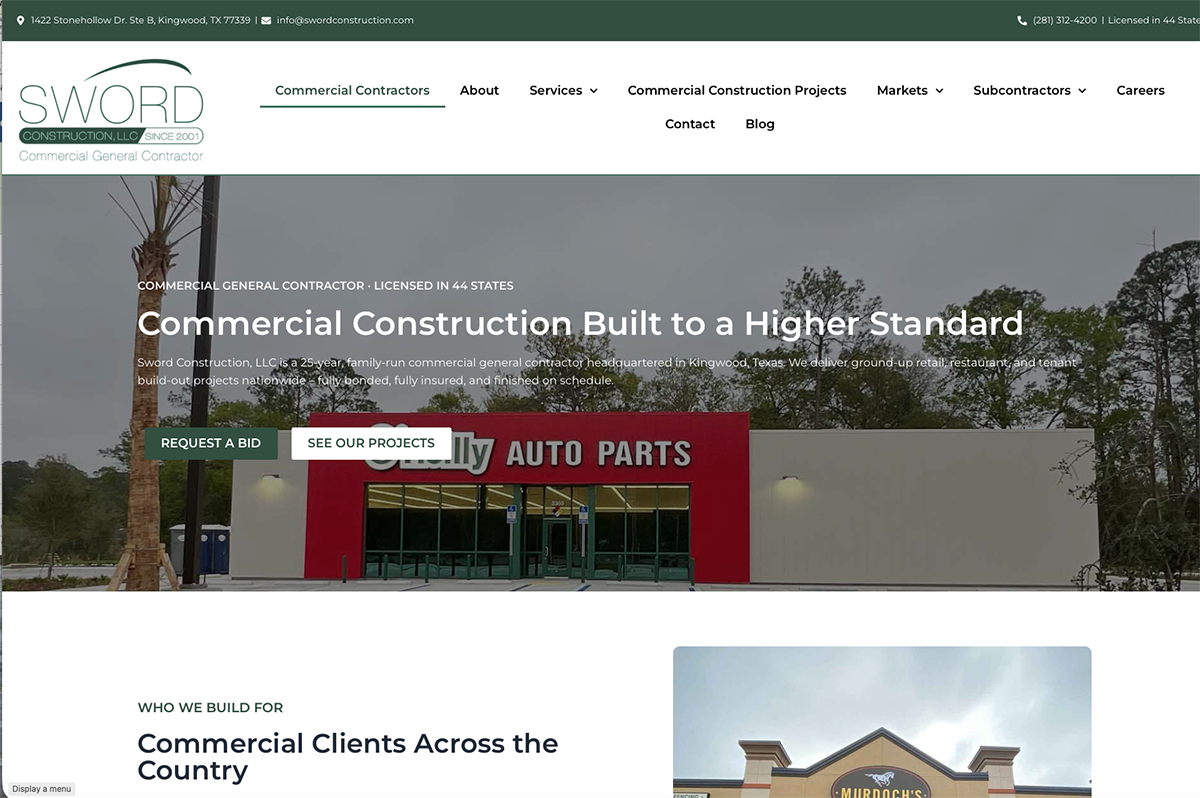
Sword Construction

American Paving
REVIEWS AND PROOF
How do contractors get more Google reviews without breaking the rules?
Ask, every time, and make it easy. The contractors with the most reviews tend to sit at the top of the map pack, and reviews are gaining weight again. Most happy clients will leave one if you send a link right after the walkthrough. Many will not until you call and ask.
Ask them to name the work. “Great to work with” helps a little. “They built our 6,000 square foot office in Spring on schedule” helps a lot, because it puts the service and the place in the review. Google reads those words.
Never buy reviews and never have friends and family flood your profile. It looks fake because it is fake, and it can cost you the profile.
Reply to every review. When one is bad, do not argue. Write your answer for the next owner who reads it, calmly and with facts. Our reputation management service sets up the request process so it runs after every job, not just when someone remembers.
THE MISTAKES
Why is my construction company website not getting leads?
We review contractor websites every week, and the same problems show up again and again.
- The page says your name, not what you do. A headline like “Building Excellence” tells Google nothing. If a stranger cannot tell from the top of the page that you are a concrete contractor or a custom home builder, neither can a search engine.
- The city is missing. We have seen contractor sites where the only clue to location is the phone number. If you do not tell Google where you work, it does not know.
- Vague headlines. “Elevate your home with stylish doors.” Garage doors? Front doors? Where? Specific beats clever every time.
- You rank for your name and nothing else. We once checked the large competitors of a marine construction firm. Every one ranked on its brand. None ranked for marine construction or industrial construction. Ranking on your name only helps people who already know you.
- The gallery has no words. A photo grid with no project name, location, scope or building type is invisible to Google and to AI tools.
Every one of these can be fixed. Our guide to the website problems that quietly cost you business walks through how we find them, and a free website analysis shows which ones are on your site today.
OUR PROCESS
What does Vertical Web do for construction companies, and in what order?
The order matters as much as the work.
- Map the business. We start with a conversation about the work you want more of. Every building type, trade, delivery method and service area goes on a mind map, laid against the firms that already rank. The gaps become pages.
- Build the project pages. One page per significant project, with location, scope, size, schedule, photos and the problem you solved. These pages do the selling for owners and architects.
- Fix the structure and the words. Title tags, headings and navigation that say what you build and where, in the same order on every level.
- Set up the map pack. Categories, service area, job site photos and a review request that goes out after every job.
- Get cited by AI. Owners now ask ChatGPT, Gemini and Perplexity which builders to call, and people tend to trust those answers as if the businesses had been vetted. Plain-language FAQs and schema on your service and project pages help put you in that answer. Our AI search optimization handles that part.
- Follow up through the long cycle. Commercial projects can take months from first look to contract. Email updates with new completed projects keep your name in front of owners and architects until the job is ready to bid.
- Report on projects, not clicks. Every form and call is tagged to the page that produced it.
COST AND THE CASE FOR US
How much does construction marketing cost, and why choose Vertical Web?
We do not publish a price, because the right scope depends on your firm. What drives it: how many lines of business you run, how many areas you serve, how competitive your terms are, how much of your project history needs to become pages, and how fast you want to move. Construction terms are competitive, though usually not as crowded as law or dental, so a well-built site has room to move. We scope it in writing after your free website analysis.
Think about ROI in jobs, not leads. One commercial contract or one custom home can pay for a long stretch of marketing. Paid search can fill gaps while organic rankings build, and we will tell you plainly when a term costs more per lead than the work is worth.
Why Vertical Web. Hire the people other marketers learn from. Beth Guide has taught SEO since 2003 for the SBA, the University of Houston SBDC, Lone Star College and HCC, and she is a Fox 26 technology expert.
One accountable team. Hosting, design, development, content and SEO are all in-house. When a project page needs photos, schema and a better form, one team does it that week, with no vendor pointing at another vendor.
Staying power. We opened in 1998, and the original 1998 client is still with us. We are a Certified Google Partner with a 4.9 Google rating and First Place triple honors in Best of West Houston 2025.
Candor. We manage more than $1M a year in PPC, so we know what a lead costs, and we will talk you out of the wrong purchase. If you also sell or rent machines, see our heavy equipment marketing. Residential trades should look at our home services marketing.
Questions
Construction marketing: common questions
For your significant projects, yes. A project page with location, scope, size and photos answers the exact search an owner or architect runs. A photo gallery with no words does not rank and does not convince anyone.
Usually one website with separate trees for each line of business. Each tree gets its own service pages, project pages and headings. Two separate domains for related work tends to split your authority and create more problems than it solves.
You can rank for work in those areas with pages about real projects there, but the map pack leans hard on your actual address. Job site photos, reviews that name the town and real local project pages help. Fake addresses do not, and they can get your profile suspended.
Make it easy for a GC to qualify you. Show your trade, capacity, service area, safety information and recent commercial projects in one place, with a clear way to send bid invitations. Then make sure that page ranks when a GC searches your trade and city.
It can. A careers page that shows real projects, your crew and your safety culture gives job seekers a reason to pick you. It reuses the same project pages your clients see, so the work does double duty.
It depends on your current site and how competitive your terms are, so we do not promise a date. Structure fixes and project pages often move first. A tight paid campaign can bring in inquiries while organic rankings build.
Keep reading
Marketing for other industries, and the related services
Find out why owners are not finding your firm
Request a free website analysis and we will show you the project searches you are missing and the pages it takes to win them.
Galleria 713-703-3030 | Kingwood 281-852-8253 | info@verticalweb.com
No related posts.