
WEB DESIGN FOR GENERAL CONTRACTORS AND BUILDERS
Construction Website Design That Wins Bids
Websites for commercial general contractors, builders, construction managers and design firms that show your project portfolio, prove your safety and capacity and turn owners, architects and developers into bid invitations.
Galleria 713-703-3030 | Kingwood 281-852-8253
YOUR WEBSITE IS YOUR PREQUALIFICATION
How do owners and developers vet a contractor online?
Before a developer, facilities manager or architect invites a general contractor to bid, someone on their team checks the contractor’s website. They want to see the kinds of projects you build, how big they are, where you work, how you handle safety and whether you look like a company that finishes on time. A thin or dated site can take you off the short list before anyone calls.
Construction websites have a different job than most. The buyers are professionals and the projects are large, so the site has to read like a capabilities statement: clear markets, strong project photography, credentials and a simple way to invite a bid or register as a subcontractor.
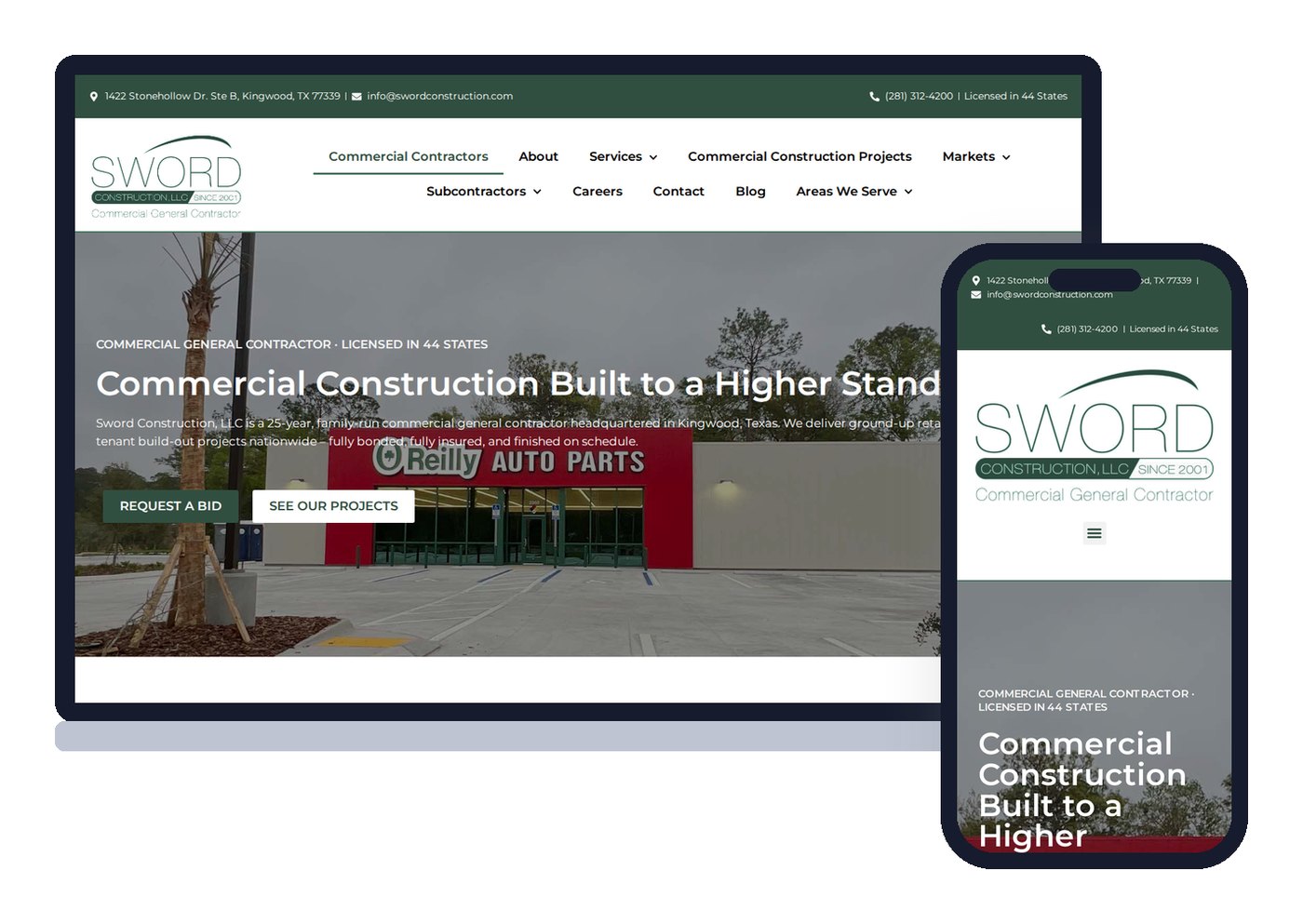
The site shown here is one we built for a commercial general contractor that works in many states. Every construction site we design is mobile first and built on WordPress, so your team can add projects as they finish.
WHAT BUYERS CHECK
What owners, architects and developers look for
Markets you build
Pages for each market, such as industrial, healthcare, retail, education, hospitality or multifamily.
A real project portfolio
Strong photos with scope, square footage, delivery method and location for every featured project.
Safety and quality
Your safety program, training and the metrics your safety director approves.
Where you work
The cities, regions and states where you are licensed and have built, with offices listed clearly.
Credentials
Licenses, bonding capacity, insurance and memberships, ready for an owner’s prequalification packet.
Bid and sub paths
A bid invitation or RFP contact for owners and a registration form for subcontractors and vendors.
MONETIZED KEYWORDS
What should a construction company rank for?
Beth Guide tells a story about a marine and commercial construction company that won a Houston business plan competition. When she checked its much larger competitors, they ranked for their own brand names and almost nothing else. They had beautiful websites, but they were all about themselves. Nobody ranked for “industrial construction” or “marine construction,” the terms that actually bring in owners with projects.
Her rule is to focus on the keywords that make you money. Ranking for your company name is nice, but people who already know your name will find you anyway. The searches that grow a construction business combine the market, the project type, the delivery method and the region:
- Industrial construction or warehouse construction in Houston
- Medical office or healthcare construction in Texas
- Design build or construction management at risk contractors
- Tilt wall, pre-engineered metal building or concrete contractors
- Marine, port or Gulf Coast construction
Each of those deserves its own page with project examples that prove the claim. We map the terms before design begins and build the navigation around them. Our SEO services team keeps that work going after launch.
THE PORTFOLIO
How should a construction website show its projects?
For a contractor, the portfolio is the product. It is also where most construction sites underperform. A grid of photos with project names tells an owner very little and gives search engines nothing to index. Worse, many portfolios stop at the projects someone remembered to upload three years ago, so the company looks smaller and less active than it is. A portfolio that grows with every completed job tells owners you are busy for a reason.
We build each project as its own page with:
- Professional photography of the finished work, plus progress shots when they tell a story.
- The facts buyers want, such as market, square footage, delivery method, location and schedule.
- The challenge and the solution, such as an occupied facility, a compressed schedule or a difficult site.
- Owner and architect credits where you have permission to share them.
- Links to the market page the project supports, so each project strengthens the pages that rank.
Projects are filterable by market and region, so a hospital facilities director can see every healthcare job in two clicks. Drone video and short time lapse clips add a lot; our video marketing team can produce them.
Beth also stresses breadcrumbs on structured sites like this. A clear trail from home to market to project helps visitors and AI engines understand how the site fits together. She explains it in website structure for AI search.
THE CASE FOR VERTICAL WEB ON CONSTRUCTION WEBSITES
A web team that builds to spec
We teach this
Beth Guide teaches SEO and site structure for the SBA, the University of Houston SBDC, Lone Star College and HCC.
One in-house crew since 1998
Design, writing, development and hosting by our own staff. No subcontracting your website.
Straight scope
If your site needs a stronger portfolio and five market pages instead of a full rebuild, we will tell you.
RECRUITING AND SUBS
Websites that help you staff and bid every job
Winning work is only half the challenge. Construction companies also need superintendents, project managers, estimators and field crews, and they need a reliable bench of subcontractors. The website can help with both.
Careers. A careers section with real photos of your teams and job sites, clear descriptions of each role, benefits and a short mobile application competes for talent in a tight labor market. Job schema helps openings appear in Google’s job listings.
Subcontractors and vendors. A registration form that captures trade, service area, certifications, insurance and diversity status sends qualified subs straight to estimating. Bid notices or a plan room link can live on the same page.
Owners and developers. A simple “invite us to bid” or RFP contact, routed to business development, makes it easy for a new owner to start a conversation.
For trade contractors that sell to homeowners and property managers, such as roofers, plumbers and electricians, see our contractor website design page. Suppliers and equipment companies should see heavy equipment website design.
OUR PROCESS
How we build a construction company website
1. Markets and money terms. We sit down with leadership and business development to list the markets, project types and regions that matter most, then match them to real searches.
2. Project inventory. We gather your best projects with photos and facts, and identify gaps where new photography is worth the investment.
3. Content written with your team. Our writers interview your estimators and project executives so market pages sound like builders, not marketers. Your team checks every number, from square footage to bonding capacity, before anything is published.
4. Design and build. Bold project imagery, clear navigation by market and fast load times on a phone at a job site, where many superintendents and owners first pull up your site.
5. Launch without losing ground. If you have an existing site, every URL is mapped and redirected. Our website redesign process protects the pages that already rank.
From inquiry to invitation
How a builder's website supports the bidding process and estimate requests
Most commercial construction work starts with an invitation to bid. The owner, developer or architect builds a short list, sends drawings and specs, and asks each contractor for an estimate. Your website decides whether you make that list. It should make the bidding process simple: a clear bid invitation or RFP contact, the right person’s phone number and email, and a form that accepts the project details and files.
What is the difference between bidding and tendering? In the US, the terms are often used the same way. Tendering is more common in other countries and on public work, where a formal tender package goes out to every qualified contractor. Either way, the buyer is comparing price, schedule, capacity and trust. Your website is where they check the last three before they look at your number.
Many builders already use construction bidding software and estimating software to manage bids. Your website can connect to those tools, or to your CRM, so a request from the site lands in the same place as every other lead. Our business automation team handles those integrations, so nobody has to copy and paste a bid request from an inbox.
Proof before the first meeting
How to build trust before you win the job: project photos, content and trust signals
Trust is the real product on a construction website. A customer about to hand you a multi-million dollar project wants proof that you have done the work before. Real project photos do more than any headline. Show finished buildings, work in progress, your crews and your equipment. Stock photos of hard hats are a common mistake, and buyers can tell.
Add trust signals to every key page: safety programs, licenses, bonding capacity, insurance, memberships and client testimonials when you have permission to use them. Put project details next to every photo: scope, size, delivery method, timeline and location. Buyers who know what to look for will read the details, and that content also helps your pages rank.
The homepage should say in one line what you build and where. Each market and service page should show matching projects. Our web design portfolio shows how we present project work, and our contractor website design page covers the trades and specialty contractors who bid under you.
Leads from search
Construction company web design for leads: service pages, local SEO and service areas
Construction companies need online lead generation because buyers search before they call. A facilities manager looking for a tilt wall contractor, a developer looking for a design build firm, or a homeowner looking for a custom builder all start on Google. A service page for each type of work, with real projects on it, is how you show up for those searches.
Local SEO matters even for builders who work across a region. Create a page for each city or market you truly serve, with projects you have built there. Keep your business name, address and phone number the same on your site, your Google Business Profile and every directory. Do not create pages for places you have never worked. Google and buyers both notice.
Track every lead the site produces: calls, bid invitations, estimate requests and subcontractor registrations. That shows which pages bring in work and which need help. If you want a review of your current site, start with a free website analysis and we will show you what to fix first.
QUESTIONS
Construction website design questions
Clear market and project type pages, a project portfolio with strong photography and real scope details, the regions and states you work in, safety programs and the metrics you choose to share, licenses, bonding and insurance information, leadership bios, a bid invitation or request for proposal path and a subcontractor and vendor registration form.
Mostly by passing the quiet review that happens before an invitation to bid. Owners, developers, facility managers and architects check your site to see whether you build projects like theirs. Ranking for market terms such as industrial construction in Houston or tilt wall contractor also brings in owners who do not know you yet.
The ones that make you money: your markets, project types, delivery methods and regions, such as medical office construction, design build contractor or marine construction on the Gulf Coast. Many large contractors rank only for their own name, which leaves those valuable searches open.
Usually, yes, in the form your safety team approves. Owners and general contractors screen for safety before price. Many companies show their safety program, training and recognitions, and some publish EMR or TRIR figures. Publish only numbers you are prepared to stand behind.
Yes. A subcontractor registration form can capture trades, service areas, certifications, insurance and diversity status and send it straight to estimating, which keeps your bid lists current without phone calls.
Construction company sites sell to professional buyers on large projects, so they read like a capabilities statement. Trade and home service contractors sell to homeowners and property managers who need someone this week, so their sites focus on calls, service areas and reviews. We cover those on our contractor website design page.
In the US, the terms are often used the same way. Tendering is more common on public work and in other countries, where a formal package goes to every qualified contractor. Both compare price, schedule, capacity and trust.
Usually, yes. We can route bid requests and estimate forms into your CRM or the software your team already uses, so every lead lands in one place.
Use real project photos with scope and size, show your safety program, licenses, bonding and insurance, and add testimonials when clients allow it.
Create a page for each market you truly serve with real projects there, and keep your name, address and phone consistent everywhere online.
Is your website getting you invited to bid?
Request a free website audit. We will review your market pages, portfolio, credentials and search visibility, then tell you plainly what is keeping owners from calling.
Galleria 713-703-3030 | Kingwood 281-852-8253 | info@verticalweb.com
No related posts.