
RESTAURANT AND HOSPITALITY WEB DESIGN
Restaurant Website Design That Fills Tables
Websites for restaurants, bars, cafes, caterers and food trucks with menus people can read on a phone, easy reservations and online ordering and local SEO that brings in hungry neighbors and visitors.
Galleria 713-703-3030 | Kingwood 281-852-8253
THE HUNGRY SEARCH
How do guests decide where to eat?
Most restaurant decisions happen fast. Someone searches for dinner near me or brunch in The Heights, taps the first few results, glances at the menu, checks the hours and decides in under a minute. If your site is slow, hides the menu in a PDF or does not show whether you are open, that guest goes somewhere else.
A restaurant website does not need to be complicated. It needs to show your food and atmosphere, make the menu easy to read, keep hours and location current and make it effortless to reserve, order or book an event.
We build restaurant sites on WordPress, so your manager can change a special or holiday hours in minutes without calling anyone.
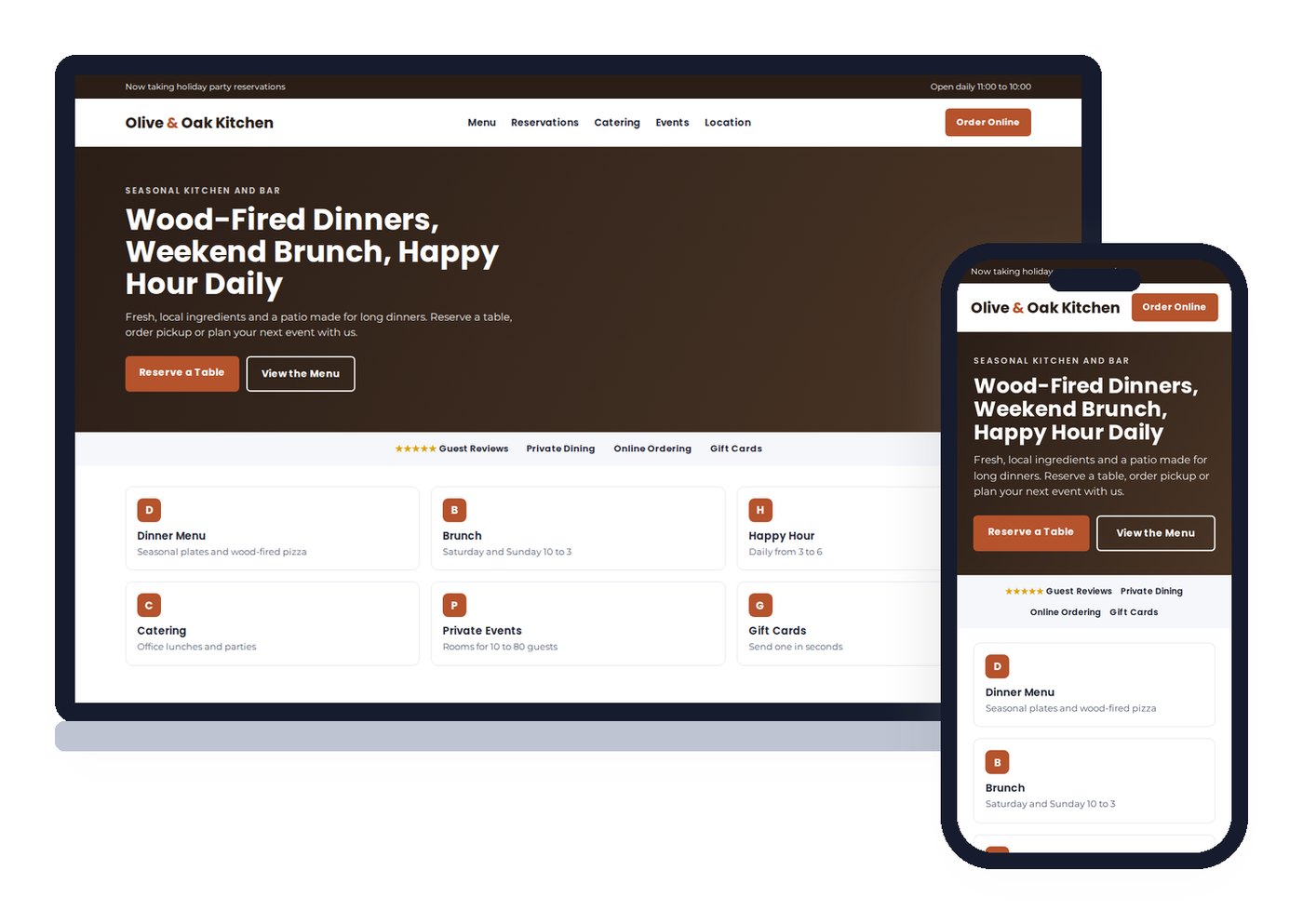
WHAT GUESTS LOOK FOR
What a guest needs to see before they pick your restaurant
A menu that reads on a phone
Built as a web page, not a PDF, with prices, dietary notes and photos of signature dishes.
Hours you can trust
Current hours, holiday hours and kitchen closing times shown at the top.
Location and parking
Address, map, parking tips and patio or accessibility notes.
Reservations
A reservation button on every page, connected to the system you already use.
Online ordering
Pickup and delivery from your own site, so you keep more of each order.
Real food photos
Your dishes, your dining room and your team. Atmosphere sells the visit.
FRESH CONTENT
How do daily specials help a restaurant website?
Beth Guide gives restaurants advice in her email and social media classes that surprises a lot of owners. If you run daily or weekly specials, post them on your website as a short blog post every day, then send them out by email and social. Over time, you train regulars to check your site at the same time each day to see what is cooking.
Timing matters as much as the post. Beth’s example: if you want the lunch rush, put lunch posts out around 10 in the morning, when people start talking about where to eat. Sending a lunch menu at 7 in the morning lands when nobody is thinking about lunch yet.
That steady stream of fresh pages also helps search. Google sees a site that changes and stays relevant, and each special can rank for dish searches such as crawfish etouffee in Kingwood or brisket tacos near the Galleria.
Multi-location restaurants need one more adjustment. Beth uses a pizza example: a pizza place in California, Louisiana and New Jersey would not post the same specials, because what sells in one market can flop in another. Location pages and posts should reflect each market, even inside Houston. Our email marketing and social media teams can run the schedule for you.
ORDERING AND RESERVATIONS
Should a restaurant take orders on its own website?
Delivery apps bring reach, but they also take a large share of each order and keep the customer data. Direct ordering on your own site lets you keep more of every ticket and build your own list of regulars.
Most restaurants do best with both: delivery apps for discovery and a direct ordering button on the website, menus and social profiles for people who already know you. Small incentives, such as a loyalty reward or free item for ordering direct, move regulars over.
We connect the ordering, reservation and waitlist tools you already use, or help you choose new ones that work with your point of sale. The goal is simple: a guest on a phone should reach a confirmed reservation or order in a few taps. We test that path on older phones and slow connections, because a guest standing in a parking lot deciding where to eat will not wait for a heavy page to load. If it takes more than a few seconds, they are already calling the place across the street.
Text messages work well for restaurants whose guests opt in. Order ready alerts, waitlist notifications and weekly specials through text message marketing drive repeat visits.
THE CASE FOR VERTICAL WEB ON RESTAURANT WEBSITES
A web team that answers before the dinner rush
We teach this
Beth Guide teaches local search, email and social media for the SBA, the University of Houston SBDC, Lone Star College and HCC.
One in-house team since 1998
Design, ordering integrations, hosting and SEO by our own Houston staff.
We will tell you what not to buy
If your Google profile and menu page need work more than a new design, that is what we will recommend.
LOCAL SEARCH
How do restaurants show up in the map pack?
For restaurants, the map pack is the front door. When someone searches for Mexican food, happy hour or brunch near me, Google shows a map with three places first. The restaurants that win those spots usually have:
- A complete Google Business Profile with the right primary category, current hours, menu link, attributes such as patio or kid friendly and fresh photos.
- A website menu built as text, so Google can read dishes and prices.
- Restaurant schema on the site with cuisine, hours, price range and location.
- Steady reviews that mention dishes and occasions, and owner replies to them.
- Consistent listings on review sites, maps apps and reservation platforms.
Our local SEO team manages that work, and our reputation management service helps you respond to reviews quickly and graciously, which future guests notice.
MORE THAN DINNER
Pages that bring in catering and private events
Catering and private events are often the most profitable business a restaurant does, and the most overlooked on its website. A single line saying “we cater” captures almost none of it.
- Catering page with menus, package pricing or starting points, minimums, delivery areas and an inquiry form.
- Corporate catering page for office lunches and recurring orders, written for office managers in Downtown, the Energy Corridor or wherever your customers work.
- Private events page with rooms, capacities, photos and menus for rehearsal dinners, showers and holiday parties.
- Gift cards that sell year round and spike in December, sold online so they work as last minute gifts.
Food and beverage producers, distributors and specialty food brands have different needs; see our food and beverage website design page. Venues that mix food with activities should see entertainment website design.
OUR PROCESS
How we build a restaurant website
1. Start with the menu. We build the menu first, as clean web pages organized the way guests order, with dietary tags and the dishes you want to sell most at the top.
2. Shoot the food. A short photo session of your signature dishes, bar and dining room does more for bookings than any design choice.
3. Connect the tools. Reservations, ordering, waitlist and gift cards are connected and tested on real phones.
4. Line up local search. Your Google Business Profile, menu link and listings are updated to match the new site at launch.
5. Train the manager. We show your team how to change hours, post specials and update the menu in minutes.
Booking and the mobile experience
What the best restaurant web pages get right about booking on mobile
Diners decide on their phones, often standing on the sidewalk or sitting in a parked car. The mobile experience is the restaurant website for most guests, so the essentials have to be one tap away: the menu, the hours, the address, the phone number and the booking button.
A custom restaurant website puts table booking in the same spot on every page. Guests pick a date, a time and the size of the party without leaving your site. If you use a reservation platform, we connect it so the booking flows straight into the system your host stand already uses. Fewer steps means more tables filled.
Answer the questions guests ask before they walk in the door. Can they bring children, a dog or a group of twelve? Are you open on a Monday? Is there parking or a patio? Is the kitchen open late? Each answer removes a reason to pick the place down the street. Your contact details, holiday hours and private event options should be easy to find, not buried in a slow PDF.
The story matters too. Real photos of your dining room in its best light, your team and your food tell guests what the atmosphere feels like. Pair them with recent reviews and a short note on the neighborhood, and your restaurant home page does the job a host does at the door. Our local SEO work helps that page show up when people nearby search for a place to eat.
QUESTIONS
Restaurant website design questions
A menu that is easy to read on a phone, current hours including holidays, the address with a map and parking notes, a reservation button, online ordering if you offer it, photos of your food and dining room, catering and private event pages and links to your social accounts.
No. PDF menus are hard to read on phones, slow to load and often ignored by search engines. A menu built as a web page loads fast, can be updated in minutes and lets Google show dishes and prices in search.
Yes. Direct online ordering systems connect to your website and your point of sale, so you keep more of each order and own the customer relationship. Many restaurants keep delivery apps for reach but promote direct ordering on their own site.
With a complete Google Business Profile, accurate hours, a web menu, recent photos, steady reviews and a website whose name, address and phone match the profile. Pages for catering, private events and specific dishes help you show up for more than dinner near me.
Whenever the menu, hours or specials change, and that should take minutes. Restaurants that post daily or weekly specials train regulars to check the site, and the fresh content helps search too.
Yes. Caterers need menus, packages and inquiry forms for events. Bars and breweries need event calendars and happy hour pages. Food trucks need a live schedule of where they will be. We build each around how its customers decide.
Yes. Instagram and your Google Business Profile bring people in, but your website is the one place you control the menu, hours, booking and online ordering without paying a platform fee. It also gives Google more information to rank you in the map pack.
It helps. Google uses your website to confirm what you serve, where you are and when you are open. Combined with a complete Google Business Profile and steady reviews, a strong site improves your chances in the map pack.
Most often because the menu is a slow PDF, the hours are wrong, the phone number is hard to tap or there is no way to book a table. Each of those sends a hungry guest to the next result.
Is your website filling tables?
Request a free website audit. We will check your menu page, map pack signals, ordering path and mobile speed, then tell you plainly what will bring in more guests.
Galleria 713-703-3030 | Kingwood 281-852-8253 | info@verticalweb.com
No related posts.