
WEB DESIGN FOR INSURANCE AGENCIES AND BROKERS
Insurance Agency Website Design
Websites for independent agencies, captive agents, brokers and specialty insurers that explain coverage in plain English, build trust and turn shoppers into quote requests and long term policyholders.
Galleria 713-703-3030 | Kingwood 281-852-8253
TRUST IS THE PRODUCT
Do insurance shoppers compare agencies online?
They do, and more carefully than most agents think. A shopper wants to know what coverage you write, which carriers you represent, whether you understand their situation and how easy you are to reach when a claim happens.
Beth Guide hears a common line from agents in her classes: “People do not really go to insurance agency websites, they just need my phone number.” Her answer is that everybody Googles. Even a referral looks you up before calling, and the agency with clear answers wins the call.
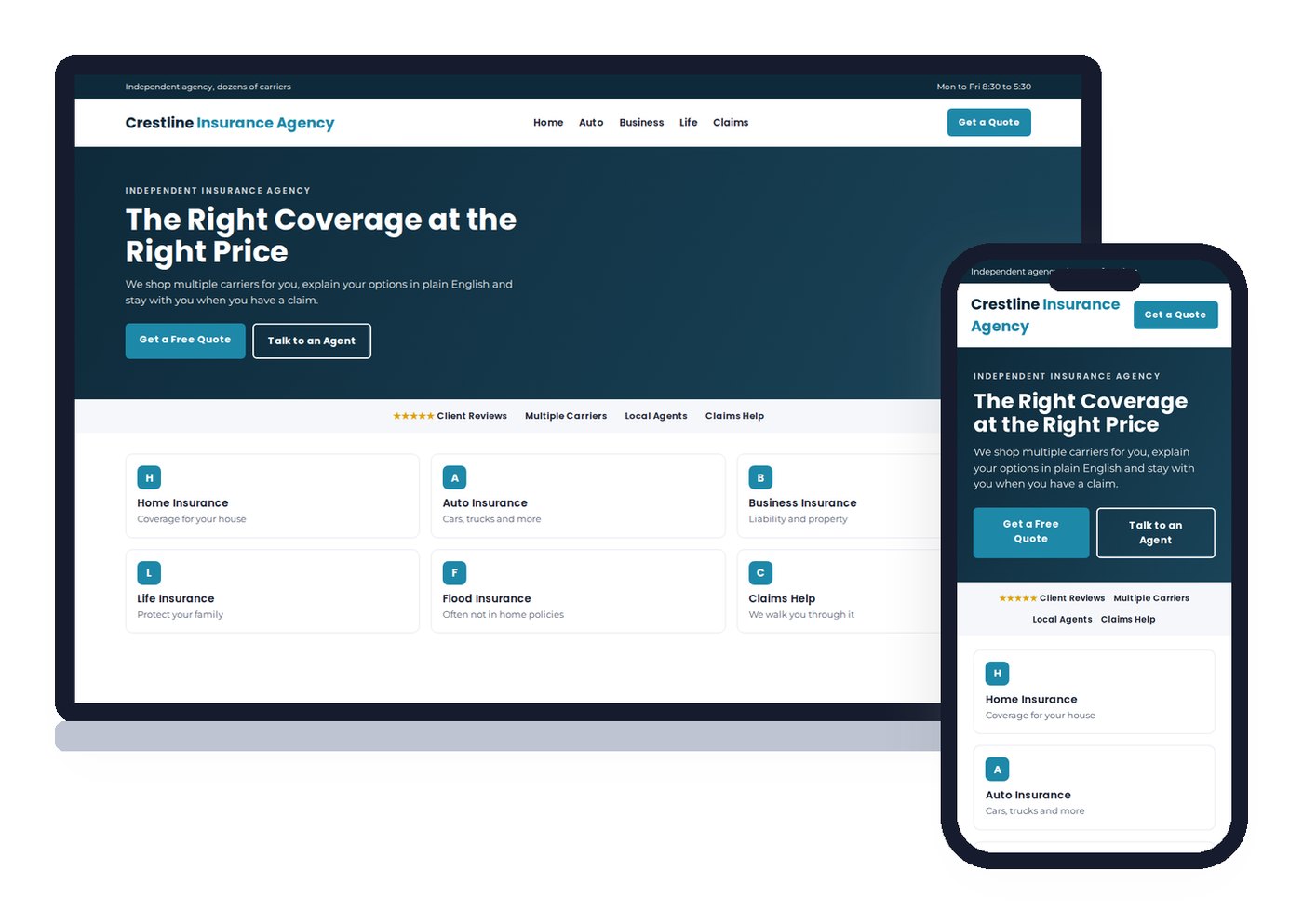
Insurance is confusing and a little stressful for most people. The best insurance sites lower that stress with plain language, clear next steps and proof that the agency shows up. We build them on WordPress, mobile first, with our SEO services team planning every page.
WHAT SHOPPERS LOOK FOR
What turns an insurance shopper into a quote request
Easy quote requests
Short quote forms for each line, on the page that explains that coverage. Ask only what you need to start.
Plain language coverage pages
What each policy protects, who needs it and common gaps, written so a first time buyer understands.
Carriers and choice
The carriers you represent and why an independent agent can shop the market for the client.
Agents and team
Photos, licenses and short bios, so clients know who they will talk to before they call.
Claims help
How to report a claim for each carrier, after hours numbers and how your agency helps.
Service requests
Certificates of insurance, ID cards, policy changes and payments, so clients stop calling for routine tasks.
LOCAL AND NATIONAL LINES
How should an insurance website target local and out of state leads?
This is one of the most useful distinctions Beth teaches agents. Auto and homeowners insurance are bought locally. People want an agent near home, so those pages should lean on your city, your office and local factors, such as flood zones, windstorm coverage and hail claims around Houston.
Other lines work differently. Life, long-term care, Medicare supplements, disability and some commercial coverages can be sold across every state where you are licensed. Those pages need expert content that is not tied to one town. In some cases, Beth recommends a separate site for a national line, so a long-term care specialist page is not tangled up with “local insurance agent in Sugar Land.”
A strong agency site usually includes:
- Personal lines pages for auto, home, renters, flood, umbrella, boat and motorcycle.
- Commercial lines pages for general liability, workers’ compensation, commercial auto, BOPs and industry programs such as contractors or restaurants.
- Life and health pages written for the states you serve.
- Location pages for each office, matched to its Google Business Profile.
- Guides that answer real shopper questions, such as whether flood insurance is required in your area.
Local visibility depends on more than the website. Our local SEO work keeps each office competitive in the map pack.
TEMPLATE SITES
Should you use your carrier's or franchise's website template?
Many carriers and franchise programs offer agents a ready made site. It launches fast, and for a new agent that has value. Look closely before you depend on it.
- Shared content. The same coverage descriptions appear on hundreds of agent sites, so Google has no reason to rank yours.
- Limited control. You often cannot add pages, change the menu or write about the niches where you are strongest.
- Ownership. If you leave the program, the site and its rankings may stay behind.
Our recommendation is to keep the carrier tools you need, such as payment and claims links, and build your agency’s own site as the home base. The same reasoning applies to multi-location agencies; see franchise website design for how we handle brand rules across offices.
THE CASE FOR VERTICAL WEB ON INSURANCE WEBSITES
An agency website partner that explains its work
We teach this
Beth Guide teaches digital marketing for the SBA, the University of Houston SBDC, Lone Star College and HCC. Agents in her classes ask these exact questions.
One in-house team since 1998
Design, writing, hosting and SEO under one roof, with no offshore developers handling client data.
We will tell you what not to buy
If your agency needs better coverage pages and not a new design, you will hear that from us first.
BEST PRACTICES
Design elements of a trustworthy insurance website
A clear promise
Who you insure and where, in one line at the top of the home page.
Phone and quote on every page
A number that taps to call and a Get a Quote button that never scrolls out of reach.
Licensing details
Agency and agent license information where your state requires it.
Speed and security matter for agencies too. Quote forms collect personal information, so the site needs SSL, careful form handling and regular updates. We host agency sites on our own WordPress hosting.
Reviews carry extra weight in insurance, because the real test of an agency is the claim. A plan to earn and answer reviews, backed by our reputation management service, helps shoppers trust you before they meet you. A short monthly email newsletter keeps clients in touch between renewals and invites cross-sell conversations.
COMPLIANCE AND CONTENT
What can an insurance agency website say?
Insurance advertising is regulated by each state’s department of insurance, and carriers add brand rules of their own. That means care with claims about savings, careful use of carrier logos and licensing details where required.
We write coverage pages conservatively. They explain what a policy typically covers and the questions to ask, then send the reader to an agent for advice on their specific situation. Your compliance contact approves final copy before launch.
Wealth managers and financial advisors face a different set of rules. If your agency also offers investment products, see our financial services website design page. For firms that sell other expert services, the professional services website design page covers bios, insights and consultations.
RETENTION
Can an insurance website help keep clients at renewal?
Most agency websites are built only to win new business. The agencies that grow fastest also use the site to keep the clients they already have, because a renewal costs far less to earn than a new policy.
A retention minded agency site does a few quiet things well. It gives existing clients a fast path to the tasks they call about most: printing an ID card, requesting a certificate of insurance, adding a driver or a vehicle, making a payment and reporting a claim. Each of those becomes a short form or a direct link, available at midnight, so the client never feels stuck.
It also explains life events. Pages on what to do when you buy a home, add a teen driver, start a business or retire answer the question at the moment it comes up and invite a coverage review. Those pages rank for real searches and remind clients that their agent is a resource, not just a bill.
Finally, it measures. We set up tracking on quote forms, service requests and calls, so you can see which pages bring in new households and which ones keep the ones you have.
Pages built for one action
Insurance website design best practices: landing pages that turn visitors into customers
The best insurance website design is not the flashiest one. It is the site where a visitor finds the coverage they need, trusts the agency and asks for a quote without hunting. Most of that work happens on landing pages: one page per line of coverage, built around one action.
A strong insurance landing page opens with who the coverage is for and where you write it. It explains what the policy covers in plain language, lists the common gaps, shows the carriers you can quote, and ends with a short form. The same page works for an individual shopping auto coverage on a phone, a business owner reading about workers’ compensation on a tablet, and a prospect who came from an ad. Every landing page should load fast on any device and keep the call button in reach.
Separate landing pages also make your advertising work harder. When an ad for flood coverage sends a consumer to a flood page instead of the home page, conversion goes up and the cost per lead comes down. Our landing page design service builds those pages, and our guide on conversion rate optimization explains how we test them.
Custom or template
Custom insurance web design vs template platforms: what is included
Insurance agents have more options than ever. Carrier programs, agency management vendors and website platforms built for the insurance industry all offer ready-made sites. They launch quickly and cost little up front, and some small business agencies start there. The trade-off is that hundreds of agencies share the same pages, and you have little access to change them.
A custom website design for an agency includes the plan, the pages and the technology behind them. That means a page structure built around the lines you actually write, coverage copy written for your market, quote forms routed to the right producer, local SEO for each office, schema, fast WordPress hosting and support from the team that built it. Our designs are not templates, and you own the site and the domain if you ever leave.
Every project follows the same process: discovery, page plan, design, build on a staging copy, your review, launch and tracking. Pricing depends on how many lines, offices and integrations the site needs, and we quote in writing after a free review. The recurring cost covers hosting, updates, backups and security, plus any SEO or content work you choose. You can see the range of our work in the web design portfolio.
Raising the bar
What insurance agencies can learn from insurance company and fintech websites
Large insurance companies and fintech startups have trained consumers to expect a lot from a website. They expect to get a quote, pay a bill, download an ID card and report a claim from a phone, at any hour. An agency site that only lists a phone number feels behind, even when the agency gives better service.
You do not need a fintech budget to meet that bar. Clear coverage pages, a fast quote path, self-service links for policyholders and simple tools such as a coverage checklist go a long way. The innovation that matters most is removing steps, not adding features.
What an independent agency has that a national insurance company does not is personal expertise. Show it. Agent bios, local guides on flood and windstorm coverage, and answers to the questions your team hears every week build credibility that a call center cannot match. Use the data from your quote forms and service requests to see which pages help customers most, then build more of those.
QUESTIONS
Insurance website design questions
A page for each line of coverage, short quote forms on those pages, the carriers you represent, agent bios with photos, how to report a claim, service requests for existing clients and your office locations and hours. Shoppers compare agencies, so the site has to answer their questions before they call.
Yes. Some agents tell us shoppers just want a phone number, but nearly everyone checks Google before they call, and many compare three or four agencies first. A thin site loses that comparison to an agency that explains coverage clearly.
It can help you start, but those templates share content with every other agent in the program, so they rarely rank. You may not control the domain or the pages, and the site may leave with the contract. Your own site, linked to the carrier tools you need, is an asset you keep.
Separate local and national lines. Auto and home insurance are bought locally, so those pages lean on your city and office. Life, long-term care, Medicare and other lines sold across states need expert content that is not tied to one town, sometimes on a separate site.
Often, yes. We can link or embed comparative raters and carrier quote tools, and route form submissions into many agency management systems or your email, so a quote request reaches the right producer quickly.
Yes. Insurance advertising is regulated by each state, and carriers have their own brand rules. Your site should show licensing information where required and avoid promising savings or coverage it cannot guarantee. We write conservatively, and your compliance contact should approve final copy.
Clear coverage pages for each line, a short quote form on every page, fast loading on phones, visible licensing and carrier information, self-service links for policyholders, and local SEO for each office. Looks matter, but trust and an easy next step win the quote.
No. We build each agency site on WordPress around the lines you write, the markets you serve and your brand. You own the site and the domain.
Hosting, WordPress and plugin updates, backups, security and support. SEO, content and advertising are separate services you can add when they make sense for the agency.
Is your agency website winning the comparison?
Request a free website audit. We will check your coverage pages, quote paths, local search signals and speed, then tell you plainly what to fix first.
Galleria 713-703-3030 | Kingwood 281-852-8253 | info@verticalweb.com
No related posts.