
WEB DESIGN FOR COMMUNITY ASSOCIATIONS
HOA Website Design Residents Actually Use
Websites for homeowners associations, condo associations, property owners associations and community management companies: dues, documents, calendars, amenity reservations and board communication in one place.
Galleria 713-703-3030 | Kingwood 281-852-8253
BUILT FOR COMMUNITIES
What does a good HOA website do?
Most HOA boards and managers field the same questions every week. When is the pool open? Where are the deed restrictions? How do I pay my dues? Who approves a fence? When is the next board meeting? A well built HOA website answers all of them before anyone calls or emails a volunteer board member.
It also builds trust. Residents who can read minutes, see the budget and follow a project from approval to completion feel informed instead of left out. Buyers and real estate agents use the site to check fees, rules and amenities before closing.
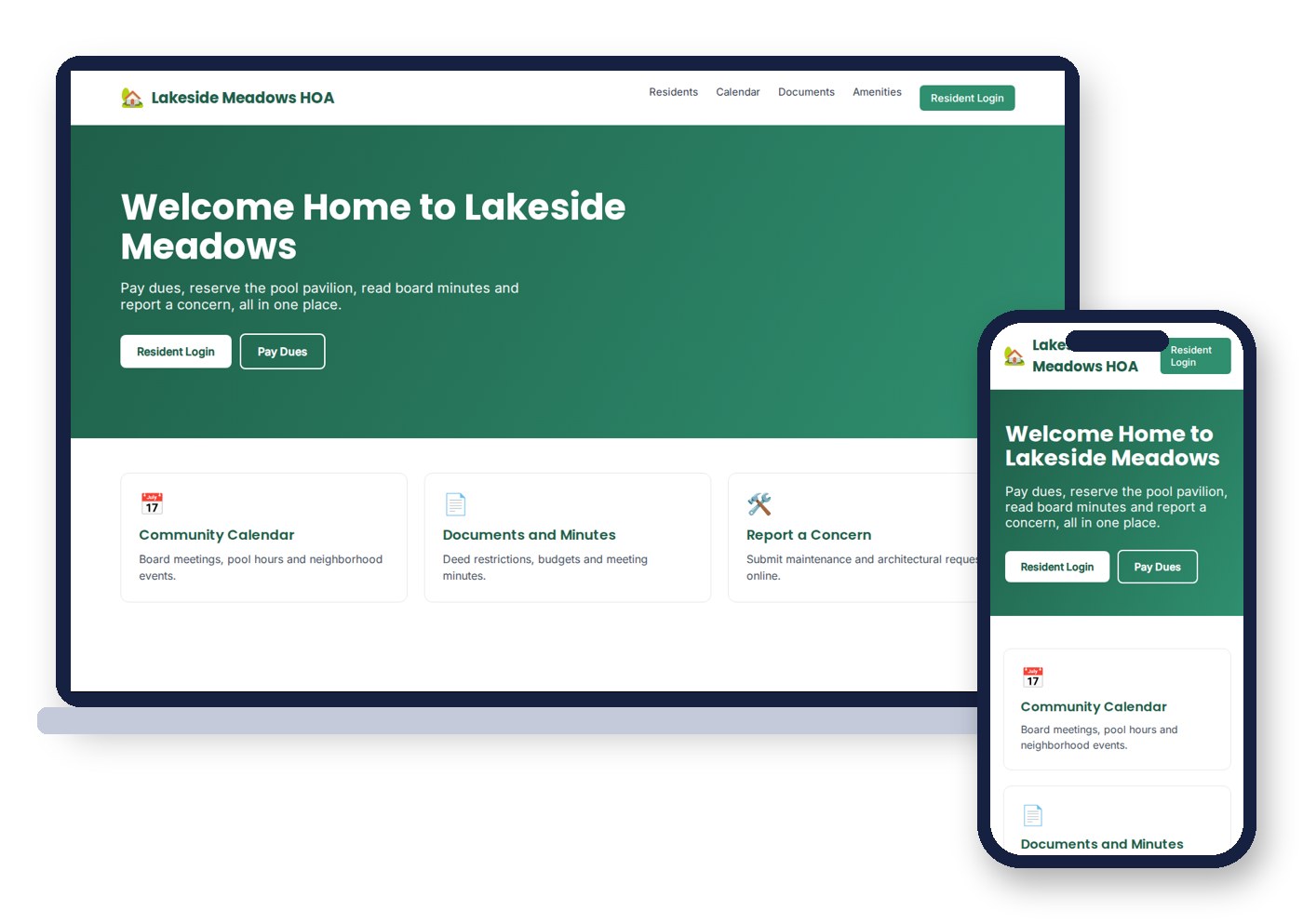
The sample shown here is a fictional community that illustrates the layout we use: a clear resident login, dues payment, a calendar, documents and a simple way to report concerns. We build on WordPress so your board or manager can keep it current.
THE CORE FEATURES
What residents use most on an HOA website
Resident portal
A secure login for owners to see private documents, directories and member only news.
Online dues payment
A clear path to pay assessments online through your management or payment system.
Documents library
Governing documents, deed restrictions, budgets, minutes and forms, organized and searchable.
Community calendar
Board meetings, trash and recycling days, pool hours, events and maintenance notices.
Requests and reviews
Online forms for architectural review, maintenance requests and concerns.
News and alerts
Announcements, storm and freeze notices and newsletters residents can subscribe to.
TEXAS RULES
What are the Texas HOA website requirements?
Texas does not require every association to run a website. But under the Texas Property Code, many property owners’ associations that have a website, or whose management company maintains one, must make their dedicatory instruments available online. Those include declarations, bylaws, deed restrictions and rules. Certain policies, such as payment plan and records policies, also need to be posted or made available.
The details depend on the association’s size, type and management arrangement, and the rules change from time to time. Your association’s attorney should confirm exactly what applies. What we do is make compliance easy: a clearly labeled documents section, organized by type, with dates so residents and buyers always find the current version.
Meeting notices are another area where a website helps. Posting board meeting dates, agendas and minutes on the calendar gives owners one reliable place to check, which cuts down on disputes about who was told what.
COMMUNICATION
How can an HOA website improve resident relations?
Many residents only hear from their HOA when they get a violation letter, and that sets the tone for everything else. Beth Guide has strong feelings here. She once pushed a management company to stop sending trash can letters on the same day the garbage is picked up. People are at work. They will bring the can in when they get home. Letters like that create resentment and cost homeowners money for no real benefit.
A good HOA website shifts the relationship from enforcement to service. It explains why rules exist, shows what dues pay for and celebrates community events and improvements. Beth suggests going further for communities with active boards: record a short monthly update from the board president, post it as a video on the site, turn the audio into a podcast and publish the written version on the same page. People learn in different ways, and giving them all three formats reaches far more residents than a PDF newsletter.
Email remains the workhorse. A monthly newsletter and urgent alerts through email marketing reach owners who never log in, and opt in text message alerts work well for freezes, storms and water outages.
THE CASE FOR VERTICAL WEB ON HOA WEBSITES
A community website partner close to home
We teach this
Beth Guide teaches digital marketing for the SBA, the University of Houston SBDC, Lone Star College and HCC. Volunteer boards get plain answers.
Local offices
Galleria, Kingwood and Cypress, close to the master planned communities we serve.
The community owns it
The domain and the site belong to the association, not to a board member or a management company.
FOR BUYERS AND AGENTS
What should the public side of an HOA website show?
An HOA website has two audiences: the owners who live there and the people deciding whether to buy there. The public pages are often the first impression a buyer gets of the community, and real estate agents check them before every showing.
The public side should cover the basics clearly: the community name and location, amenities with photos, the management company and how to reach it, how to request resale certificates and other closing documents and the general rules a buyer should know, such as fencing, parking or rental limits. Annual assessment information helps buyers budget and saves the manager a lot of phone calls.
Keep the tone welcoming. A community that looks cared for online signals a community that is cared for in person, and that helps every owner’s home value.
WHO WE BUILD FOR
Websites for every kind of community association
Single family HOAs
Amenities, architectural guidelines, events and a resident directory for members.
Condo and townhome associations
Building rules, move in procedures, parking, elevator reservations and maintenance requests.
Master planned communities
Multiple villages, sub associations, trails, facilities and a full events calendar.
Community management companies need something a little different: a company site that wins new associations, plus individual community sites or portals for each client. We build both, with a template that keeps every community site consistent and easy to manage. If you are a management company competing with large national firms, your own site should explain what makes you different, such as response times, local staff and how you handle violations.
Ownership matters more than boards expect. We have seen associations lose their website when a volunteer moved away or a management contract ended, because the domain was registered to a person. We register the domain to the association and document every login. Our domain management service keeps it renewed.
SECURITY AND PRIVACY
Keeping resident information safe
HOA websites hold names, addresses, phone numbers and sometimes account details. That information deserves care.
- Resident directories and private documents sit behind a member login.
- Payments run through your management company’s portal or a payment provider, never stored on the website.
- Board and volunteer accounts get only the access they need.
- SSL, updates, daily backups and monitoring run on our own WordPress hosting.
Associations that operate like small public bodies, such as municipal utility districts, should also see our government website design page. Real estate agents marketing homes in your community may find our real estate website design page useful too.
OUR PROCESS
How we build an HOA website
1. Meet the board and manager. We list the questions residents ask most and the documents the association must publish.
2. Organize the documents. We sort governing documents, policies, budgets and minutes into a clear library with dates.
3. Connect payments and forms. Dues, architectural review and maintenance forms route to the right people.
4. Train the editors. Board members or managers learn to post news, events and alerts in minutes.
5. Hand off with documentation. Logins, domain records and a simple guide stay with the association when boards change.
Templates, builders and features
HOA website template, general website builder or custom site: comparing features
Boards shopping for an HOA website usually find three options. A general website builder is quick and low cost, but it was not designed for community associations, so features like a resident portal, document permissions and dues payment get bolted on with extra tools. An HOA website template from a community management platform comes with those features, but every community on the platform looks alike and the content often stays with the vendor. A custom WordPress site gives your association the features it needs on a site the board owns.
Whatever platform you pick, compare the same features. Can residents reach community information and important documents on any device, including a smartphone? Does the site separate public pages for prospective buyers and real estate agents from private pages for current residents? Is there a community calendar for upcoming events, a photo gallery, community news and a way to report concerns? Can a volunteer on the board update the homepage without calling anyone?
The best HOA website examples share one purpose: easy access to the information residents need, in as few clicks as possible. Rules, regulations, minutes, budgets and contact information should be one tap from the home page. Good engagement tools, such as email alerts and event signups, keep community communication flowing between meetings instead of piling up in a board member’s inbox.
We also host the sites we build, so association website hosting, updates and backups are handled by the same team. See our WordPress hosting for details, or compare our work for other community groups on the nonprofit website design page.
QUESTIONS
HOA website design questions
A resident login, online dues payment, a documents library with governing documents, deed restrictions, budgets and minutes, a community calendar, architectural review and maintenance request forms, news and alerts, board and management contacts and amenity information such as pool hours and reservations.
Texas does not require every association to have a website, but the Property Code requires many property owners’ associations that have one, or whose management company has one, to post dedicatory instruments and certain policies online. Rules depend on the size and type of the association, so your association’s attorney should confirm what applies to you.
Yes. We connect the site to your management company’s payment portal or a payment provider, so owners can pay assessments online without the site storing card or bank details.
With a resident login. Public pages hold information buyers and agents need, such as amenities and contact details. Member only pages hold directories, private minutes and documents the board limits to owners.
Whoever the board chooses: a management company, a volunteer or a committee chair. We build on WordPress with simple editing and set user roles so a volunteer can post news without access to settings or resident data.
Yes, that is one of its main jobs. When pool hours, trash days, dues instructions, deed restrictions and request forms are easy to find, routine questions stop landing in volunteer board members’ inboxes.
Yes. We build on WordPress so a board member or manager can post news, add events and upload documents without code.
Yes. Every HOA website we build is designed to work on phones first, because most residents check pool hours, pay dues and read alerts from a smartphone.
Yes. Public pages can show amenities, fees and contact information for buyers and agents, while a secure resident portal holds directories, private documents and member news.
Is your community website answering residents' questions?
Request a free website audit. We will review your documents, dues path, calendar and mobile use, then tell you plainly what would cut calls to the board.
Galleria 713-703-3030 | Kingwood 281-852-8253 | info@verticalweb.com
No related posts.