
WEB DESIGN FOR FRANCHISES AND MULTI-LOCATION BUSINESSES
Franchise Website Design for Multi-Location Brands
Websites for franchise systems and multi-location companies that keep one strong brand, give every location a page that ranks in its own market and recruit the next franchisee.
Galleria 713-703-3030 | Kingwood 281-852-8253
ONE BRAND, MANY LOCATIONS
Why do customers search locally, even for a national brand?
A franchise or multi-location business has two websites to get right at once. The brand site builds recognition and trust across every market. Each location has to show up when someone nearby searches “near me,” with its own hours, phone number, services and reviews.
Most franchise sites struggle with the second job. Location pages are copies with the address swapped, local managers cannot change anything and adding a new location takes weeks. Local rankings suffer and franchisees get frustrated.
We design franchise websites around a brand system and a location page template that scales. Every site is mobile first and built on WordPress, so corporate controls the brand while each location keeps its details current.
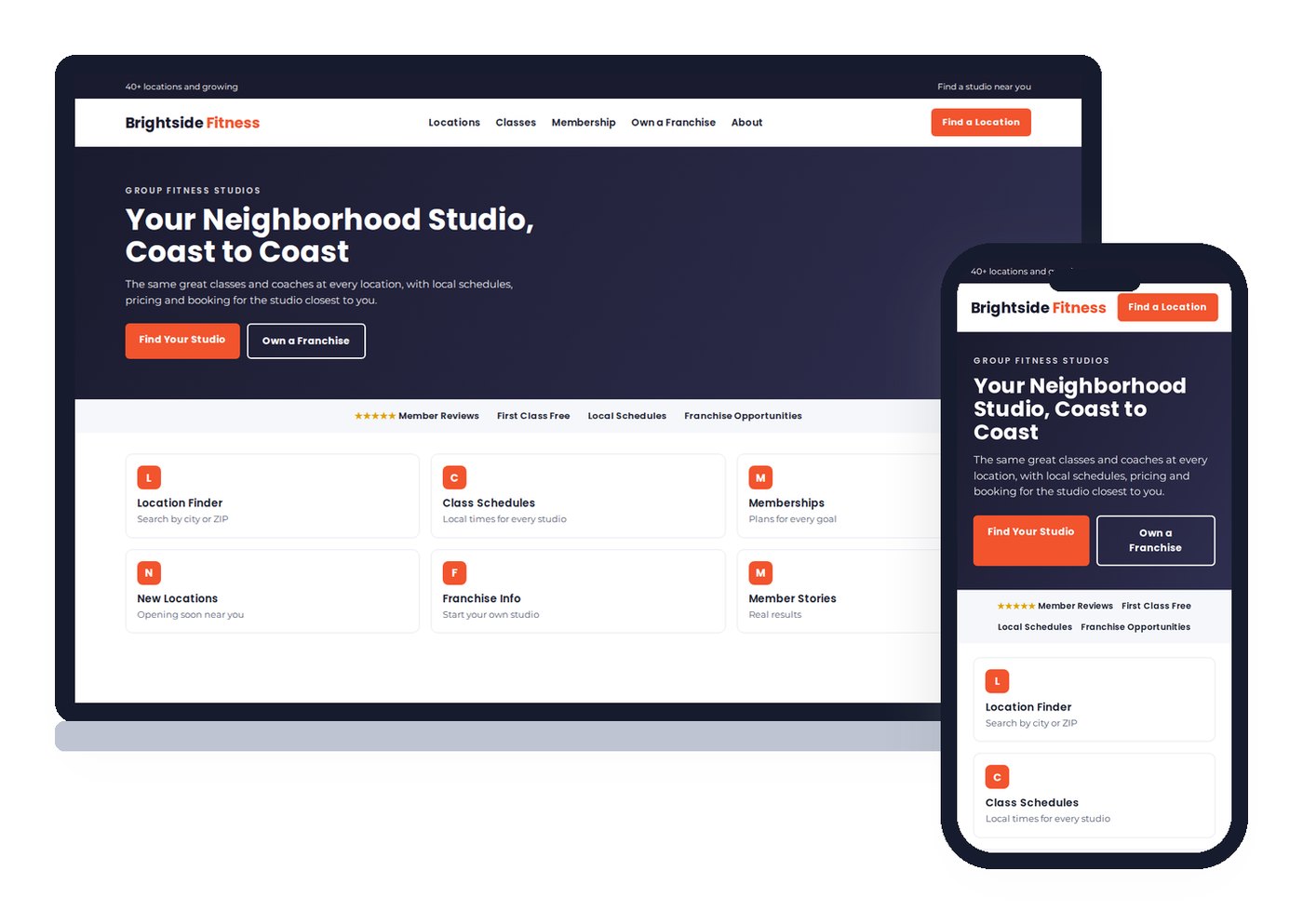
WHAT A FRANCHISE SITE MUST DO
What a franchise website must do well
Fast location finder
Search by city or ZIP, a map and the nearest locations first, with directions one tap away.
Real location pages
Unique pages with local hours, phone, services, staff, photos, reviews and the areas each location serves.
One consistent brand
One design system, voice and set of offers across every market, enforced by the template.
Local booking and ordering
Bookings, orders and quote requests routed to the right location automatically.
Owner editing with limits
Location managers update their own details without touching logos, core copy or legal language.
Franchise recruitment
A separate section for prospective owners with territories, support details and an inquiry form.
ONE SITE OR MANY
Should each franchise location have its own website?
For most systems, no. One domain with strong location pages is easier to rank, less costly to run and simpler to keep on brand. Every link a location earns strengthens the whole brand, and every brand campaign helps every location.
Separate sites for each franchisee split that authority. They also multiply hosting, updates and security work, and within a year or two they drift. Fonts change, offers go stale and some locations stop updating altogether.
The structure we recommend looks like this:
- Brand pages for the company story, services and offers, written once and kept consistent.
- A location finder that lists every location by city and ZIP.
- Location pages at clean addresses, such as /locations/the-woodlands, built from one template but filled with local content.
- Local service pages where a location offers something others do not.
- A franchise opportunity section for recruiting, separate from the customer path.
The search behind it is the same as any local business. Learn how we handle maps and Google Business Profiles on our local SEO page and our guide to local SEO and Google Business Profiles.
LOCATION PAGES THAT RANK
What makes a franchise location page rank?
Google does not reward a page that is identical to 50 others except for the street name. Those pages are treated as thin copies, and most of them never reach the map pack. A location page has to earn its spot with real local substance.
Here is what we build into every location template:
- Local basics. Exact name, address and phone that match the Google Business Profile, hours including holidays and a map.
- Local proof. Photos of the actual location and team, the manager’s name and reviews from that location’s customers.
- Local services. What this location offers, including anything unique, and the neighborhoods and suburbs it serves.
- Local content. A paragraph or two about the area written by someone who knows it, plus local news, events and community work.
- Location schema. LocalBusiness markup on each page, tied to the brand organization.
Houston is a good test of this. The metro covers dozens of suburbs and unincorporated communities, and customers search by the name they use, whether that is Katy, Cypress, Spring or Kingwood. A location page should speak to the communities it really serves. Consistent listings across directories matter too, which is what our Citation Lock listing service manages for multi-location brands.
THE CASE FOR VERTICAL WEB ON FRANCHISE WEBSITES
A franchise website team that scales with you
We teach this
Beth Guide teaches local SEO and site structure for the SBA, the University of Houston SBDC, Lone Star College and HCC.
One in-house team since 1998
Design, development, hosting and SEO by our own staff. New locations go live without waiting on a subcontractor.
Honest about structure
If one strong site will outrank a network of microsites, we will tell you before you pay for twenty.
FOR FRANCHISEES
What if corporate controls your franchise website?
Many franchisees come to us after learning they cannot change their own location page. It is a real problem, because the owner knows the local market far better than the brand team does.
Start with a conversation. Ask the brand what local content it will accept: photos, staff, community news, local service details. Many systems will say yes when the request comes with a clear plan.
If the answer is no, read your franchise agreement before building anything. Beth has helped owners in that position with a different approach. For one assisted living location inside a chain that would not allow a separate site, we built helpful pages on topics families were searching, such as Medicare questions and how to choose an assisted living facility, with clear paths to the official location page. Done within the agreement, that kind of resource brings in people the brand site was missing.
Paid search is the other lever a franchisee often controls. Our PPC management team runs local campaigns that send clicks to the official location page.
BUILT FOR GROWTH
Features that help franchise systems grow
New locations in a day
A finished template means a new location page needs content and photos, not development.
Shared and local offers
National promotions show everywhere, while locations can add local specials inside the brand rules.
Tracking by location
Calls, forms and bookings tracked for each location, so owners see their own results.
Campaign pages are part of the system too. When a franchise runs a seasonal offer or a grand opening, a focused page converts better than the home page. Our landing page design service builds those to the same brand standards.
Agencies with several offices face many of the same questions. Insurance agencies should also see our insurance website design page.
OUR PROCESS
How we build a franchise website system
1. Audit every location. We list each location, its current pages, its Google Business Profile and its rankings. Most systems find a few locations doing well and many that are invisible, and the difference is usually content, not design.
2. Design the brand system. Colors, type, buttons and content blocks are set once in Elementor and Astra globals, so every page stays on brand without anyone policing it.
3. Build the location template. We decide which fields are required, which are optional and which only corporate can change. Then we write a guide for owners on what good local content looks like.
4. Migrate without losing rankings. Existing location URLs are kept where they rank and redirected where they move, so no location loses the searches it already earns.
5. Train and measure. Owners get a short training session, and corporate gets reporting by location for calls, forms and bookings.
Structure decides rankings
How to set up franchise websites: one domain with subdirectories or multiple websites?
Most franchisors face the same choice early: one single domain with a page or subdirectory for each location, or a separate website for every franchise location. For most brands, the single domain wins. Every link, review mention and piece of content builds authority for one site, and each location page borrows that strength in the local search results. A brand-new franchisee gets a page that starts with the brand’s authority instead of starting from zero on a new domain.
A subdirectory structure looks like yourbrand.com/locations/katy/. Each location gets its own page, its own NAP (name, address and phone), its own hours, its own map and its own Google Business Profile pointing to it. Corporate controls the template and the brand. The owner controls the local details.
Multiple websites make sense in a few cases: a franchise business that sells under different names in different markets, a location that offers a very different set of services, or a franchise agreement that gives owners their own domain. Even then, the sites should share one CMS and one design system so updates do not have to be made hundreds of times. Our WordPress development team builds both models.
Multi-location SEO
Franchise website development for SEO: duplicate content, NAP and multiple locations
Multi-location SEO is the work of getting each franchise location found for searches in its own area, without the pages competing with each other. The biggest risk is duplicate content. When fifty location pages share the same text with only the city name swapped, Google sees one page, picks one to show and ignores the rest. Potential customers in the other areas never see you.
Each location page needs information that is true only for that specific location: the neighborhood and the landmarks near it, the team, the services or products that store carries, local reviews, directions and a local FAQ. That gives Google and the user a reason to treat each page as its own answer. We build the template with fields for those details, so owners know exactly what to fill in.
NAP consistency is the other half. The name, address and phone on the location page, the Google Business Profile and every directory listing must match exactly, or the location loses trust in the map pack. Our citation management service keeps every listing in line, and our local SEO team handles the profiles.
Marketing that converts locally
Web design for franchise marketing: user experience that turns visitors into customers
A national brand gets the visitor to the site. The location page has to convert them. The user experience goal is simple: within a few seconds, a visitor should know the nearest location, whether it is open, and how to call, book or order. A store locator that works on a phone, a click-to-call button and a short form do more for conversion than any banner.
Keep the user in mind when the corporate team plans the site. People rarely start on the home page. They land on a location page from a search result or a map listing, so that page needs the full story: who you are, what this location offers and why to pick it over a competitor nearby. We test the key paths on a phone before launch and track calls and bookings by location after, so each owner can see the performance of their own page.
Franchise recruitment needs its own path, too. A prospective new franchisee looks for very different information than a customer, so we keep those pages separate and easy to find. If you are comparing builders for a smaller system, our guide on how to hire a web designer covers the questions to ask.
QUESTIONS
Franchise website design questions
With one design system and one location page template on a single website. Corporate controls the brand, the menus and the offers. Each location gets its own page built from the template, with unique local details, photos, staff and reviews that the local owner can update inside set limits.
Usually no. Separate sites split authority, multiply hosting and update costs and drift off brand. One domain with strong location pages, such as brand.com/locations/katy, ranks better for most systems. The exception is a franchisee who needs content the brand site will not allow, which should be handled by agreement.
Unique content. A page that only swaps the address is a thin copy. A page that ranks has local hours, a direct phone number, the services offered at that location, staff, photos, nearby areas served, location schema and details that match the Google Business Profile exactly.
It is the repeatable structure behind a multi-location site: a page layout for each location, a location finder, shared content blocks and rules about what local owners can change. A good system lets you launch a new location page in a day instead of weeks.
Yes, with limits. We give location managers access to their hours, staff, photos, local news and specials, while the brand team keeps control of logos, colors, core service copy and legal language.
Start by asking what local content the brand will allow. If the answer is little or none, read your franchise agreement before building anything else. Some franchisees publish helpful local resources that point back to their official location page, where the agreement permits it.
If you are growing, yes. Prospective franchisees research investment levels, territories, training and support. A dedicated section with an inquiry form keeps that audience separate from customers and makes it easy to track.
Multi-location SEO gets each location of a brand found in its own local search results. It combines a unique page for every location, a Google Business Profile for each, consistent NAP across directories and reviews tied to the right location.
Yes. When location pages share the same copy with only the city swapped, Google tends to show one and ignore the rest. Each location page needs local details that are true only for that location.
All the authority from links, content and brand searches builds on one domain, so every location page starts stronger. Corporate keeps one template and one CMS, and owners update only their own local details.
Owner-built sites often break brand rules, split authority across dozens of weak domains and leave customers with outdated information. A shared system with owner editing gives local control without those risks.
Are your location pages pulling their weight?
Request a free website audit. We will review your location template, local signals and finder, then show you which locations are missing searches and why.
Galleria 713-703-3030 | Kingwood 281-852-8253 | info@verticalweb.com
No related posts.