
WEB DESIGN FOR DEALERS AND DISTRIBUTORS
Dealer and Distributor Website Design
Contractors, plant buyers and resellers come to your site with a part number or a brand name. We design distributor websites that tell them, fast, whether you carry it, what it costs their account and how soon it can ship.
Galleria 713-703-3030 | Kingwood 281-852-8253
BUYERS WANT ANSWERS
Do you have it, and how fast can I get it?
A distributor’s website is a counter that never closes. Buyers arrive with a specific question: do you stock this brand, is it in inventory, what is my price and can I pick it up today? A site that cannot answer sends them to the next result in Google.
Distributor and dealer sites also have to satisfy the manufacturers you represent. Logo rules, authorized dealer language and a current line card matter. An outdated brand page hurts you and your supplier at the same time.
We build dealer and distributor sites on WordPress with search, quote and account tools sized to how you actually sell. When a full store makes sense, we build it with our ecommerce web design team.
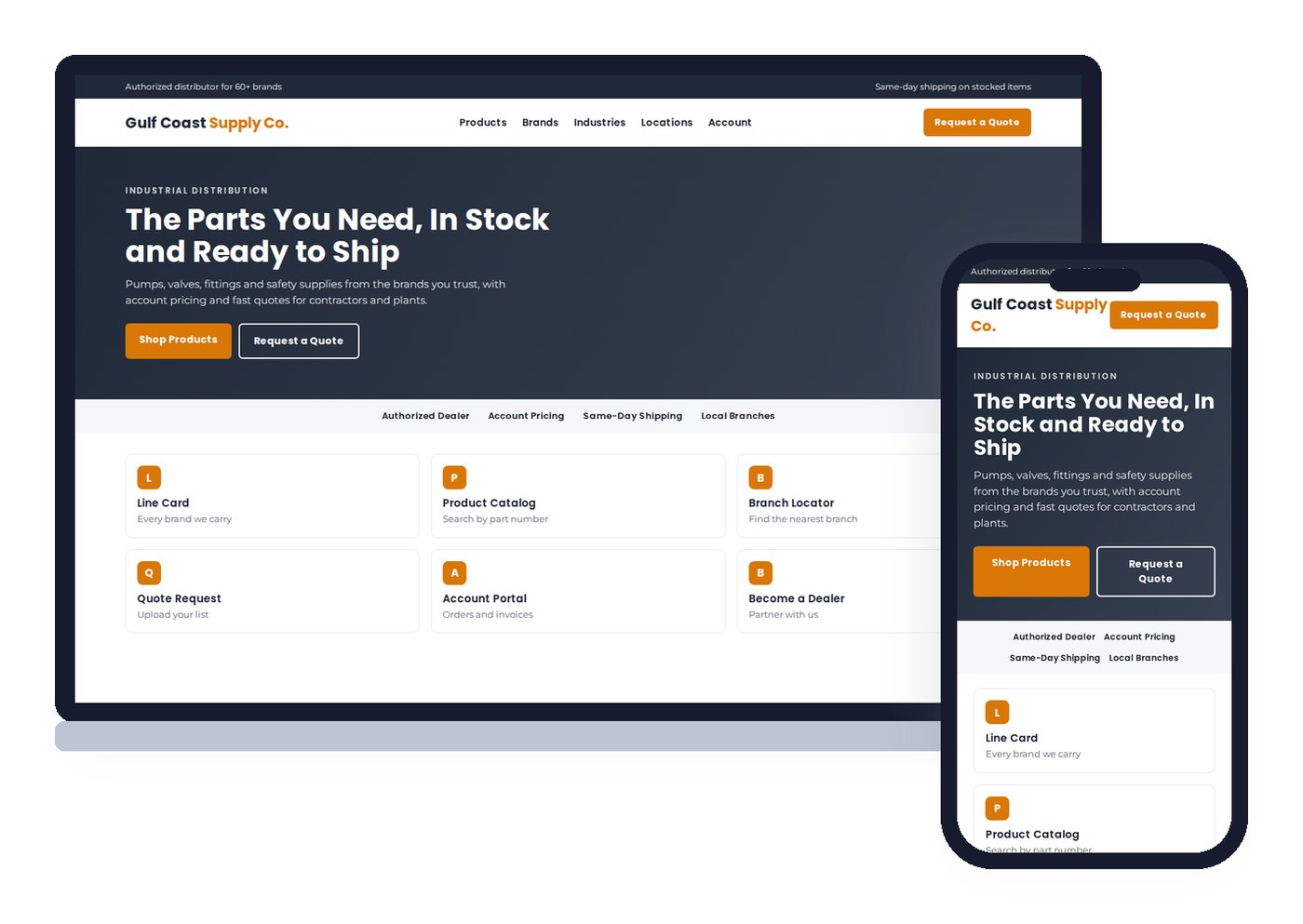
WHAT BUYERS CHECK FIRST
What contractors and buyers need from a distributor site
A current line card
Every brand you carry, with logos, authorized dealer language and a link to a page for each one.
Search that knows part numbers
A search bar on every page that finds a part by number, brand or category, including partial numbers.
Quote requests
Request a Quote on every product and category page, plus a way to upload a full list in one step.
Account access
Order history, invoices and account pricing for existing customers, so reorders do not need a phone call.
Branch locations
Hours, inventory focus and the right contact for each branch, with directions that open on a tap.
Shipping and will-call
Clear shipping cutoffs, delivery zones and pickup options, written so a buyer can plan a job.
THE FREE SITE QUESTION
Should you use the free branded website from your manufacturer?
Many manufacturers offer dealers a free branded website. It is tempting, and for a brand new dealer it can be a reasonable stopgap. Before you rely on one, look at what you are getting.
- It usually lives on their platform. If you leave the program or the manufacturer changes vendors, the site and its rankings go with it.
- The content is shared. Hundreds of dealers get the same product copy. Google has little reason to rank one copy over another, so most of those sites never show up.
- It only shows one brand. Most distributors carry many lines. A buyer who needs a different brand has to leave and find you somewhere else.
- You do not control the structure. You cannot add branch pages, industry pages or the products that actually make you money.
Our advice is candid: use the free site if it helps, but build your own domain as the real home of your business and link to the program from it. The website you own is the one that compounds. The same logic applies to every small business website we build.
STRUCTURE THAT RANKS
How should a distributor website be organized?
Buyers search by brand, by product and by location. Each of those deserves its own page. One “Products” page with a PDF catalog cannot rank for any of them.
Beth makes this point in her classes with a lighting distributor’s site we built. Instead of one Products tab, the main menu has drop downs for parking lot lighting, sports lighting and each other application. Buyers find their category in one click, and Google sees a clear map of what the company sells. Navigation is one of the places where a designer who knows SEO and one who does not get very different results.
The pages we build for distributors usually include:
- Brand pages for each line, which capture searches like “brand name distributor Houston.”
- Category pages organized by application, with specs and a quote path.
- Industry pages for the trades you serve, such as oil and gas, construction or healthcare.
- Branch pages with local details for each location.
- Resources such as spec sheets, catalogs, manuals and technical guides.
- Become a dealer or supplier pages for partners who want to work with you.
Product categories are just as important for sites that list inventory without selling it online. See how we handle business listings and product catalogs.
THE CASE FOR VERTICAL WEB ON DISTRIBUTOR WEBSITES
A distributor website built by people who answer the phone
We teach this
Beth Guide teaches site structure and SEO for the SBA, the University of Houston SBDC, Lone Star College and HCC. You get the reasons, not just the deliverables.
One in-house team
Design, development, ERP integration, hosting and SEO done by our own staff since 1998. No hand-offs to a subcontractor.
Candor on scope
If a catalog with quote requests fits your pricing better than a full store, we will tell you before you pay for features you do not need.
ORDERING MODEL
Full ecommerce or a catalog with quote requests?
Some distributors need online ordering. Others need a strong catalog that feeds quote requests to inside sales. The right answer depends on your pricing model, your customers and your ERP.
Quote first works best when most buyers have account pricing, contracts, volume breaks or freight that changes the total. The site does the research work, and your sales team closes.
Online ordering fits standard items at list price, repeat consumables and customers who want to reorder at night. WooCommerce handles B2B pricing tiers, tax exemptions and purchase orders well.
Both together is common: a public catalog with quote buttons, plus a logged in account area where approved customers see their pricing and reorder. When stock and pricing live in an ERP, our web development team connects the two so nobody retypes data, and business automation can route quotes to the right branch.
BUILT TO BE FOUND
Distributor website design and SEO
Buyers search for brands, part numbers and categories, often with a city attached. A distributor site built around those searches brings in people who are ready to order, not browsers.
We write clear titles and headings for every brand, category and branch page, add organization and product schema and keep branch details consistent with each Google Business Profile. That supports local search for every branch, not just headquarters.
Buyers increasingly ask AI assistants where to buy a specific product. Clear brand pages and accurate product data help AI engines name you as a source. Our SEO services extend that work after launch with content, links and reporting.
We also design for the field. Contractors check availability from job sites on their phones, so search, quote buttons and spec sheets have to work on a small screen with one thumb.
WHO WE DESIGN FOR
Websites for every kind of distributor and dealer
Industrial and MRO
Pumps, valves, bearings, fasteners and maintenance supplies with deep catalogs and spec data.
Electrical, plumbing and HVAC supply
Branches, brands and contractor accounts with will-call and job site delivery.
Equipment and vehicle dealers
Inventory, parts and service departments on one site. See also heavy equipment.
If you sell machinery, our heavy equipment website design page covers inventory listings, rentals and parts in more depth.
B2B commerce, done right
Wholesale website development: B2B commerce, CRM and inventory management
A wholesale website has a different job than a retail store. Your buyers are clients with accounts, contract pricing and purchase orders. A wholesale website should let an approved buyer log in, see their own prices, check stock and reorder without a phone call, while the public side of the site still ranks and brings in new accounts.
The technology behind that is integration. Inventory management, pricing and customer records usually live in an ERP or a CRM. When the website talks to those systems, stock levels stay accurate, quotes land with the right salesperson and nobody retypes orders. Our custom ecommerce development team builds those connections on WooCommerce, which handles B2B pricing tiers, tax exemptions and net terms.
Not every distributor needs full ecommerce. If most of your sales come from quotes, a catalog with strong quote paths and a CRM connection may bring a better return than a full store. We will tell you which fits your market and your goals before the project starts.
Design for buyers on the job
UI and UX design for distributor websites: the project process and best practices
Good UI and UX design on a distributor site is about speed to the answer. A contractor on a job site needs to find a part, see if it is in stock and request a price in a few taps. That means a search bar on every page, clear categories by application, large buttons that work with gloves on a phone, and product pages with specs, photos and a quote path above the fold.
Every project follows the same steps. We start with analysis: how your buyers search, which brands and categories drive sales, and what your current site does well and poorly. Then comes the site map, UI design mockups for your review, development on a private staging copy, product data import and testing. Deployment happens only after search, quote forms and account logins are checked on a phone. Old URLs that rank keep their place or get a 301 redirect.
Product photos and illustrations matter more on a distributor site than most owners expect. Clear images and technical illustrations help a buyer confirm they have the right part, and they reduce returns. Where manufacturer images are weak, we plan for better ones as part of the project.
Heavy equipment and industrial lines
Website design for machinery distributors and equipment dealers: built for the sale
Machinery distributors and equipment dealers sell high-value products with long buying cycles. A buyer may visit your site many times before a sale: to compare models, read specs, check financing, find a branch and ask for a demo. Each of those visits is a chance to earn trust, and each one needs a clear next step.
Your pages should cover every model you carry, with specs, photos, video where you have it and the brand’s authorized dealer language. Add pages for parts, service and rentals if you offer them, because many buyers search for those first. Inventory pages for used equipment can bring in steady traffic when they stay current.
Brand identity still matters, even when you sell other companies’ products. Buyers choose a dealer for service, parts availability and expertise. Show your techs, your shop and your branches. For more on this market, see our heavy equipment website design page, or our manufacturing website design work for the companies upstream of you.
QUESTIONS
Distributor website design questions
A current line card, product search that handles part numbers, a request a quote path on every product and category page, branch locations, shipping and will-call details, spec sheets and an account area for existing customers. Buyers want to know if you have it, what it costs them and how fast it ships.
It can be a fine starting point, but read the terms. Those sites usually live on the manufacturer’s platform, carry the same content as every other dealer and only show that one brand. Duplicate copy rarely ranks, and if you leave the program the site goes with it. Your own domain with your own brand pages is an asset you keep.
It depends on your pricing. If most customers have account pricing, contracts or volume breaks, a catalog with quote requests and an account portal is often the better fit. If you sell standard items at list price, online ordering makes sense. Many distributors do both.
Often, yes. Many ERP and inventory systems can export product data or connect through an API, so stock levels and pricing stay current without retyping. We review your system before we quote, because the integration decides much of the scope.
With a page for each brand you carry, category pages organized by application, clean product titles that include part numbers and product schema. Brand plus distributor searches are some of the highest intent traffic a distributor can get.
Yes. We follow each supplier’s logo rules and authorized dealer language, and we set the site up so your team can update line cards and brand pages when a line is added or dropped.
A wholesale website lets approved business buyers log in, see account pricing, check stock and reorder, while the public side brings in new accounts through search.
Usually, yes, when the system offers an API. We connect inventory, pricing and customer records so quotes and orders flow without retyping.
Model pages with specs and photos, parts, service and rental pages, current used inventory, branch pages and a clear quote or demo request on every page.
Is your website losing buyers to the next distributor?
Get a free website audit. We check how your site handles brand and part number searches, quote paths and mobile use, then show you what to fix first.
Galleria 713-703-3030 | Kingwood 281-852-8253 | info@verticalweb.com
No related posts.