
SAAS AND SOFTWARE MARKETING
A SaaS Marketing Agency That Builds and Markets Its Own Software
Software companies hire us to turn search and AI visibility into demos, trials and subscriptions. We build and market our own SEO software, so we know the job from the inside.
Galleria 713-703-3030 | Kingwood 281-852-8253
Home › Digital Marketing › Industries › SaaS Marketing
A SaaS buyer does not want your story first. They want 3 answers fast: what does it do, who is it for, and what does it cost. If your website makes them dig for any of those, they open a competitor’s tab and you never know they were there.
We are a SaaS marketing agency that also ships SaaS. We built elev8tor, our own SEO platform, and we market it with the same growth strategy on this page. The site side is covered on our SaaS website design page. This page covers how we get the right buyers to it and turn them into pipeline, demos and trials.
Watch: AI’s Impact: Why Ignoring It Is a HUGE Mistake!
THE OUTCOME
What does a SaaS marketing agency do, and what should a SaaS marketing strategy include?
A SaaS marketing agency fills your pipeline with qualified demos, trials and paid accounts, then helps keep those accounts so revenue grows. Not traffic for its own sake, and not a pretty report full of impressions.
A real SaaS marketing strategy is a go-to-market plan with these parts working together:
- Positioning and messaging. One clear sentence on what problem your SaaS solves and for whom. Every page, ad and email is built on it.
- Content marketing and SEO. Pages and articles that answer what your buyers search, structured so Google and the AI engines understand them. This is the demand generation engine behind long-term SaaS growth, and it keeps working when ads stop.
- Product-led growth. A free trial or free plan that lets the SaaS product sell itself, backed by pages that get the right people into it.
- Paid search and paid social media. Ads on the searches that signal buying intent, plus retargeting that follows site visitors so you stay in their head while they compare.
- LinkedIn. For B2B SaaS, the place your buyers actually read business content and the channel where B2B SaaS messaging gets tested fastest.
- Email onboarding and nurture. Sequences that turn trial users into active users and keep leads warm until they are ready.
- Review sites and partner programs. Third-party proof and links from the tools you integrate with.
- Conversion rate optimization (CRO). Testing headlines, forms and calls to action so more visitors start a trial.
- Analytics and attribution. Knowing which channel produced which demo, so budget goes where it pays back.
Most SaaS companies do 2 or 3 of these well and leave the rest to chance. A growth strategy is only as good as its execution, so we look at all of them, then tell you which 2 or 3 to focus on first for your stage.
For SaaS, the whole strategy depends on clarity. A buyer who lands on your site should be able to answer the 3 questions in under a minute:
- What does it do? In plain words, not a slogan.
- Who is it for? The industry, the company size, the job title.
- What does it cost? Your own pricing page, on your own site. Beth says it about our own services: we put the pricing page up so there are no surprises. Buyers who reach a demo already knowing the range are better leads.
When those answers are clear, every other channel works better. Ads convert. Content converts. AI engines can describe you correctly. When they are not clear, every channel leaks.
HOW SOFTWARE BUYERS SEARCH
How do B2B SaaS buyers find and choose software today?
SaaS buyers rarely start with your brand. They start with a problem, then a category, then a shortlist. The searches look like this:
- The problem: “how to track where my leads come from.”
- The category: “scheduling software for dental offices.”
- The shortlist: “[competitor] alternatives” and “[tool A] vs [tool B].”
More and more of that research now happens inside ChatGPT, Gemini, Perplexity and Google’s AI answers. A buyer asks for the best tool for a specific job, gets 3 or 4 names, and treats that list as vetted. Beth has seen this firsthand with her more technical clients. Their content became the source material the AI engines quote, and the niche questions they answered on their own sites are exactly the questions people were asking the AI.
That is good news for focused SaaS products and a big growth opening for a smaller B2B SaaS company. The more specific your use case, the easier it is to own the answer. Our AI search optimization service is built around being that source.
If you sell to small businesses, remember who your buyer is. A dentist or a contractor thinks in local terms first, so content that teaches them local SEO and local marketing earns their trust before they ever need your product.
What we do for saas and technology
SaaS Marketing Services for Growth
SaaS SEO and Site Structure
Feature, use-case, integration and pricing pages built into silos that Google and AI engines understand.
Comparison and Alternative Pages
Fair, honest pages for the vs and alternatives searches your buyers are already running.
AI Search Visibility
Original, expert content built to be the source ChatGPT, Gemini and Perplexity quote when buyers ask.
Technical SEO for JavaScript Sites
We make sure crawlers can read your marketing pages, trim script bloat and keep the site fast.
Trial Onboarding Email
Sequences that walk new trial users to their first win, so more of them become paying accounts.
Demo and Trial Conversion
Clear asks on every page and lead source tracking, so you know which channels produce demos.
THE PAGES THAT RANK
What pages does a SaaS website need for SaaS SEO?
A 5 page SaaS site does not have enough to say for Google or the AI engines to trust it, and it leaves no room for growth. Beth’s rule for any digital strategy applies doubly here: Google wants category pages, and every category wants its own supporting pages, linked together into a silo.
For SaaS, that site strategy usually looks like this:
- Feature pages. One page per major feature, written around the job it does, not the name your product team gave it.
- Use-case and industry pages. “For accountants,” “for agencies,” “for multi-location teams.” Each one speaks to a different buyer with different words.
- Comparison and alternative pages. Buyers are searching these terms whether you write the page or not. Write it, keep it fair, and say plainly who you are not a fit for. Honesty is what makes these pages convert.
- Integration pages. Each tool you connect to is a search someone is already running.
- A real pricing page. With plans, limits and what happens after the trial.
- Help and how-to content. These pages answer the niche questions that AI engines love to cite.
Every one of these pages links up to its parent and across to its siblings. That internal linking is how Google learns which pages matter. It is the core of our SEO services for every industry we serve.
Your own site is only half the picture. B2B SaaS buyers also check software review sites, and the AI engines read them too. Ask happy customers for reviews there, and answer the critical ones. Before you pay for a premium listing, though, compare the traffic it claims against your own Google Analytics. Beth has audited paid directory campaigns where the reported numbers never matched the server logs. Partnerships work the same way. An integration partner that lists you on its site sends real buyers and a trusted link Google counts.
TECHNICAL SEO
Can Google and AI engines read a JavaScript SaaS site?
Sometimes, and not as well as you think. Many SaaS companies build the marketing site in the same JavaScript framework as the app. It looks great to a person. To a crawler, content that only appears after scripts run is slower and harder to read, and some AI crawlers may never see it at all.
Beth’s position on platforms is simple. If your goal is organic traffic from Google, ChatGPT or Perplexity, the site has to be built on solid technical SEO principles, and if those are lacking, the site will not rank. That is why our technical strategy usually includes:
- Keep the marketing site separate from the app. The app can live on its own subdomain. The marketing site should be fast, crawlable WordPress that your growth team can edit without a developer.
- Watch the third-party scripts. Chat widgets, heatmaps, video players and tracking tags each add JavaScript. Beth has watched her own chat tool and plugins drag page speed down. Load only what earns its keep, because a slow page drags down conversion rate optimization work too.
- Get the basics right on every page. One H1, a real title tag, a meta description, schema and clean URLs.
- Check Google Search Console. It shows which pages Google has indexed and which it skipped.
If you suspect your site has bigger issues, our list of common website problems we fix is a good place to start.
Recent work
SaaS websites we have built
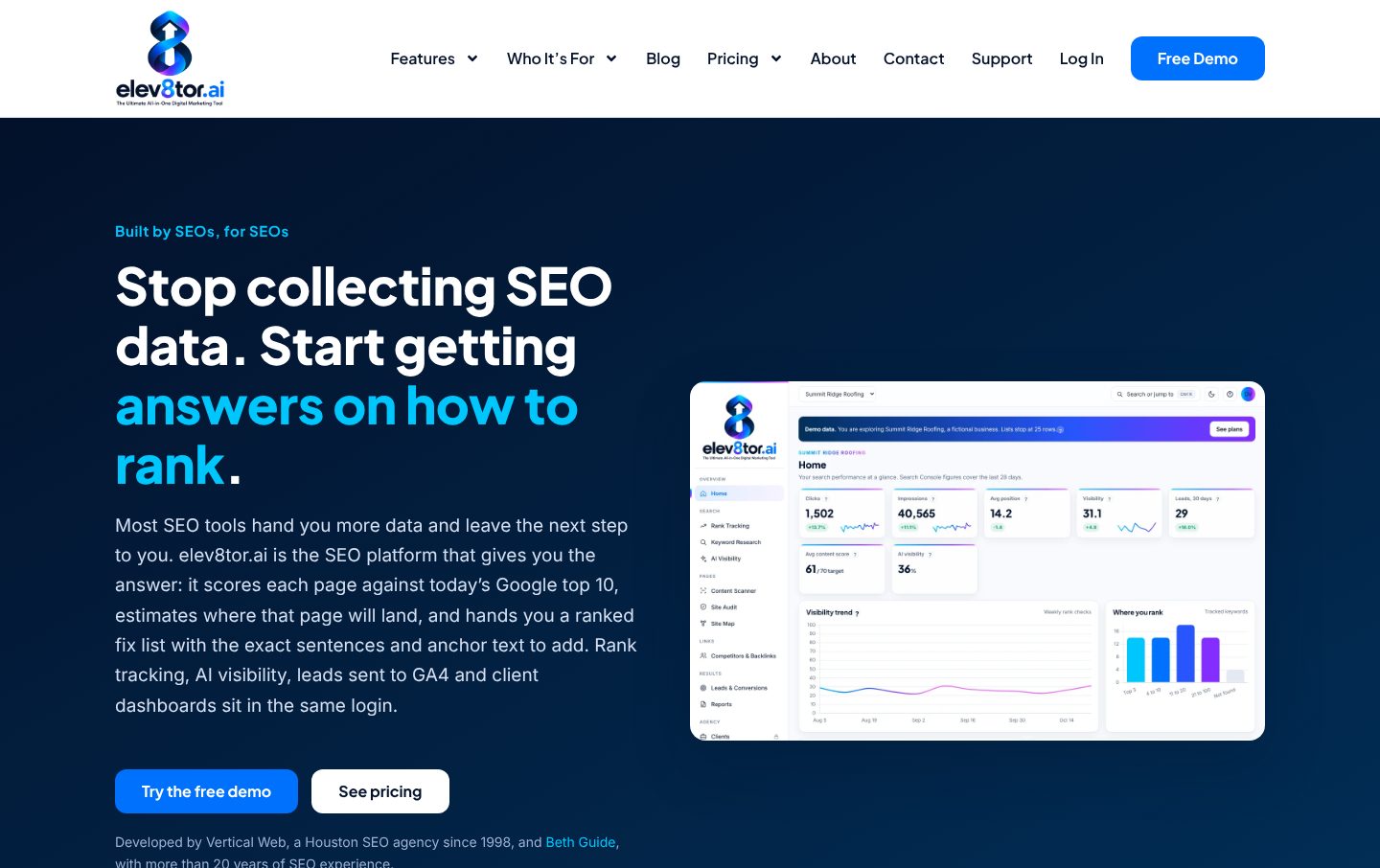
Recent work for software and technology companies includes elev8tor.ai, our own SEO platform, and Data Projections.
elev8tor.ai

Data Projections
CONTENT THAT GETS CITED
How does SaaS content get cited by ChatGPT and AI search?
By saying something only you can say. Beth repeats this in every class: Google does not like AI-written filler, and AI does not like AI either, because a rewrite of what is already out there adds no value. The content that gets cited carries original expertise.
Software teams are sitting on that expertise. Your founders, engineers and support team know things about the problem nobody else does. The content strategy Beth uses for her own content works well here:
- Record a founder or product lead explaining a problem, a feature or a common mistake.
- Use their own words as the source for the page.
- Have a human expert check every claim and change anything that is wrong.
- Publish it inside the right silo, linked to the feature it supports.
That human element is what makes the page unique, and unique is what earns rankings and citations. It also gives you video, which keeps visitors on the page longer, a signal Google watches. Done every month, this is how SaaS content becomes a growth channel instead of a blog nobody reads.
CONVERSION
How do you turn SaaS traffic into pipeline, demos and revenue?
Treat the demo request and the trial signup as the first finish line, and activation as the second. A trial nobody uses is not a customer, and it will not renew.
Most SaaS lead generation runs down one of 2 funnels, and many B2B SaaS teams run both:
- Product-led. The visitor starts a free trial and the product does the selling. Your job is to make signup easy and get the user to their first real result fast.
- Sales-led. The visitor books a demo and a person does the selling. Your job is to bring in the right companies and give sales the context to close.
Either way, these habits drive SaaS growth:
- Know where every lead comes from. Clients tell Beth they are not getting leads when she can see them coming in. So we built source tracking into our own software that shows whether each lead was direct, organic, referral, paid or social. You should know the same about yours.
- Put the ask on every page. Start a trial, book a demo, see pricing. A feature page with no next step is a dead end. Conversion rate optimization starts here.
- Use LinkedIn for B2B SaaS. Beth’s own experience: a business post that went nowhere on Facebook produced 2 to 3 calls for quotes every time she put it on LinkedIn. For SaaS sold to businesses, that is usually where your buyers are.
- Win the trial with email. A trial user who never finishes setup never pays. An onboarding sequence that walks them to the first win, one step per email, does the work while your team sleeps. Our email marketing team builds and tests those sequences.
- Own your list. Followers on a platform you do not own can vanish. Your email list stays yours.
- Buy your own name. Beth runs a small ad on her own brand name so nobody else can sit on top of it. Competitors bidding on your name is common in software, and a brand ad is the defense.
- Retarget visitors. Software buyers compare for weeks. A retargeting pixel keeps your product in front of the people who already visited, which is how a smaller brand stays on the shortlist.
- Keep the customers you win. Churn quietly cancels out new signups. Beth watches how many of her visitors come back on a regular basis, and the reason they return is useful content. Help articles, release notes and customer emails that teach do the same job for retention, and retention is where recurring revenue growth compounds.
WHY VERTICAL WEB
Why should a SaaS company choose Vertical Web?
We build SaaS, and we market it. elev8tor started as a tool Beth built so her own staff would know what to fix next: audits, a dashboard, lead source tracking and a weekly list of open items. It grew into our own SEO platform, and you can see a piece of it in our DIY SEO tool. Every feature page, comparison question and onboarding problem on this page is one we deal with ourselves, so our SaaS strategy comes from execution, not theory.
You hire the people other marketers learn from. Beth Guide has taught SEO since 2003 for the SBA, the University of Houston SBDC, Lone Star College and HCC, and she is a Fox 26 technology expert.
One accountable digital team. Hosting, design, development, content and SEO happen in-house. When a page drops out of the index, nobody points at another vendor.
Staying power and candor. We have been in business since 1998, we are a Certified Google Partner with a 4.9 Google rating and First Place triple honors in Best of West Houston 2025, and our original 1998 client is still with us. We manage more than $1M a year in PPC, so we know what a click and a lead cost, and we will tell you when paid search is the wrong move for your stage of growth. SaaS firms that sell expertise as much as code may also find our professional services marketing approach useful.
COST
How do you measure SaaS growth and revenue, and what does it cost?
You measure SaaS marketing by revenue, not by visits. The numbers we track with SaaS clients:
- Trials and demos booked, by channel and by page.
- Activation, the share of trial users who reach the first real result.
- Pipeline and MRR growth, the recurring revenue that marketing helped create, and how fast it can scale.
- Customer acquisition cost, what it takes to win one paying customer through each channel.
- Lifetime value, what a customer is worth over the life of the subscription. It sets how much you can afford to spend to win one.
- Churn and retention, because a channel that brings in customers who leave in 2 months is not a good channel.
The tools are free and they matter. Google Analytics shows which pages and channels lead to signups and growth, once the trial and demo forms are set up as key events. Google Search Console shows what you rank for, what gets clicks and which pages Google has indexed. Beth also warns that not every form fill is a real lead. A lead-based business has no automatic dollar amount on a conversion the way a store does, so you have to check which leads were real and feed that back into the numbers.
One more thing she has seen: when a company shut off its paid ads, organic traffic dropped too, by more than it should have. Channels feed each other, so judge your growth strategy as a whole, not one channel at a time.
As for cost, we do not publish a number, because the right scope depends on your product, your growth goals and your market. What drives it:
- How many features, use cases and buyer types need their own pages.
- How crowded your category is. A niche tool for one industry is a different job than a crowded horizontal category.
- B2B SaaS or small business. Long enterprise sales cycles need different content than a self-serve trial.
- The state of your site. A JavaScript marketing site that Google cannot read well may need a rebuild before content pays off.
- Whether paid search runs alongside SEO, and how fast you want to move.
It starts with a free website analysis of your site and your category. Then we scope the strategy in writing, in the order most likely to produce demos and pipeline first.
Questions
SaaS marketing agency: common questions
It brings the right buyers to your software and turns them into demos, trials and paid accounts. That covers SaaS SEO, feature and comparison pages, AI search visibility, technical SEO, paid search where it makes sense, and onboarding email. The goal is revenue growth, measured in signups and pipeline, not traffic.
In most cases, yes. Buyers want to know what it costs before they book a demo, and a clear pricing page filters out poor fits. We keep our own pricing page up for the same reason: no surprises.
Yes, if they are fair. Buyers search those terms whether you write the page or not, so you either shape that answer or let a competitor do it. Say plainly who your product is not a fit for, and the page earns more trust.
Often, but not as reliably as plain HTML, and some AI crawlers struggle more. We usually recommend keeping the marketing site separate from the app, on a fast, crawlable platform your team can edit. Google Search Console shows which pages are actually indexed.
It depends on your category, your site’s starting point and how much content needs to be built. We will not promise a timeline before we look. The free website analysis shows where you stand and which growth strategy to start with.
Keep reading
Marketing for other industries, and the related services
Ready to Turn Searches Into SaaS Growth?
Start with a free website analysis of your SaaS site, and we will show you what buyers and AI engines see today and which growth strategy to start with.
Galleria 713-703-3030 | Kingwood 281-852-8253 | info@verticalweb.com
No related posts.