WORDPRESS DEVELOPERS IN HOUSTON
Custom WordPress Development Services
Custom WordPress development for businesses that need more than a theme: custom functionality, content structures, integrations, performance work and ongoing development, built in-house by the team that designs and hosts your site.
Galleria 713-703-3030 | Kingwood 281-852-8253
BEYOND THEMES AND PLUGINS
When does a website need more than a theme allows?
WordPress powers a large share of the web because it is flexible, yet most sites use only a fraction of that flexibility. Themes and plugins cover the basics. When a business needs a custom content structure, a unique workflow, a connection to another system or a site that stays fast with thousands of pages, it needs development.
Done well, custom development makes a site easier to use and easier to maintain. Done poorly, it creates a fragile site that breaks with every update.
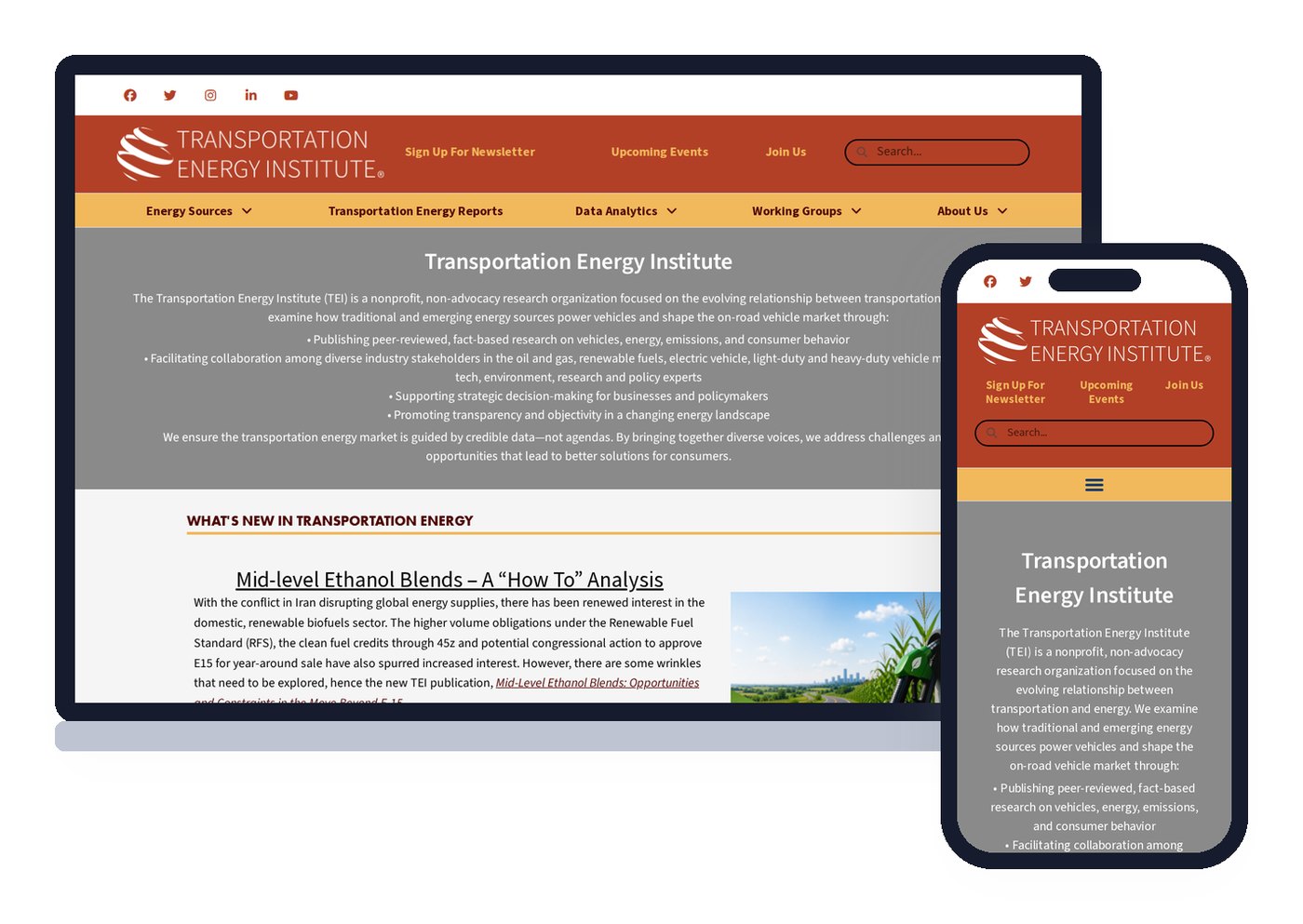
The research organization site shown here is a WordPress build we develop and support, with report pages, data sections and working group content organized so staff publish on their own. Our developers work side by side with our WordPress web design team, so design and code are planned together.
WHAT WE BUILD
Custom WordPress development services
Custom post types and fields
Structured content for reports, listings, team members, events, products or anything you publish often.
Custom plugins
Features built as clean, update-safe plugins instead of fragile edits to a theme.
API integrations
Connections to CRMs, ERPs, booking systems, payment providers, MLS feeds and data sources.
Performance optimization
Database, caching, image and code work for fast pages and strong Core Web Vitals.
Security hardening
Secure code, access control, login protection, updates and monitoring.
Migrations and rebuilds
Moves from other platforms and rebuilds of aging WordPress sites without losing rankings.
WHY WORDPRESS
Why build custom functionality on WordPress?
Beth Guide has said it in classes for years: if you are serious about internet marketing, WordPress is the way to go. Google understands it, the SEO tools are mature and you own your site outright. Closed builders such as Wix, Squarespace and Weebly limit what you can change, and when you outgrow them you start over.
One distinction trips up a lot of owners. WordPress.org is the free, open source software you install on your own hosting. WordPress.com is a commercial hosted service with its own limits. Custom development means WordPress.org on hosting you control, so nothing stops the site from doing what your business needs.
Ownership is also why we keep custom features in plugins. Your theme can change in a redesign years from now, and the custom report library, calculator or integration keeps working because it never lived in the theme.
PLUGINS DONE RIGHT
How many plugins are too many on a WordPress site?
Owners ask this all the time. Beth’s answer is that there is no magic number. You can install one bad plugin and cripple everything, or install a hundred and never have a problem. Quality, weight and overlap matter far more than the count.
She tells a story from years ago about a site where someone kept adding plugins, until one of them was asked to bill 4,000 customers at once while also running the website. The whole site ground to a halt. The plugin was not built for the job, and nobody had asked whether the website was the right place to do it.
That is the judgment a developer brings. On a typical audit we:
- Find plugins that do the same job twice and remove the extras.
- Identify heavy plugins that slow every page and replace them with lighter options.
- Check that premium plugins, such as form, builder and security tools, are licensed and updating.
- Move work that does not belong on the website, such as large billing runs or data processing, to the right system.
- Replace fragile stacks of small plugins with one clean custom plugin when it simplifies the site.
The result is a site that is faster, easier to update and less likely to break. For more on picking tools, see how to get WordPress set up for business websites.
THE CASE FOR VERTICAL WEB ON WORDPRESS DEVELOPMENT
Developers who also run the servers
We teach this
Beth Guide teaches WordPress and SEO for the SBA, the University of Houston SBDC, Lone Star College and HCC.
One in-house team since 1998
Designers, developers and hosting engineers on our own payroll in Houston. No offshore code in your site.
Code you own
Documented, standards based code that belongs to you. No lock-in and no mystery plugins.
HOW WE DEVELOP
Our WordPress development standards
WordPress coding standards
Code that follows WordPress conventions so any qualified developer can understand it.
Staging first
Every change is built and tested on a staging copy before it reaches your live site.
Plugins over theme hacks
Custom functionality lives in plugins, so theme updates and redesigns do not erase it.
Documentation
Clear notes on what was built, how it works and how your team uses it.
Least privilege access
Admin roles and permissions set carefully, so staff can do their jobs without risky access.
Update friendly
Built on WordPress APIs so core and plugin updates install cleanly.
WHAT IT CONNECTS TO
Integrations and related services
Most custom development projects connect WordPress to something else. Common examples include syncing form leads into a CRM, pulling inventory and pricing from an ERP, displaying MLS listings through IDX and MLS integration, connecting booking and payment systems and automating routine office tasks through business automation.
Online stores get their own development track. When WooCommerce needs custom checkout steps, configurators or wholesale pricing, our ecommerce web development team handles it.
Custom code runs best on hosting tuned for it. We host the sites we develop on our own WordPress hosting, so the developer who wrote the code can also see the server it runs on. That shortens every troubleshooting call and removes the finger pointing between a developer and a separate host. For larger projects outside WordPress, see our full web development services.
TAKING OVER A SITE
What happens when we inherit a WordPress site?
Many development clients come to us with a site someone else built. The original developer moved on, the agency closed or the freelancer stopped answering. The site still works, mostly, but nobody knows what is holding it together.
We start every takeover with an audit, not a sales pitch. We get admin and hosting access, back up the whole site, then review the theme, every plugin, any custom code, the server setup and the security history. We look for abandoned plugins that no longer get updates, edits made directly to theme files, hard coded passwords, outdated PHP and anything that would break on the next WordPress update.
You get a plain English report in three parts: what is solid and should stay, what is risky and should be fixed soon and what can wait. Then we fix the urgent items first, on a staging copy, and move the site to stable hosting if it needs it.
The goal is a site your business can depend on again, with documentation and shared credentials stored safely, so you are never stuck in the same spot. If we ever part ways, the next developer gets a clean, well documented handoff.
Theme choices
Custom WordPress theme development vs a prebuilt WordPress theme
A WordPress theme controls how your site looks: the layout, the style, the fonts and the way each component sits on the page. A prebuilt theme from a marketplace is fast to start with, but it usually ships with features you will never use, extra JavaScript and CSS on every page, and design limits that show up the first time you want something different.
For most business sites we build on Astra, a light and well-supported WordPress theme, with Elementor Pro for page layout and a child theme for your brand’s style. That gives you a fast site you can edit yourself, built on code that thousands of developers know. Custom theme development from scratch makes sense when the design is central to your brand, when the site has unusual templates, or when performance has to be squeezed further than a general theme allows.
Either way, the rule is the same: the theme handles the look, and custom features live in plugins. That separation is what lets your site change its style in a redesign without losing the report library, the calculator or the integration your team depends on. Our WordPress web design team handles the visual side, and our developers handle the code underneath.
How a project runs
Custom WordPress website development process: requirements, testing and deployment
Every custom WordPress website development project starts with requirements. What does the site have to do, for which users, on which devices? What systems does it connect to? Who will edit it, and how often? We write those down and agree on them before anyone writes code, because most project problems come from a requirement nobody said out loud.
Next is the build on a staging copy, never the live site. Developers write the code, the design team checks it against the layout, and the SEO team checks headings, schema and speed. Testing covers every major browser and device, forms and payment steps, user roles, and what happens when WordPress core and plugins update. We test the user experience too: can a first-time visitor find what they came for?
Deployment happens when the testing is done, with a full backup taken first so the change can be rolled back. You get documentation of what was built, where the files live and how your team uses it. You work directly with the developers and designers doing the work, not a sales layer, because the whole development team is in-house.
Budget and scope
How much does custom WordPress development cost?
The cost of custom WordPress development depends on scope: how many templates, how many custom features, how many integrations and how much content needs to move. A site that needs a custom post type and a CRM connection is a much smaller project than a member portal with payments and an ERP sync.
We quote in writing after a review of the site and the requirements. If the scope changes mid-project, which happens, we tell you what the change will cost before we do the work, so there are no surprises on the invoice. Sometimes the honest answer is that an existing plugin does the job well enough, and custom code would cost more than it saves. We will tell you that.
Think about the long-term cost, not just the build. Well-documented, standards-based code costs less to maintain and is easier to scale, because any qualified developer can work on it. Fragile code saves money once and costs money every update after. Scalability and efficiency are built in at the start, or paid for later.
The platform question
Is WordPress still worth it in 2026?
Yes, for most business websites. WordPress is open source, it runs a large share of the web, and you own your files and your content. Google reads it well, the SEO tools are mature and there is a large pool of developers who know it. You can move to a new host at any time without rebuilding.
Some people move away from WordPress because their site became slow or broke after updates. In almost every case we see, the cause was a heavy theme, too many overlapping plugins or edits made directly to theme files, not the platform itself. Others move to closed builders because they want one monthly bill. That works until they outgrow it, and then they start over. If you want to learn the basics yourself, our episode on getting started with WordPress is a good place to begin, and our article on why a CMS is a must for any website covers the bigger picture.
QUESTIONS
Custom WordPress development questions
It is the engineering side of a WordPress site: custom post types and fields, custom plugins, API integrations, performance tuning, security hardening and the code that makes the site work the way your business does. It goes beyond choosing a theme and installing plugins.
When the site has to do something themes and off the shelf plugins cannot do cleanly: a custom content structure such as reports or listings, a connection to a CRM or ERP, a member area, a calculator or a site that has to stay fast with thousands of pages. If a designer is stacking plugins to fake it, you need a developer.
There is no magic number. One poorly built plugin can cripple a site, and a hundred well built ones can run fine. What matters is quality, overlap and weight. We audit plugins, remove the ones that duplicate each other and replace fragile combinations with one clean custom plugin when it makes sense.
Not if it is built correctly. We follow WordPress coding standards, keep functionality in plugins instead of theme edits, test on a staging copy and use WordPress APIs rather than shortcuts, so core and plugin updates do not erase or break the work.
You do. Custom plugins and theme code we write for your site are yours, documented so another developer could pick them up. We do not lock clients in with code only we can read.
Yes. We start with an audit of the theme, plugins, custom code, hosting and security, then give you a plain list of what is solid, what is risky and what should be fixed first.
Usually because their site became slow or fragile from a heavy theme, too many plugins or direct theme edits. A clean build with a light theme and custom features in plugins solves most of those problems without leaving the platform.
Yes. Our designers, developers and hosting engineers are all in-house, so you talk with the people doing the work on your project.
We put the requirements in writing before the build. If something changes, we tell you what it will cost and how it affects the project before we do the work.
When the project calls for it. Most business sites are best served by Astra with Elementor Pro and a child theme for brand style. A fully custom theme makes sense for unusual templates or strict performance needs.
Need your website to do more?
Request a free website audit. We will review your theme, plugins, custom code and speed, then tell you plainly what to fix, what to replace and what to leave alone.
Galleria 713-703-3030 | Kingwood 281-852-8253 | info@verticalweb.com
No related posts.