

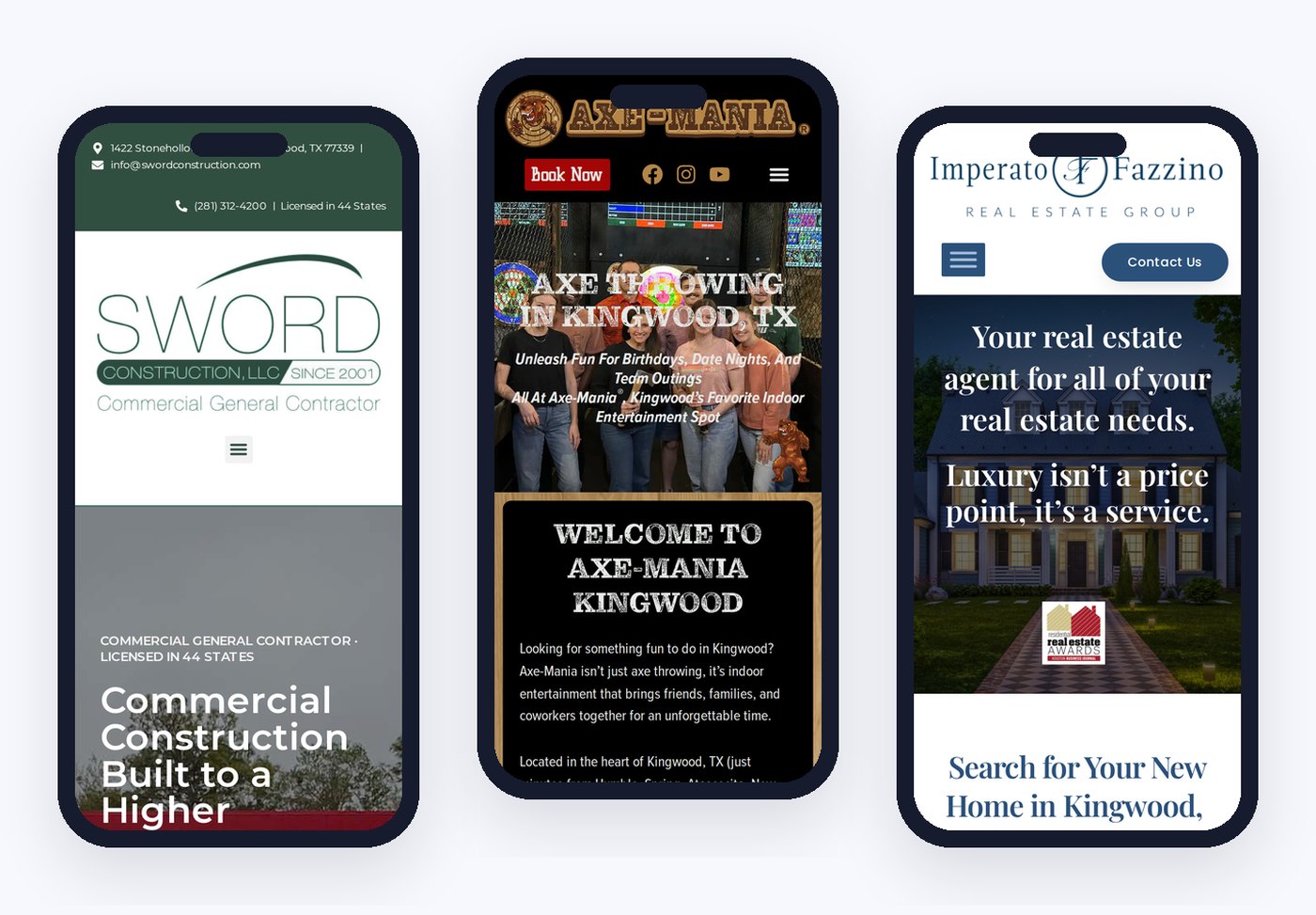
Custom WooCommerce Development
Ecommerce Web Development for Stores That Need More
Custom ecommerce development for businesses that have outgrown an out-of-the-box store: quote carts, B2B pricing, integrations, custom product builders and performance work, built in-house on WooCommerce.
Galleria 713-703-3030 | Kingwood 281-852-8253
Beyond the Template
When a Standard Online Store Is Not Enough
Most online stores start with a theme and a handful of plugins, and that works until the business needs something the store was never built to do. A rental company needs customers to build a quote instead of paying up front. A distributor needs customer-specific pricing and net terms. A manufacturer needs products configured from options. A growing store needs its inventory, accounting and shipping systems talking to each other.
That is where ecommerce web development comes in. Development is the engineering behind the store: custom functionality, integrations, data, performance and security. Design decides how the store looks and feels; development decides what it can do and how reliably it does it.
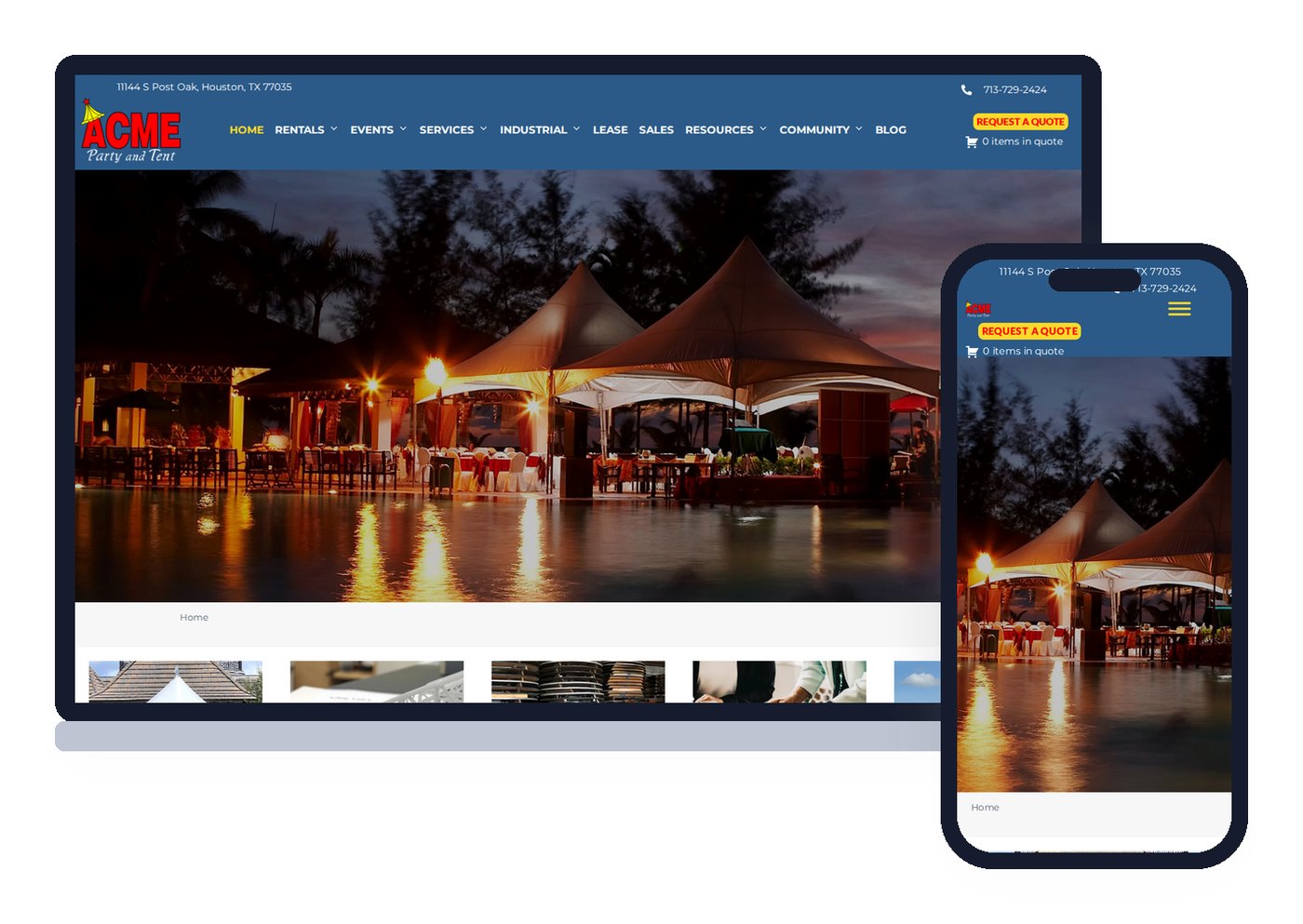
The site above is ACME Party and Tent, where customers add rental items to a custom quote cart and request a quote instead of checking out. We build and support ecommerce functionality like that in-house on WooCommerce, alongside our ecommerce web design team, so design and development are planned together.
What We Build
Custom Ecommerce Development Services
These are the development projects we take on most often for growing online stores.
Quote carts and request for quote
Let customers build a list and request pricing instead of checking out, with quotes routed to your team.
B2B and wholesale features
Customer-specific pricing, tiered pricing, net terms, account approval and purchase orders.
Product configurators
Custom options, add-ons and calculated pricing for configurable and made-to-order products.
Integrations
Connections to ERP, inventory, accounting, CRM, shipping and marketing systems where they provide an API.
Migrations and data
Moving products, customers and orders from another platform, with clean data and redirects.
Performance and scaling
Speed work for large catalogs, database optimization, caching and hosting tuned for WooCommerce.
How We Develop
Our Approach to Ecommerce Web Development
Custom development should make your store more reliable, not more fragile. These principles guide every build.
Plan before code
We document requirements, edge cases and integrations before development starts.
Extend, do not fight, WooCommerce
We build on WooCommerce’s standard hooks and data so updates stay safe.
Test on staging
Every change is built and tested on a staging copy before it touches your live store.
Security first
Secure code, least-privilege access and careful handling of customer and payment data.
Documented work
Clear notes on what was built and how it works, so your store is never a black box.
Update-friendly
Custom code kept separate from themes and plugins so routine updates do not break it.
We also tell you when not to build. Many needs can be met with a well-supported plugin configured correctly, and that is often faster to set up and less costly to maintain than custom code. We recommend custom development only where it clearly pays for itself.
Common Projects
Ecommerce Development Projects We Handle
Every store is different, but these projects come up again and again.
Custom checkout flows
Checkout steps, fields and rules tailored to how your customers buy.
Large catalog management
Bulk imports, product data cleanup, attributes and filtering for thousands of products.
Rentals and bookings
Date-based availability, deposits and rental quotes.
Subscriptions and memberships
Recurring orders, member pricing and gated content.
Shipping and fulfillment rules
Custom shipping rates, freight quotes, pickup and warehouse logic.
Reporting and analytics
Custom reports and ecommerce tracking that show what drives revenue.
Not sure whether you need design, development or both? Start with our ecommerce web design overview or a free website audit, and we will tell you where your store’s biggest opportunities are.
Who We Build For
Ecommerce Development for Growing Businesses
We work with businesses whose stores need to do more than a template allows.
Manufacturers and distributors
B2B pricing, quotes, catalogs and ERP integration.
Medical and industrial suppliers
Large catalogs, specs and professional buyers.
Rental companies
Quote carts, availability and deposits.
Custom and made-to-order products
Configurators, proofs and production workflows.
Retailers with physical stores
Inventory sync, local pickup and in-store integration.
Stores leaving other platforms
Migration to WooCommerce with rankings protected.
Development and SEO
Ecommerce Development That Protects Your Search Traffic
Development work can help or hurt your search visibility. Faceted filters can create thousands of duplicate URLs, slow queries can drag down Core Web Vitals and a careless migration can erase years of product and category rankings.
We build with search in mind: clean URL structures, controlled filtering, fast database queries, product and review schema and redirect maps for anything that moves. That foundation supports ongoing SEO services for your store.
Accurate, structured product data also helps AI search engines understand and recommend your products.
Integrations
Systems We Connect to WooCommerce
The right integrations remove manual work and errors from your operations.
ERP and inventory
Stock, pricing and orders synced with your ERP or inventory system.
Accounting
Orders and payments flowing into your accounting software.
Payments
Payment gateways, saved cards and wallets where your provider supports them.
Shipping and freight
Carrier rates, freight quotes and label printing.
CRM and email
Customer data and order events in your CRM and email tools.
Analytics
Ecommerce tracking and custom dashboards.
Every store we build runs on ecommerce hosting we manage ourselves, so the team that writes the code also keeps the store fast, updated and backed up.
Development vs Design
Ecommerce Web Development and Ecommerce Web Design: What Is the Difference?
Design
How the store looks and feels: layout, navigation, product pages and the shopping experience.
Development
What the store can do: custom features, integrations, data, performance and security.
Both, in-house
One team plans both together, so features and experience fit from the start.
Businesses often ask for a website redesign when what they really need is development, or the reverse. A store that looks dated but works well may only need design. A store that looks fine but forces staff to rekey every order into another system needs development. Many stores need some of each.
Because our designers and developers work side by side, we can scope exactly what your store needs, avoid paying for work that does not move the business forward and deliver features that look and work right the first time.
Choosing a Platform
WooCommerce, Shopify, BigCommerce or Magento: Choosing an Ecommerce Platform
WooCommerce
Open source on WordPress. Full ownership of your store, code and data, strong SEO control and almost unlimited customization. You need good hosting and a development partner.
Shopify
A hosted platform that is quick to launch with a large app ecosystem. Less control over URLs, checkout and data, and costs grow with apps and transaction fees.
BigCommerce and Magento
BigCommerce is hosted with strong built-in B2B features. Magento, now Adobe Commerce, is powerful for very large catalogs but carries higher development and infrastructure costs.
Every ecommerce platform involves tradeoffs, and the right solution depends on your products, your customers, your team and your growth plans. Hosted platforms make setup simple but limit how far you can customize, and apps can add monthly costs and conflicts. Open-source platforms give you more control but require a partner who can build and maintain them well.
We build on WooCommerce because it gives most small and mid-size businesses the best balance of ownership, flexibility and search visibility, and because it keeps your store and your content marketing in one place. If another platform is a better fit for your business goals, we will say so plainly rather than force every project onto the same tool.
Architecture and Infrastructure
Building a Store Architecture That Supports Growth
Clean data architecture
Product attributes, categories and customer data structured so the store stays fast and reports stay accurate as it grows.
Infrastructure sized for your store
Hosting, caching and database tuning matched to your traffic, catalog size and seasonal peaks.
Integration-ready design
Systems connected through stable APIs, so new tools can be added without rebuilding the store.
Growth exposes weak architecture. A store that runs fine with 200 products and a few orders a day can slow to a crawl with 20,000 products, heavy filtering and a holiday sales spike. We design the underlying architecture, from how products and variations are stored to how searches and filters query the database, so performance holds up as sales grow.
Infrastructure matters just as much. We host WooCommerce stores on servers we manage and tune specifically for ecommerce workloads, with caching that respects carts and checkouts, regular backups and monitoring. The result is a store that supports your sales goals and a user experience that stays fast when it matters most.
How We Work
Our Ecommerce Development Process
1. Discovery and requirements
We document your products, workflows, systems and goals, then write a requirements document you approve.
2. Build on staging
Development happens on a staging copy of your store, with regular check-ins so you see progress.
3. Test, launch and support
We test every workflow, launch carefully, monitor the live store and support you after launch.
Clear requirements are what keep ecommerce development on time and on budget. Before any code is written, we agree on exactly how each feature should behave, including the edge cases that tend to cause trouble later, such as partial shipments, backorders, tax rules and customer-specific pricing. After launch, we stay involved with maintenance, updates and new features as your business grows.
Planning Your Project
Budget, Timeline and Strategy for Your Ecommerce Development Website
Every ecommerce development website project starts with strategy: who you need to reach, what you want them to do and what your competitors already offer. That strategy shapes the page structure, the calls to action and the content we write. Custom development projects start with a written requirements document so everyone agrees on what will be built.
Development budgets depend on the features, integrations and data work involved, and on how much existing code or data needs to be cleaned up first. Timelines depend most on API access to your other systems and on testing real order scenarios.
After launch, we monitor orders and integrations closely, then handle updates, fixes and new features through ongoing development support.
How We Work
Our Web Design Process
1. Discovery
We learn how your customers choose, what your best jobs are and what your current site and search data show.
2. Plan and wireframe
Every page is mapped to a search and a next step, then wireframed around the calls to action.
3. Design
Phone-first design in your brand, with real photos of your team and your work wherever we can.
4. Build and write
WordPress and Elementor Pro, copy written for your buyers, plus SEO, schema and call tracking.
5. Launch and grow
We test on real devices, keep any URLs that already rank, launch, and improve from real data.
FAQ
Ecommerce Web Development Questions
It is the engineering behind an online store: custom functionality, integrations with other systems, data migration, performance and security. Ecommerce web design covers how the store looks and how shoppers move through it.
WooCommerce is our primary platform because it gives you ownership, flexibility and strong SEO control. If your business needs a different platform, we will tell you.
Yes. We build request-for-quote carts where customers add items and submit a quote request, like the ACME Party and Tent site, with quotes routed to your team.
In many cases, yes, when the system provides an API or a supported connector. We confirm what is possible during planning.
It depends on the features and integrations involved. We write a requirements document and give you one number in writing before development starts.
We build on WooCommerce’s standard hooks and keep custom code separate from themes and plugins, and we test updates on staging before they go live.
Yes. We start with a review of the current code, plugins, hosting and data, then recommend what to keep, fix or rebuild.
Let's Build the Store Your Business Needs
Tell us what your store needs to do that it cannot do today. We will scope it, price it in writing and build it in-house.
Galleria 713-703-3030 | Kingwood 281-852-8253 | info@verticalweb.com
Keep Exploring
Related Pages
No related posts.