
WEB DESIGN FOR MANUFACTURERS AND INDUSTRIAL COMPANIES
Manufacturing Website Design That Generates RFQs
Websites for manufacturers, machine shops, fabricators, molders and industrial suppliers that explain capabilities in the detail engineers want, earn their trust and turn research into requests for quote.
Galleria 713-703-3030 | Kingwood 281-852-8253
ENGINEERS RESEARCH FIRST
How do buyers find and qualify manufacturers online?
Engineers, buyers and procurement teams do most of their supplier research before they contact anyone. They want to know exactly what you can make, which materials and tolerances you hold, what certifications you have, which industries you serve and how to send a drawing.
Beth Guide puts it bluntly to manufacturers who think their business runs on relationships: anybody under 35 who needs what you make is going to the internet long before they ask who knows you. If your site cannot answer them, they quote with someone else.
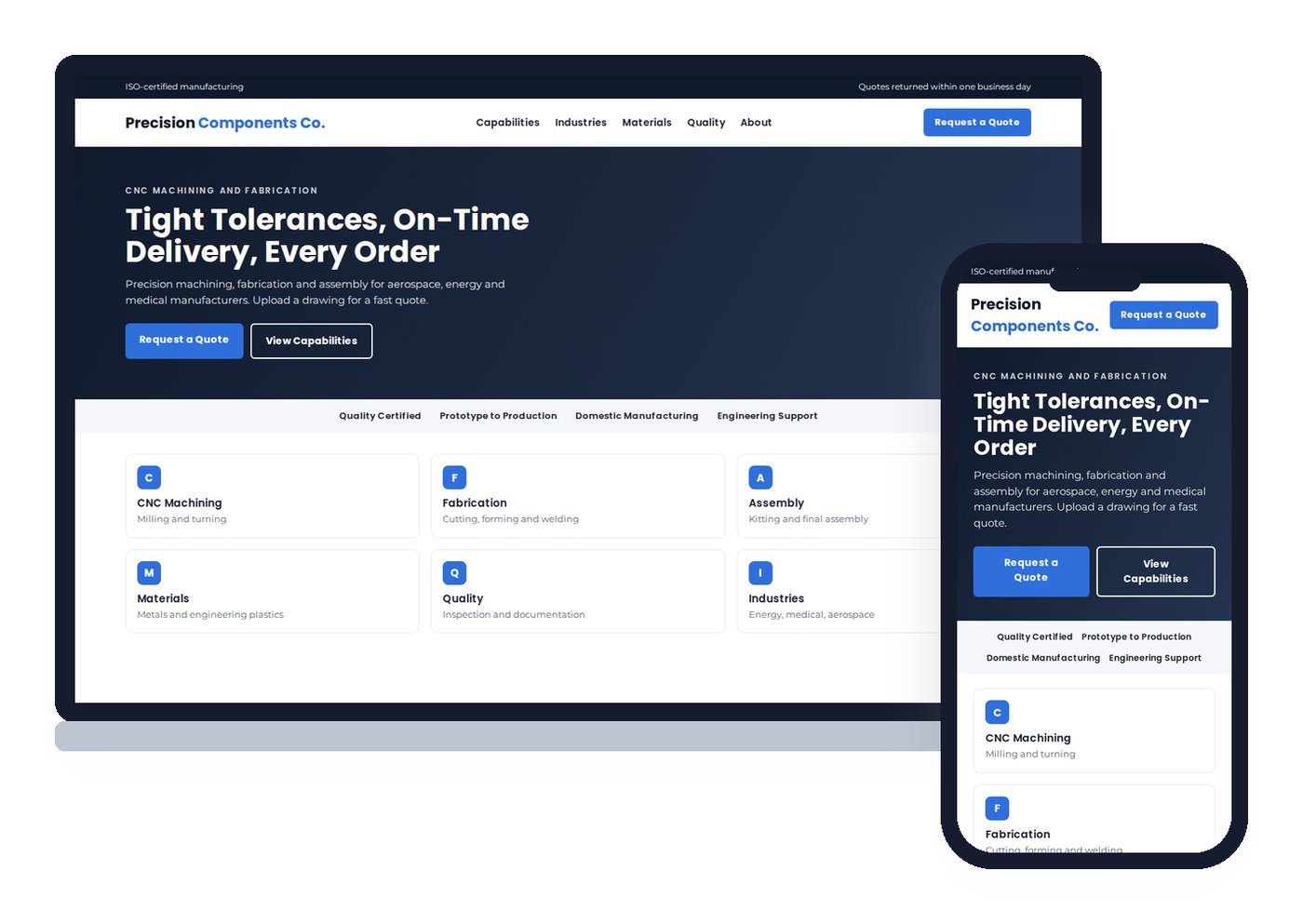
We design manufacturing sites that read like a capabilities statement and work like a sales engineer. Our team works out of offices in the Galleria, Kingwood and Drake Technology Park in Cypress, so industrial clients are familiar ground. Every site is built on WordPress so your team can add capabilities and case studies.
WHAT EARNS AN RFQ
What engineers and buyers check first on a manufacturer's website
Capabilities in detail
A page for each process, such as CNC machining, molding, fabrication or finishing, with size ranges and tolerances.
Materials
The metals, plastics and composites you work with, including the hard ones that set you apart.
Certifications
Quality systems and registrations you actually hold, with dates and scope stated accurately.
Equipment list
Machines, capacities and inspection equipment. Engineers read this closely to judge fit.
Industries and examples
Aerospace, oil and gas, medical, semiconductor or whatever you serve, with project examples you can share.
An RFQ form that takes files
Upload STEP, DWG or PDF drawings, enter quantities and dates and reach the right estimator.
NICHE KEYWORDS
Is SEO worth it for a niche manufacturer?
Many manufacturers look at keyword tools, see that their most important terms get 20 or 30 searches a month and decide SEO is not for them. Beth sees it the other way. She works with a resin manufacturer whose niche terms would never justify the spend by volume alone, yet the people searching them convert at extremely high rates. Every one is a buyer with a real project.
Industrial search works because it is specific. Engineers do not search “manufacturer.” They search the process, the material, the part and the industry together:
- Precision machining of PEEK or Torlon parts
- Low volume injection molding for medical devices
- ASME code pressure vessel fabrication in Texas
- Waterjet cutting of thick stainless plate
Each of those deserves a page that answers it with real technical detail. We map the searches before design begins, then build capability, material and industry pages around them. Our SEO services team continues that work after launch, and for urgent pipeline, industrial PPC management can target the exact process and material terms your estimators want.
PAGES THAT RANK
What pages should a manufacturing website have?
Most manufacturing sites sum up their capabilities in one paragraph and a photo of the shop floor. That gives Google one page to rank for dozens of different searches, and it gives engineers nothing to evaluate.
The structure we build:
- Capability pages for each process, with size limits, tolerances, finishes and secondary operations.
- Material pages for the materials you know best, especially the difficult ones.
- Industry pages that explain how you support each sector’s standards and documentation.
- Quality page with certifications, inspection equipment and traceability.
- Equipment page organized by process and capacity.
- Case studies that describe the problem, the approach and the result, within what customers allow you to share.
- Careers page, because skilled machinists and technicians are as hard to win as customers.
Breadcrumbs and clean internal links tie it together so search engines and AI engines understand which pages belong to which capability. Beth explains that structure in website structure for AI search.
THE CASE FOR VERTICAL WEB ON MANUFACTURING WEBSITES
A web team that speaks shop floor
We teach this
Beth Guide teaches SEO for the SBA, the University of Houston SBDC, Lone Star College and HCC. Your team gets the reasoning, not just a deliverable.
One in-house team, no offshore
Design, development, hosting and SEO by our own staff since 1998. Your drawings and specs never pass through an offshore contractor.
Close to industry
Offices in the Galleria, Kingwood and Drake Technology Park in Cypress, close to the manufacturers we serve.
SELLING DIRECT
Should a manufacturer sell products on its website?
Some should. Stock shapes, standard components, replacement parts and consumables can sell well online, and engineers appreciate being able to order a small quantity without a phone call. A B2B store can show account pricing, accept purchase orders and handle tax exempt buyers.
The caution Beth raises is channel conflict. If distributors sell your products, a manufacturer that suddenly undercuts them online can damage relationships that took years to build. Common solutions include a dealer locator, account only ordering for approved customers or online sales limited to products your channel does not carry.
If ecommerce fits, see our ecommerce web design page. If your customers buy through dealers, our distributor website design page shows how to support that channel.
TRUST AND SECURITY
Protecting drawings, specs and controlled data
Manufacturing websites handle sensitive files. RFQ uploads can include proprietary drawings, and some shops work under ITAR or other export controls. The website has to respect that.
- Secure uploads. Files go to protected storage or directly to your team, not into a public folder or an open email chain.
- No controlled data on public pages. You can state registrations and capabilities without publishing technical data. Your compliance team approves the wording.
- Who touches the code. Our developers are W2 employees in the United States. Ask any web vendor the same question.
- Hosting you can audit. SSL, updates, daily backups and monitoring on servers our own team manages. Larger sites run on managed cloud hosting.
Many industrial clients are also in the energy sector. If that is you, see our oil and gas website design page for the specific needs of upstream, midstream and service companies.
OUR PROCESS
How we build a manufacturing website
1. Shop floor interview. We talk with your engineers, estimators and sales lead, not just marketing. They know which jobs make money, which materials scare competitors off and which questions buyers ask on every call. That becomes the page list.
2. Technical keyword map. We match each capability, material and industry to the real terms engineers search, including the low volume, high value ones.
3. Content written with your experts. Our writers draft capability pages from those interviews, then your team checks every tolerance, size limit and certification for accuracy. Nothing technical goes live without your sign off.
4. Photography and proof. Real photos of your machines, parts and people do more than any stock image. We plan a shoot or use what you have, and we build case studies around the projects you are allowed to share.
5. Launch, track and improve. We track RFQs, file uploads and calls by page, so you can see which capabilities bring in work and where to add content next.
From brochure to pipeline
Manufacturing website redesign: how to turn a digital brochure into a lead and conversion tool
Most manufacturing company websites were built as a digital brochure: a homepage, an about page, a photo of the shop and a contact form. That made sense when the sales team did all the selling. Today the prospect has done most of the evaluation before the first conversation, so the website has to carry part of the sales job.
A manufacturing website redesign starts with the question every visitor brings: can this shop make my part, and can I trust them with it? The pages that answer that question earn leads. The pages that do not are where buyers leave. We rebuild around a few rules:
- Clear calls to action on every page: request a quote, upload a drawing or talk to an engineer, not just a lonely contact link.
- Intuitive navigation: capabilities, materials, industries and quality in the main menu, so an engineer finds the right page in one click.
- Clarity over slogans: say what you make, in what materials, to what tolerances, for which industries.
- Tracked conversion: every RFQ, phone call and file upload measured, so marketing decisions are based on real lead data.
A redesign also has to protect what already works. Pages that rank keep their URLs, and anything we combine gets a 301 redirect. Our website redesign process maps every old page before the new design goes live.
Detail is the sales pitch
Web design for machine shops: product pages, specifications and technical content that convert
Engineers trust evidence, not adjectives. Technical content is what turns a visitor into a lead on an industrial website: specifications, tolerances, material data, application notes, inspection methods and real project examples. The more of that information a page gives, the easier the buyer’s decision making becomes.
For machine shops and fabricators, the product page or capability page should read like an answer to an engineering question. What is the largest part you can run? What tolerances do you hold on that material? What secondary operations do you handle in-house? Which industries have you served with this process? A short case study, a testimonial a customer has approved, and photos of actual parts are the signals that move a prospect from browsing to sending a drawing.
Functionality matters as much as content. Spec sheets should download without a login. RFQ forms should accept large files. Customer portals, when you need them, should give the right people access to drawings and order status without exposing controlled data. If your products are sold through distributors, our dealer and distributor website design page covers locators and catalogs.
Hiring the right team
How do you choose a manufacturing website designer or agency?
Look for an agency that asks about your machines, materials and customers before it shows you a layout. A manufacturing website designer who has never written a capability page will hand you a nice-looking homepage and very little that ranks or converts.
Ask three questions in your evaluation. Can they show you manufacturing or industrial sites they built that rank for process and material searches? Will they write technical content with your engineers, or expect you to supply every word? Who handles hosting, security and support after launch? The answers tell you more about competence than any portfolio.
Our experience comes from working next to industry. We have an office in Drake Technology Park in Cypress, and one in-house team handles design, development, hosting and SEO. If you also need marketing support after launch, SEO services and PPC management keep the user experience and the lead flow improving month after month.
QUESTIONS
Manufacturing website design questions
Detailed capability pages, materials and tolerances you work with, an equipment list, certifications such as ISO 9001 or AS9100 if you hold them, industries served, case studies or project examples and a request for quote form that accepts CAD files and drawings. Engineers want specifics, not slogans.
By answering the exact searches engineers and buyers make: the process, the material, the part type and the industry, such as PEEK machining or low volume injection molding for medical devices. Search volume for those terms is often small, but the buyers are qualified and conversion rates are high.
Rarely. Beth Guide works with niche manufacturers whose best keywords get only a handful of searches a month, yet nearly every one is a real buyer. One qualified engineer who finds you can be worth more than a thousand retail visitors.
Yes. We build quote forms that accept STEP, IGES, DWG, DXF and PDF files, ask for quantities, materials and deadlines and route the request to the right estimator, with secure handling for files that carry export or confidentiality restrictions.
Sometimes. Standard parts, replacement components and stock shapes can sell online. If you also sell through distributors, plan it carefully so you support your channel instead of competing with it, for example with a dealer locator or account-only ordering.
Carefully. You can state registrations and capabilities without publishing controlled technical data. We keep sensitive drawings and specifications behind forms or out of the site entirely, and your compliance team should approve wording on regulated work.
Yes. We inventory every existing page, keep URLs that rank, redirect the rest with 301s and monitor Search Console after launch. Older manufacturing sites often rank for valuable long tail terms that a careless redesign wipes out.
It has to add technical depth, such as capability, material, industry and quality pages, while keeping the URLs that already rank. Most manufacturers also need an RFQ form that accepts drawings and tracking that shows which pages produce leads.
Capabilities with size limits and tolerances, materials, secondary operations, inspection equipment, certifications you actually hold, industries served and project examples customers allow you to share.
Ask to see industrial sites they built that rank, ask whether they will write technical content with your engineers, and ask who handles hosting and support after launch.
Is your website earning RFQs or just sitting there?
Request a free website audit. We will review your capability pages, RFQ path, technical search terms and speed, then show you what is keeping engineers from reaching out.
Galleria 713-703-3030 | Kingwood 281-852-8253 | info@verticalweb.com
No related posts.