
Web Design for General Contractors and Builders
Construction Website Design That Wins Bids
Websites for commercial general contractors, builders and construction companies that show your project portfolio, prove your safety and capacity, and turn owners, architects and developers into bid invitations.
Galleria 713-703-3030 | Kingwood 281-852-8253
Your Website Is Your Prequalification
Owners and Developers Vet Contractors Online First
Before a developer, facilities manager or architect invites a general contractor to bid, someone on their team checks the contractor’s website. They want to see the kinds of projects you build, how big they are, where you work, how you handle safety and whether you look like a company that finishes on time. A thin or outdated construction website can take you off the short list before anyone calls.
Construction websites have a different job than most. The buyers are professional and the projects are large, so the site has to read like a capabilities statement: clear markets, strong project photography, credentials and a simple way to request a bid or submit subcontractor information.
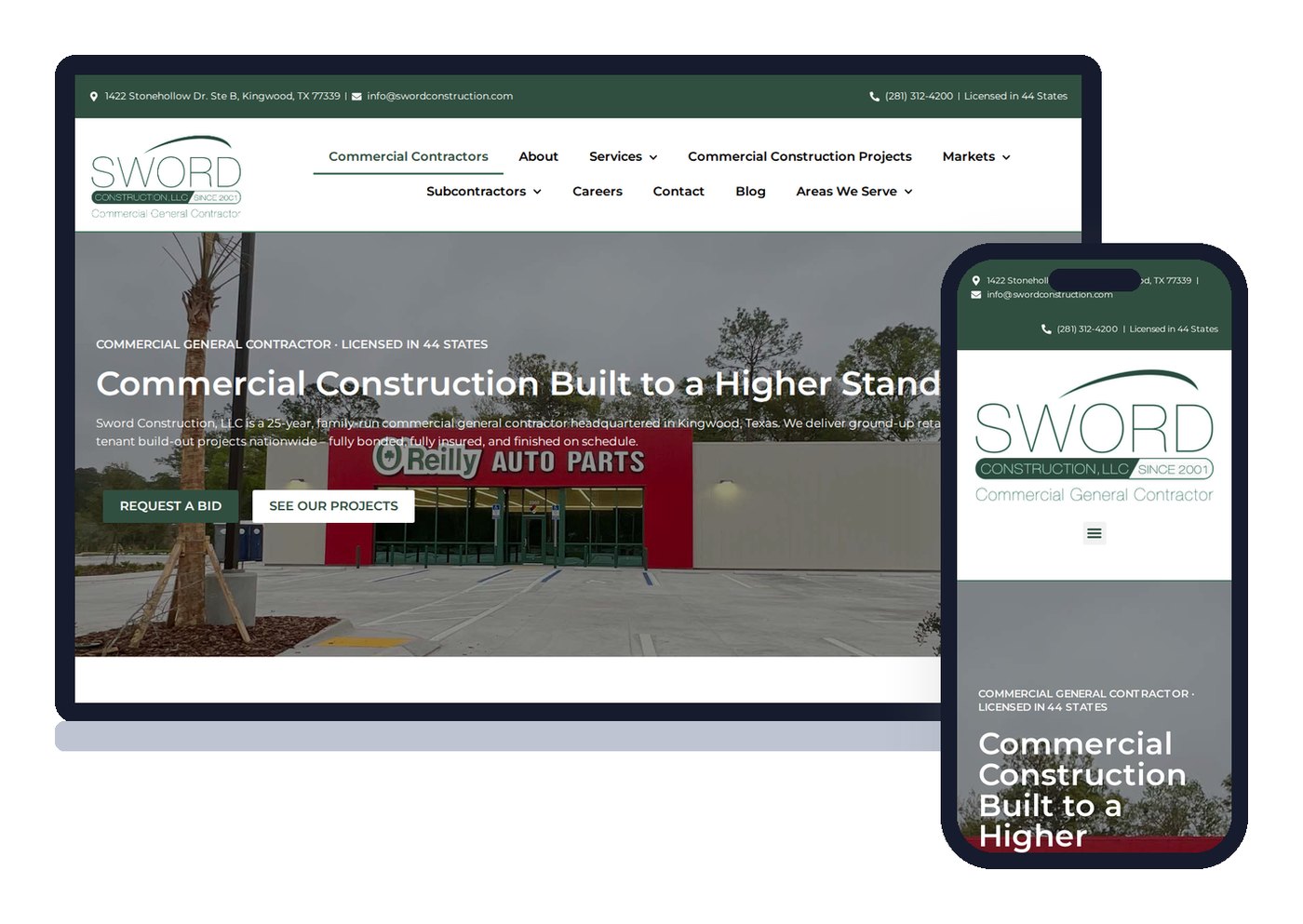
The image above is a real site we built for Sword Construction, a commercial general contractor licensed in 44 states, shown on a laptop and a phone. Every construction website we design is mobile-first and built on WordPress, so your team can add finished projects and news without a developer.
What Buyers Look For
What Earns a Bid Invitation
Owners, developers and architects scan for the same proof points. These are the elements we put up front on every construction company website.
A strong project portfolio
Completed projects with photos, square footage, scope and location, organized by market.
Safety and quality
Your safety program, training and quality control process, presented plainly.
Markets and service area
The project types you build and the states or regions you are licensed and bonded to work in.
Easy bid requests
A clear Request a Bid form that captures project type, location, size and timeline.
Leadership and team
Principals, project managers and superintendents, with experience that builds confidence.
Subcontractor information
A place for subcontractors and suppliers to submit qualifications, which strengthens your pipeline.
Construction Website Best Practices
Design Elements of a Strong Construction Website
The construction websites that win work share these design elements.
Real project photography
Your finished buildings and active job sites, never stock photos of hard hats.
Portfolio filters
Let visitors sort projects by market, such as retail, restaurant, medical or industrial.
A clear positioning statement
Say what you build, for whom and where in the first screen.
Obvious bid and contact paths
Request a Bid and Contact buttons in the header and after every project.
Mobile-first layout
Owners and supers check sites from job trailers and phones.
Credentials in view
Licensing, bonding capacity and safety information where buyers expect them.
Construction companies also need to recruit. Skilled trades, project managers and superintendents research you online before applying, so a careers page with real photos of your crews and a short application helps you hire as well as win bids.
Strong visuals also help your teams. Project managers can send an owner a link to a relevant project page instead of attaching photos, and business development staff can point prospects to a market page that answers most first-meeting questions before anyone sits down. The website stops being a brochure and becomes a sales tool others on your team use every week.
Pages That Win Work
Pages We Build for Construction Companies
A good construction website is organized around the markets you serve and the projects that prove it.
Market pages
A page for each market you build in, like retail, restaurant, healthcare, industrial or tenant build-out.
Project pages
Detailed project write-ups with photos, scope, schedule and results.
Service pages
Pre-construction, general contracting, design-build and construction management.
Service area pages
States and regions you are licensed in, written for owners in those markets.
Careers
Open positions and a short application for trades and project staff.
Subcontractors
Prequalification forms and requirements for subs and suppliers.
If your company already ranks for construction searches, we protect those pages during a redesign. See more of our work in our portfolio.
Who We Design For
Websites for Every Kind of Builder
We design around how your clients buy construction services.
Commercial general contractors
Portfolios, markets and bid requests for owners and developers.
Design-build firms
Process pages that explain design and construction under one contract.
Industrial contractors
Capabilities, safety records and plant or facility project experience.
Tenant finish-out contractors
Fast-turn projects for retail, restaurant and office tenants.
Custom home builders
Galleries, floor plans and a process that reassures homeowners.
Specialty and civil contractors
Concrete, site work, steel and other trades with project proof.
Built to Be Found
Construction Website Design and SEO, Built Together
Owners and developers search for contractors by market and location, like medical office general contractor in Houston or retail build-out contractor. Project and market pages built around those searches bring in the right inquiries.
We build every page with clear titles and headings, organization schema and location details that match your Google Business Profile, which supports local SEO. Project pages are linked to their markets so Google understands the work you do and where.
Buyers also ask AI assistants for contractor recommendations. Detailed project and market pages give AI search engines accurate information about your company to cite.
Features That Work Hard
Built-In Tools for Construction Companies
Your website should collect bid requests and qualified subs while your team is in the field.
Bid request forms
Capture project details and let owners upload plans or scope documents.
Subcontractor prequalification
Collect trade, licensing and insurance details from subs.
Portfolio you control
Add new projects and photos yourself as jobs finish.
Careers and applications
Short applications for trades and management roles.
Lead tracking
See which markets and pages generate bid requests.
Fast, secure hosting
Large project photos that still load quickly on a phone.
Our sites run on WordPress hosting built for Core Web Vitals, managed by the same team that builds them. Want a second opinion first? Start with a free website audit.
Examples That Work
What the Best Construction Company Websites Do Differently
A homepage that sells capacity
The homepage leads with the markets you build in, a few signature projects and a clear Request a Bid button, not a generic slogan over a stock skyline.
Navigation built for owners
Markets, Projects, Services, About, Safety, Careers and Contact. Owners find the proof they need in one or two clicks.
Messaging that sounds like a builder
Plain, confident language about schedules, budgets and communication, the things owners actually worry about.
Look at the construction websites of the firms that win the most work in any market and you will see the same patterns. Their homepage structure puts proof first. Their project pages read like short case studies: the owner’s goal, the challenge, how the team solved it and the finished result. Their navigation is simple and their messaging is specific.
The weaker examples are easy to spot too. They rely on a single gallery with no captions, they hide the bid request form on a contact page, and their about section talks about values without showing a single project. Owners and architects comparing several general contractors at once notice the difference immediately.
Craftsmanship and Credibility
Showing Your Craftsmanship With Imagery and Testimonials
Professional project imagery
Finished-project photography and progress photos show the quality of your craftsmanship better than any description.
Owner and architect testimonials
Short quotes from owners, developers and design partners, placed next to the projects they describe.
Credentials that build trust
Licenses, bonding, safety metrics and association memberships, presented clearly as part of your credibility.
Imagery does most of the selling on a construction website, so it deserves a plan. We organize photos by project and by market, write captions that explain scope and square footage, and make sure images load quickly on every device. Where you have drone footage or time-lapse video of a build, we feature it on the project page.
Testimonials matter just as much in construction as in any service business, but they carry more weight when they come from the right people. A quote from a repeat owner or an architect who has worked with your team on several projects tells the next buyer exactly what they want to know: this contractor finishes well and is easy to work with.
Design That Signals Reliability
Typography, Layout and Professionalism for Construction Firms
Confident typography
Strong, readable type that feels solid and professional, like your buildings.
Clean page sections
Clear sections with room to breathe, so project photos and key facts stand out.
Built for prospects
Every page gives prospects a reason to trust you and an easy way to take the next step.
The design of a construction company website sends signals before anyone reads a word. Clean layouts, confident typography and generous spacing tell visitors your firm is organized and reliable. Cluttered pages, mismatched fonts and low-quality images suggest the opposite, fairly or not.
Your online presence is also part of how owners and developers make decisions about who to invite to bid. When users can quickly scan your markets, open a project that looks like theirs and see who they would work with, they feel confident moving forward. That feeling of professionalism is what turns website visitors into qualified prospects and prospects into bid invitations. The largest firms in the construction industry invest in this for a reason, and a focused site gives smaller and mid-size contractors the same edge in the spaces where they compete.
Planning Your Project
Budget, Timeline and Strategy for a Construction Website
Every construction company website project starts with strategy. We look at the markets you want to grow in, the size and type of projects you want more of, and the competition you face for those bids. That strategy shapes the site structure, the project pages we feature and the calls to action on each page.
The budget depends mostly on the number of markets, project pages and integrations, and on whether we write the content and coordinate photography. The timeline depends mostly on how quickly we gather project details and photos from your team. We give you a written scope, price and schedule before work starts so there are no surprises.
Once the site is live, it becomes the foundation for the rest of your marketing. Project pages support local SEO in the regions you work, and a clean site makes every proposal, email and social post more credible. For general contractors who also want to recruit, the same site becomes your best recruiting tool.
How We Work
How We Build Construction Websites
1. Discovery
2. Structure
3. Design
4. Build
5. Launch and grow
FAQ
Construction Website Design Questions
A project portfolio organized by market, your services, service area and licensing, safety and quality information, leadership and team pages, a bid request form, subcontractor prequalification and a careers page.
It depends on the number of markets and projects, integrations and whether we write the content. We scope your project first and give you one number in writing before work starts.
Yes. We build on WordPress with Elementor Pro so your team can add projects, photos and news without calling a developer.
A clear portfolio, market pages and easy bid requests make it easier for owners to shortlist you, and search-friendly project pages help new buyers find you.
Yes. Specialty and trade contractors need project proof, capabilities and easy contact for general contractors, and we design around that.
Yes. We benchmark your rankings and URLs, keep pages that carry value, map redirects for anything that moves and monitor after launch.
Let's Build a Website That Wins More Bids
Tell us about the markets you build in and the projects you want more of. We will show you what your current site is doing and what it will take.
Galleria 713-703-3030 | Kingwood 281-852-8253 | info@verticalweb.com
Keep Exploring
Related Pages
No related posts.