
WEB DESIGN FOR DENTISTS AND DENTAL PRACTICES
Dental Website Design That Brings In New Patients
Websites for general, cosmetic, pediatric and specialty dental practices that calm nervous patients, show off your team and make booking the next appointment easy from any phone.
Galleria 713-703-3030 | Kingwood 281-852-8253
THE FIRST VISIT STARTS ONLINE
How do patients choose a new dentist?
When someone needs a new dentist, moves into a new neighborhood or has a toothache on a Saturday, they search on their phone. They compare two or three practices, check which insurance you take, look at your team and read reviews, all before they decide who to call.
Dental patients bring a special kind of worry. Many are anxious about treatment, cost or both. A great dental website eases those fears with a warm design, clear information about services and insurance and real photos of a friendly team in a modern office.
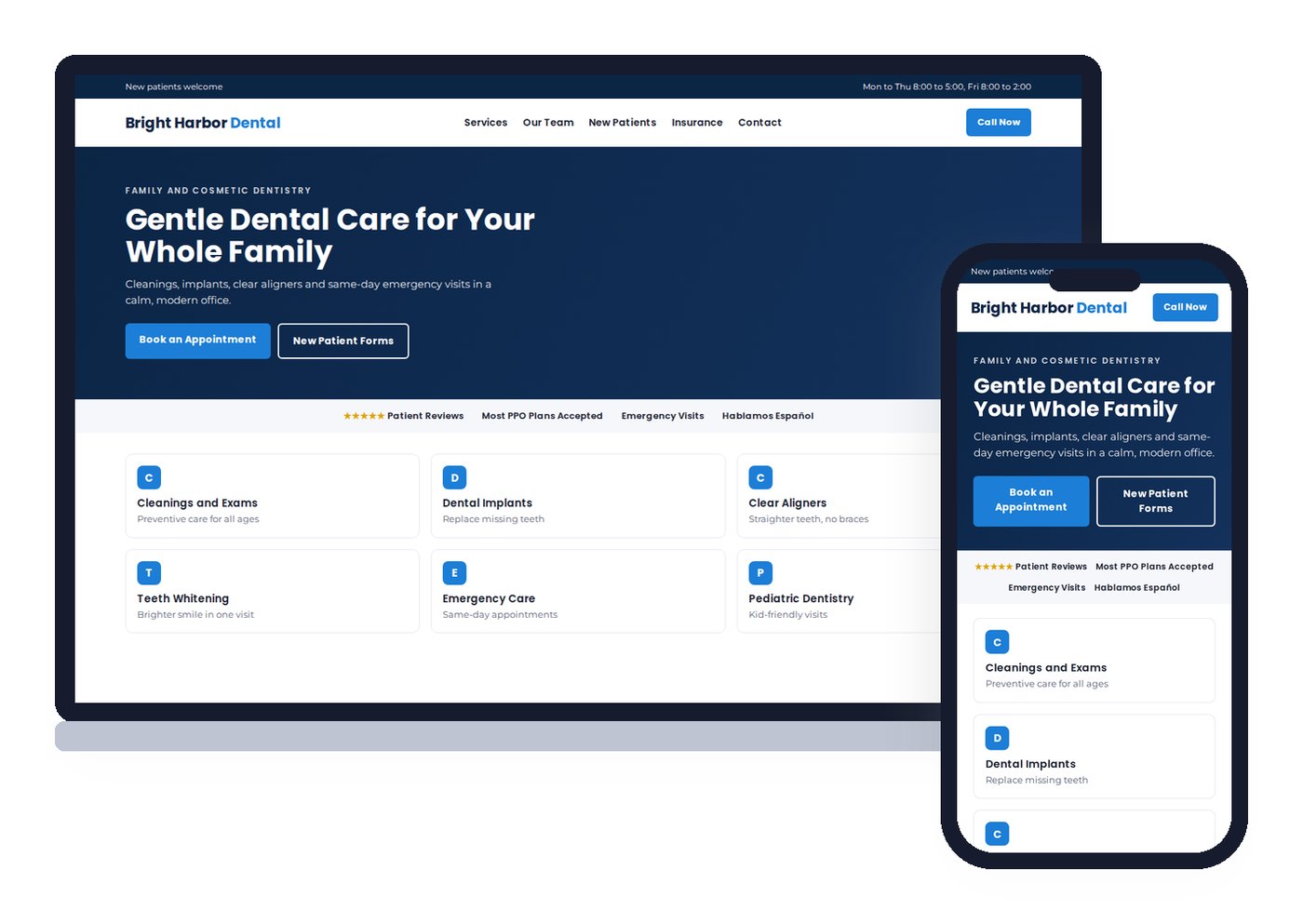
We design dental websites that do that and make booking effortless. Every site is mobile first and hosted on our own WordPress hosting, so it stays fast and secure.
WHAT PATIENTS LOOK FOR
What a new patient needs to see before booking
Services they need
A page for cleanings, crowns, implants, veneers, whitening, Invisalign and emergency care.
Dentists and team
Real photos, credentials and a friendly note for each dentist and hygienist.
Insurance and payment
Plans you accept, membership plans and financing, explained without fine print.
Before and after
Real cases for cosmetic and restorative work, shared with patient permission.
Easy booking
Online scheduling or a short request form, plus a phone number that taps to call.
Location and hours
Address, map, parking, hours and after hours emergency instructions.
PAGES THAT RANK
What pages does a dental practice website need for SEO?
Beth Guide demonstrated this in one of her classes by asking an AI tool what pages a dentist in Kingwood needed to compete. The answer matched what she sees ranking: a home page, about us, services, patient information, a before and after gallery, testimonials, a blog, contact and a map. She agreed with every one. AI tools can summarize what competitors already have. The practice that wins goes further.
The page set we build for most practices:
- Service pages for each high value procedure, such as dental implants, crowns, veneers, Invisalign, root canals, sedation dentistry and emergency care, each answering the questions patients ask.
- New patient page with what to expect, insurance, forms and a first visit special if you offer one.
- Team pages for each dentist, which also capture searches for their names.
- Smile gallery with real before and after cases.
- Patient education articles that answer common questions and support the service pages.
- Location pages for each office, matched to its Google Business Profile.
Most dental searches are local. Our local SEO team manages the profile, categories and listings that put a practice in the map pack, and our guide to getting on Google Maps explains the basics.
HEADINGS THAT TELL GOOGLE
Can someone tell what you do from your headings?
Beth has a simple test she teaches in her series on hiring a web designer. Read your page headings out loud and imagine walking into a room and saying only those words. Would anyone know what you do?
A heading like “Our Commitment to Excellence” tells a stranger nothing. Headings like teeth whitening, inlays and onlays, dental crowns, dental bonding and porcelain veneers tell everyone, including Google, that this is a dentist. “General and cosmetic dentistry in Kingwood” says it in one line.
Many dental templates fail this test. They are built by designers who use headings to make text big and pretty, not to describe the page. We write every H1 and H2 to name the service and, where it fits, the community, because that is how search engines and AI engines decide what a page is about. Read more about it in why web design and SEO go hand in hand.
THE CASE FOR VERTICAL WEB ON DENTAL WEBSITES
A dental website team in your community
We teach this
Beth Guide teaches digital marketing for the SBA, the University of Houston SBDC, Lone Star College and HCC. Dental office managers sit in her classes.
Local offices
Galleria, Kingwood and Cypress offices, so your team can meet ours in person.
No rented template
A custom WordPress site you own, not a dental marketing platform you rent and lose if you leave.
TRUST AND REVIEWS
How does a dental website calm nervous patients?
Dental anxiety is real, and your website is the first chance to address it. The best practice sites do it quietly, with design and content choices that feel like a good chairside manner:
- Real photos. Your team, your operatories and your waiting room, not stock models with impossible smiles.
- Comfort details. Sedation options, comfort amenities and what a visit actually feels like.
- Honest cost information. Insurance accepted, membership plans for uninsured patients and financing for larger treatment.
- Short videos. A dentist explaining a procedure in 60 seconds does more than a page of text.
- Reviews. Patients read them before they read your bio. Ask happy patients to mention the treatment they had.
Our reputation management service helps practices earn reviews steadily and answer the hard ones with care. Recall reminders and reactivation messages through email marketing keep hygiene schedules full.
PRIVACY AND SPECIALTIES
HIPAA, accessibility and specialty practices
Dental websites handle health information whenever a patient fills out a history or sends a question about treatment. General contact forms should ask only for what you need to call back. Health history and records belong in your patient portal or a secure form service, and marketing tags stay off booking pages. Your compliance advisor should confirm your setup, because this is general information, not legal advice.
Accessibility matters too. Readable text, strong contrast, keyboard friendly menus and captioned videos make the site work for every patient, including older adults booking on a tablet.
Specialty practices have their own needs. Pediatric dentists speak to parents with a warmer, playful tone. Orthodontists, periodontists, endodontists and oral surgeons need detailed procedure pages and a referral path for general dentists. Medical practices with similar needs should see our medical website design page.
If your practice already ranks for some searches, a website redesign can refresh it while keeping the URLs and content that bring patients in.
OUR PROCESS
How we build a dental website
1. Look at the competition. We start the way Beth does in class: see what the practices ranking in your area already have, then plan to beat it with better service pages, real photos and clearer answers.
2. Pick the money procedures. Implants, Invisalign, veneers and sedation bring more value than routine cleanings. Those get the deepest pages and the strongest calls to action.
3. Write with the dentist, not around them. Our writers interview the doctors so each page sounds like your practice, then the doctors review for clinical accuracy.
4. Photograph the practice. A half day photo session with your team and office pays off on every page for years.
5. Launch and track. We track calls, bookings and form requests by page, so you can see which services bring in new patients and where to invest next.
Pages that book
Dental landing pages: turning a potential patient into a booked appointment
A dental landing page is a single page built for one service and one kind of patient, such as implants, Invisalign or emergency care. Unlike the homepage, which has to introduce the whole dental clinic, a landing page answers one question completely and asks the visitor to take one step: book, call or request a consultation.
A strong dental landing page has the same elements every time: a headline that names the treatment and the area, a short explanation in plain words, real photos or a video of the dentist, the insurance and payment options, two or three reviews about that treatment, a short FAQ and a booking button that stays visible on a phone. Each element removes one reason a prospective patient might hesitate.
Landing pages are also where paid ads should send people. An ad for dental implants that lands on the homepage wastes the click. One that lands on an implant page with a clear next step converts far better. Our landing page design service builds them for practices running Google Ads.
Keeping it current
How often should a dental practice update its website, and what makes a great dental website in 2026?
Update the content whenever something changes: a new dentist, new technology, new hours, a new insurance plan or a new service. Old team photos and a hygienist who left two years ago tell a potential patient the site, and maybe the practice, is not paying attention. A full redesign usually makes sense when the site no longer works well on phones, loads slowly or no longer reflects the practice.
A great dental website in 2026 tells the practice’s story with real people, makes booking easy from any device, explains costs and insurance clearly, meets ADA accessibility standards so every patient can use it, and builds credibility with reviews, credentials and before and after photos where appropriate. It also answers the questions patients now ask AI assistants, so the practice gets named when someone asks for a dentist nearby.
The user experience matters more than the design trend of the year. Calm colors, readable text, fast pages and an obvious next step do more for conversion than animation. If your practice serves a larger health group, see our medical website design page too.
QUESTIONS
Dental website design questions
At minimum a home page, an about page with the dentists and team, a page for each major service, new patient information with insurance and forms, a before and after gallery, patient testimonials, a blog or patient education section and a contact page with a map. Specialty practices add pages for each procedure they are known for.
By ranking in the map pack and on page one for the services patients search, such as dental implants in Kingwood or emergency dentist near me, and by making it effortless to call or book from a phone. Strong service pages, a well managed Google Business Profile and steady reviews do most of the work.
If your practice management software supports it, yes. Many patients book after hours. If you prefer to control the schedule, an appointment request form with a quick callback works well too.
Yes, whenever the site collects health information. Keep general contact forms short, send health history and records through your patient portal or a secure form service and be careful with tracking tags on booking pages. Your compliance advisor should confirm your setup, because this is general information, not legal advice.
Pediatric sites speak to parents and need a warm, playful tone with clear first visit information. Orthodontists, periodontists, endodontists and oral surgeons need detailed procedure pages, referral information for general dentists and before and after cases.
Yes. We keep URLs that already rank, redirect any that change, carry over the content that works and check Search Console after launch. Practices that lose rankings in a redesign usually lost pages or URLs, not because of the new design.
Update content whenever your team, services, technology, hours or insurance change. Plan a redesign when the site no longer works well on phones, loads slowly or no longer reflects your practice.
It should be. Accessible design, such as readable text, image descriptions and keyboard-friendly forms, lets every patient use the site and lowers legal risk.
A page built for one treatment, such as implants or Invisalign, that answers the patient’s questions about it and asks for one step, such as booking. It is the best destination for paid ads.
Is your website filling your schedule?
Request a free website audit. We will check your service pages, map pack signals, booking path and mobile speed, then tell you plainly what will bring in more new patients.
Galleria 713-703-3030 | Kingwood 281-852-8253 | info@verticalweb.com
No related posts.