
HEALTHCARE WEB DESIGN IN HOUSTON
Medical Website Design for Practices and Clinics
Patients choose a provider online before they ever call. We design medical websites that answer their questions, earn their trust and make it easy to request an appointment, on a phone, in the waiting room or at home.
Galleria 713-703-3030 | Kingwood 281-852-8253
THE NEW FRONT DESK
What do patients look for on a medical website?
Before a new patient calls, they look you up. They want to know whether you take their insurance, whether you treat their condition, how far the office is and how fast they can be seen. Your website answers those questions first, usually on a phone.
A medical website has a harder job than most business sites. It has to feel warm and professional at the same time, explain care without jargon, work for patients of every age and ability and handle sensitive information carefully. It also has to take routine calls off your front desk.
We build healthcare sites on WordPress, so your team can update providers, hours and services without a ticket. Every site is planned with SEO from the first wireframe and hosted on our own WordPress hosting, so the people who built it keep it fast and patched.
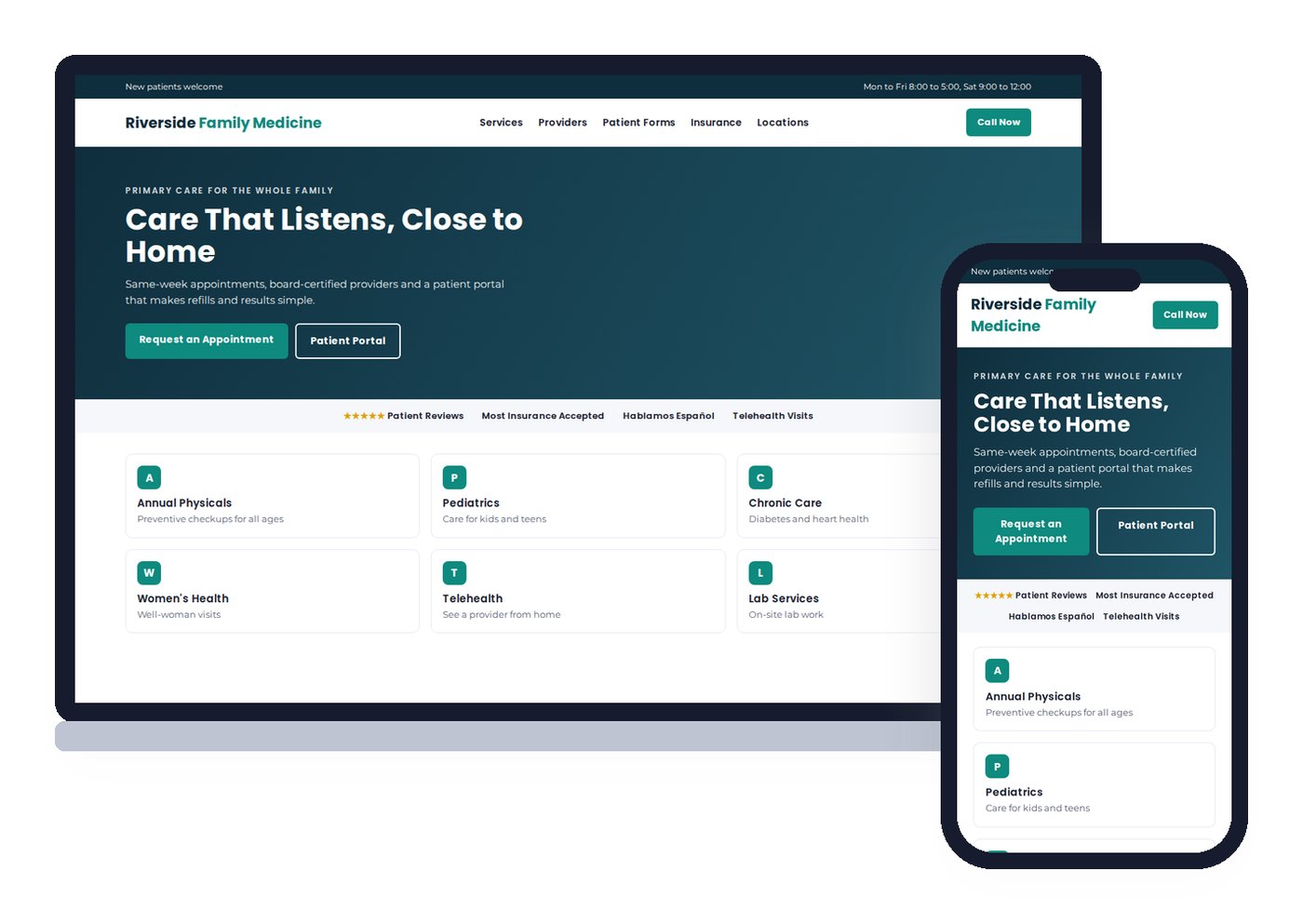
BEFORE THEY BOOK
What a patient needs to see before booking
Services and conditions
A page for each service and common condition, written in the words patients use, not the words on a billing code.
Provider profiles
Photos, credentials, specialties and a short personal note for every provider. Patients choose people, not logos.
Easy appointment requests
A request an appointment button on every page, or a link to the scheduling system you already use.
Insurance and billing
Accepted plans, payment options and what to expect, so a patient is not surprised at the front desk.
Locations and hours
Each location with a map, parking notes, hours and directions that open on a tap.
Patient resources
New patient forms, prep instructions and a clear link to your patient portal for results and refills.
STRUCTURE THAT RANKS
How should a medical website be organized for SEO?
One “Services” page cannot rank for everything your practice does. A patient searching for knee pain treatment and a patient searching for a sports physical are asking different questions, and Google wants a page that answers each one.
When we rebuilt the site for a multi-specialty medical company, Beth’s call was to drop the generic Services tab and put each specialty right in the main menu, from surgical to medical and beyond. That tells patients and Google, in one glance, what the practice does. The specialty and location words then go into the page headings, where search engines look for the topic.
A strong medical site structure usually includes:
- Specialty and service pages that explain the condition, the treatment options and what a first visit looks like.
- Provider pages for each physician, nurse practitioner and specialist, which also capture searches for their names.
- Location pages for each clinic, with the services offered at that address.
- FAQ and health guide pages that answer routine questions and reduce phone volume.
- A careers page, because recruiting nurses and medical assistants matters as much as recruiting patients.
Each page targets what patients really type, such as family doctor near me, pediatrician accepting new patients or orthopedic surgeon in Katy, and each one leads to the appointment request. Our SEO services team plans these keywords before design starts, not after launch.
BUILT TO BE FOUND
Medical website design and local SEO, built together
Patients search for care close to home, so local search matters more in healthcare than almost anywhere else. A beautiful site that does not appear when someone in Kingwood or the Medical Center searches for a doctor is not doing its job.
We build every page with clear titles and headings, MedicalOrganization and Physician schema and location details that match your Google Business Profile exactly. That consistency is the foundation of local SEO in Houston and a big part of how practices reach the map pack.
More patients now ask AI assistants which clinic to visit or what a procedure involves. Accurate, well structured service and FAQ pages give those AI engines reliable facts to cite. We cover that work on our AI SEO services page.
Reviews matter too. Patients read them before they read your bio. A website can feature real patient experiences and make it easy for happy patients to leave feedback, and our reputation management service helps you respond well to the ones that are not.
THE CASE FOR VERTICAL WEB ON MEDICAL WEBSITES
A healthcare website team you can call
We teach this
Beth Guide teaches digital marketing for the SBA, the University of Houston SBDC, Lone Star College and HCC. We explain the trade-offs to your practice manager in plain English.
One in-house team
Design, development, hosting and SEO under one roof since 1998. No offshore developers touching a site your patients trust with their information.
Your site, not a rental
A custom WordPress site you own outright, with the domain in your name. No platform lock-in if you ever change vendors.
PRIVACY AND PATIENT TRUST
Does my medical website need to be HIPAA compliant?
Healthcare websites handle more sensitive information than most, and patients know it. HIPAA governs how covered providers protect health information, and your website is part of that picture any time it collects or sends health details.
We design with privacy in mind from the start:
- Short contact forms. General forms ask only for a name, a phone number and the best time to call. They do not ask for symptoms or medical history.
- Secure paths for health information. Anything that truly needs protected information goes through your patient portal or a secure form service that fits your compliance program.
- Careful tracking. Advertising pixels and some analytics tools can pass details to third parties. We keep marketing tags off booking and condition pages and review every script before launch.
- Locked down hosting. SSL, updates, backups and monitoring on our own servers.
This is general information, not legal advice. Your compliance officer or healthcare attorney should confirm how your website, forms and marketing tools fit your obligations. We are happy to walk them through exactly what the site collects and where it goes.
WHO WE DESIGN FOR
Healthcare websites for every kind of practice
Primary care and family medicine
New patient details, same week availability and services for the whole family, front and center.
Specialty and orthopedic practices
Condition and procedure pages for orthopedics, cardiology, dermatology, gastroenterology and more.
Clinics and urgent care
Hours, walk-in details and every location on the home page, because these patients need care today.
Behavioral and mental health
A calm, private tone and gentle calls to action for people taking a hard first step.
Physical therapy and rehab
Treatment pages, home exercise resources and simple scheduling for ongoing visits.
Home health and senior care
Clear services and reassurance for adult children making decisions for a parent.
Dentists have their own search patterns and needs, so we cover them separately on our dental website design page.
ACCESSIBILITY AND SPEED
A medical website every patient can use
Your patients include an 80 year old reading on a tablet, a parent on a cracked phone screen in a parking lot and someone using a screen reader. A healthcare site has to work for all of them.
We use readable font sizes, strong color contrast, labeled buttons and form fields, headings in order and captions on video. Menus work with a keyboard. Phone numbers tap to call. Pages load fast because we size images properly and host on servers tuned for Core Web Vitals.
Good healthcare design also knows what to leave out. Autoplay video, cluttered home pages, walls of clinical text and pop-ups that cover the screen all push patients away. Real photos of your providers and your office beat stock images of stethoscopes every time.
Already have a site? A website redesign can modernize it while keeping the pages that already bring patients in. You can also see more of our work on our portfolio page.
First impression
Healthcare website design: the visual elements potential patients notice first
A potential patient decides in a few seconds whether your practice feels right. The homepage header does most of that work. It should show who you are, who you treat and how to book, with a clear call to action and a phone number that dials on a tap. Everything else on the page supports that first impression.
Good healthcare website design balances warmth and professionalism. Real images of your providers, staff and office put a patient at ease far more than stock photos of smiling models. Calm colors, plenty of white space and readable text bring comfort to someone who may already be anxious. Your brand should feel consistent from the website to the waiting room. If you plan to use AI generated images anywhere on the site, read up on AI images and website image licensing first.
Every visual element should make the next step easier. Buttons should say exactly what happens, such as Request an Appointment. Forms should be short. On a phone, which is how most visitors will first see your site, the menu, the call button and the appointment link must stay within thumb reach. That is what mobile friendly really means: the user never has to pinch, zoom or hunt.
Content that builds trust
Website design for medical practices: testimonials, staff stories and patient education content
Design gets attention. Content earns trust. Patients want to know who will treat them, what other patients experienced and what to expect at the first visit. The practices that convert the most visitors answer those questions in their own voice.
Patient testimonials, shared with permission, are one of the strongest elements on a medical website. A short story from a real patient tells a potential patient more than any list of credentials. Staff and provider pages work the same way: a photo, a short bio and a personal note about why they chose their field give the audience a person to trust. Follow your profession’s rules on testimonials and advertising, and we will build the pages around them.
Education content keeps working long after launch. A blog or health guide with articles on common conditions, wellness topics, procedure prep and recovery answers the questions patients ask your front desk every day. Each article is a page that can rank in search and be cited by AI engines. Our content marketing team can write and publish it, with your clinical expertise checked before anything goes live. Dental offices follow a similar pattern, which you can see on our dental website design page.
QUESTIONS
Medical website design questions
A clear page for each service and condition you treat, a page for each provider, every location with hours and directions, accepted insurance, new patient information, a link to your patient portal and a request an appointment button on every page. Those are the things patients check before they call.
Your website becomes part of your HIPAA picture whenever it collects or sends patient health information. General contact forms should ask only for what you need to respond. Anything involving symptoms, history or records belongs in your patient portal or a secure form service. Ask your compliance officer or healthcare attorney to confirm your setup, because this is general information, not legal advice.
They can. Advertising and analytics tags on pages where patients book or describe a condition may send information to third parties. We keep marketing tags off sensitive pages and review every script on a healthcare site before launch.
Most practice websites take 8 to 12 weeks from kickoff to launch. The biggest variable is content: provider bios, photos, service descriptions and approvals from the physicians. Practices that gather those early launch sooner.
Templates launch fast, but many practices end up on the same layout, the platform often owns the site, and moving away can mean starting over. A custom WordPress site is yours, built around your specialties, and can move with you if you ever change vendors.
It helps when the site and your Google Business Profile agree. Matching names, addresses, phone numbers and categories, a page for each location and medical schema all support local rankings. The website alone is not the whole job, so we often pair it with local SEO.
Yes. We map every existing URL, keep the pages that already rank, add 301 redirects for anything that moves and check Search Console after launch. Losing rankings in a redesign is almost always a planning mistake, not bad luck.
A responsive website rearranges itself to fit any screen, so a patient on a phone can read the text, tap the phone number and request an appointment without zooming or scrolling sideways. Google also ranks the mobile version of your site.
Yes. Your IT team keeps control of your network, email and patient systems, and we handle the website, hosting and the links to your portal or scheduling tools.
When the website is not bringing in new patients, looks dated on a phone, cannot be updated by your staff, or does not show up in local search. A professional team can fix all of those at once.
A template is quick, but it is built for every practice, so yours looks like many others. A custom site is planned around your specialties, providers and locations, which helps both patients and search engines understand what you offer.
Is your practice website bringing in new patients?
Start with a free website audit. We check speed, mobile layout, local search signals and the tracking scripts on your pages, then tell you plainly what to fix first.
Galleria 713-703-3030 | Kingwood 281-852-8253 | info@verticalweb.com
No related posts.